William Gibson - Spook Country
Здесь есть возможность читать онлайн «William Gibson - Spook Country» весь текст электронной книги совершенно бесплатно (целиком полную версию без сокращений). В некоторых случаях можно слушать аудио, скачать через торрент в формате fb2 и присутствует краткое содержание. Город: NEW YORK, Год выпуска: 2007, Издательство: G. P. PUTNAM’S SONS, Жанр: Современная проза, на английском языке. Описание произведения, (предисловие) а так же отзывы посетителей доступны на портале библиотеки ЛибКат.
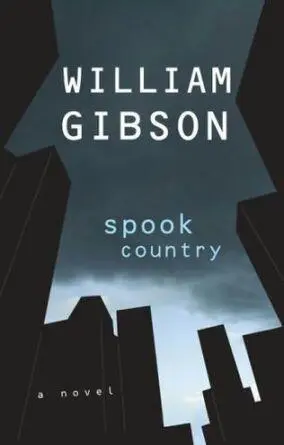
- Название:Spook Country
- Автор:
- Издательство:G. P. PUTNAM’S SONS
- Жанр:
- Год:2007
- Город:NEW YORK
- ISBN:нет данных
- Рейтинг книги:4 / 5. Голосов: 1
-
Избранное:Добавить в избранное
- Отзывы:
-
Ваша оценка:
Spook Country: краткое содержание, описание и аннотация
Предлагаем к чтению аннотацию, описание, краткое содержание или предисловие (зависит от того, что написал сам автор книги «Spook Country»). Если вы не нашли необходимую информацию о книге — напишите в комментариях, мы постараемся отыскать её.
, the challenge of writing about the present-day world drove him to create perhaps his best novel yet, and in
he remains at the top of his game. It's a stripped-down thriller that reads like the best DeLillo (or the best Gibson), with the lives of a half-dozen evocative characters connected by a tightly converging plot and by the general senses of unease and wonder in our networked, post-9/11 time.
Spook Country — читать онлайн бесплатно полную книгу (весь текст) целиком
Ниже представлен текст книги, разбитый по страницам. Система сохранения места последней прочитанной страницы, позволяет с удобством читать онлайн бесплатно книгу «Spook Country», без необходимости каждый раз заново искать на чём Вы остановились. Поставьте закладку, и сможете в любой момент перейти на страницу, на которой закончили чтение.
Интервал:
Закладка:
Milgrim reminded his hand, bold but absentminded, to pocket the bubble-packs.
The door was stuck, but then it popped open, almost spilling him on the sidewalk. A crowd had emerged from the Princeton. Baseball caps and waterproof outerwear. Hair like a Dead concert.
“Get over here,” Brown ordered, palms flat on the hood, trying to keep his weight off his injured leg.
Milgrim saw flashing lights approaching, homing fast, downhill, from the east. “No,” he said, “sorry,” and turned, walking west as quickly as he could. Expecting the hand, any hand, on his shoulder or upper arm.
He heard the siren shut off in mid-yelp. Saw the whirl of red lights from behind him, thrown across sidewalk, animating his shadow.
His hand, in the pocket of the Jos. A. Banks jacket, decided to pop a Rize out of its bubble. He didn’t entirely approve, but then had to dry-swallow it, as he didn’t like loose tablets. He saw the painted lines of a pedestrian crossing, just as the light changed, and crossed with his gaze fixed on the jaunty little illuminated pictoglyph on the far side.
He walked uphill, then, into relative darkness, the hooting of the wounded Taurus fading behind him.
“Sorry,” he said, walking, to tall dark houses looming amid low forties commercial, while his busy, clever hand patted down his own pockets as if he were some ambulatory drunk it had just encountered. Taking stock. The Rize. New wallet, empty. Toothbrush. Toothpaste. Plastic razor in a fold of toilet paper. He stopped, turned, looking back down the incline to the street where Brown had tried to kill the IF. He wished he were back in the Best Western, looking at the textured ceiling. Some old movie on the television, sound down low, just that little bit of movement out of the corner of your eye. Sort of like having a pet.
He walked on, feeling the dead fisheyes of the old houses. Oppressed by this darkness, silence, the specter of some long-vanished domesticity.
But then the upper stories of another street appeared, as if from nowhere, another, better world, with all the lurid gravity of major hallucination. As if glowing from within, the ornate gold-leaf sign of a tobacconist; beside it, a general store; more. The neighborhood of grim dark houses reconstituting itself in its innocence, before him, in this most secret moment.
Then he saw a camera dip and smoothly turn, at the end of a craning metal arm, scooping up the bright vision, and knew that this was a set, constructed, he now understood, within the black and invisible ruin of some gutted foundry. “Sorry,” he said, and walked on, past caterers’ trucks and walkie-talkied girls, his ankle starting to itch.
He bent to scratch it, finding a hundred and fifty Canadian dollars tucked into the top of his sock, left over from the Glocking expedition.
But better still, in his other, his nonclever hand, he discovered his book.
Straightening, he pressed it against his cheek, swept with gratitude for still having it. Within it, beyond the worn paper cover, lived landscapes, figures. Bearded heresiarchs in brilliantly jeweled gowns, sewn from peasant rags. Trees like giant dead twigs.
He turned, and looked back at the precise, unearthly glow of the film set.
Brown, he was certain, would be gone now, explaining himself to the police. The Princeton Hotel would have a sandwich and a Coke, which would yield whatever change one needed for a bus, or even a cab. And then he would find his way west, to this city’s downtown core, and shelter, and perhaps a plan.
“Quintin,” he said, starting back down the hill, toward the Princeton. Quintin had been a tailor. God incarnate of the Spiritual Libertines. Burned for seducing respected ladies of Tournai, in 1547.
History was queer, thought Milgrim. Deeply so.
Nodding, as he passed them, to the girls with their saucily holstered walkie-talkies. Beauties from a realm Quintin might have recognized.
75. HEY, BUDDY
O shosi, scout and hunter, had entered Tito in mid-backtuck. He heard the gray car strike the lamppost as his black Adidas found the sidewalk, confusing cause and effect. The orisha propelled him immediately forward, then, like a child walking a doll, making a puppet of its limbs. Oshosi was huge in his head, an expanding bubble forcing him against the gray interior of his skull. He wanted to scream, but Oshosi clamped fingers of cold damp wood around his throat. “Buddy,” he heard someone say. “Hey, buddy, you okay?” Oshosi walked him past the voice, his heart hammering within his rope-wrapped rib cage like a mad bird.
A bearlike, bearded man, in heavy dark clothing, having seen the crash, was climbing into the cab of an enormous pickup. Tito struck the flat black fiberglass cover of the pickup’s bed with the palm of his hand. It boomed hollowly.
“What the fuck you doing?” the man shouted back at him, craning angrily back out of the open door.
“You’re here for me,” said Oshosi, and Tito saw the man’s eyes widen above his black beard. “Open this.”
The man ran back, his face strangely white, tearing at the fastening of the cover. It popped up, and Tito hauled himself in, dropping the hard hat as he collapsed on a large sheet of spotless brown cardboard. He heard a siren.
Something struck his hand. Yellow plastic, with a yellow cord attached. An identification badge. The fiberglass cover came booming down, and Oshosi was gone. Tito groaned, fighting the urge to vomit.
He heard the truck’s door slam, its engine roar, and then they were accelerating.
The man who had followed him, in Union Square. One of the two behind him, there. That man was here, and had just tried to kill him.
His ribs ached, within the cruelly wound rope. He worked the phone from his jeans pocket and opened it, glad of the screen’s light. He speed-dialed the first of the two numbers.
“Yes?” The old man.
“One of the men who were behind me, in Union Square.”
“Here?”
“He tried to hit me, with his car, in front of the hotel. He struck a pole. Police are coming.”
“Where is he?”
“I don’t know.”
“Where are you?”
“In your friend’s truck.”
“Are you injured?”
“I don’t think so.”
The signal fizzed, faded. Was gone.
Tito used the glow of the phone to look around the truck’s bed, which proved empty, aside from the hard hat and the yellow-framed identification tag. Ramone Alcin. The photograph looked like anyone. He slipped the cord over his head, closed the phone, and rolled onto his back.
He lay there, slowing his breathing, then checked his body, methodically stretching, for sprains or other damage. How could the man from Union Square have followed him here? Terrible eyes, through the windshield of the gray car. He had seen his death coming, in another’s eyes, for the first time. His father’s death, at the hands of a madman, the old man had said.
The truck stopped, waiting at a light, then turned left.
Tito set the phone to vibrate. Put it back in the side pocket of his jeans.
The truck slowed, pulled over. He heard voices.
Then they drove on, over rattling metal grates.
76. LOCATION SHOOT
H aving dropped Tito and driven on, not far at all along this strip of low-lying auto-body repairs and marine supplies, Garreth turned right, into the parking lot of what seemed to be a much taller building, one built on an entirely different scale. Behind it, they pulled in beside a pair of shiny new dumpsters and a row of content-specific recycling bins. The dumpsters, she saw, were covered in runny silk-screened multiples of photographic images. She smelled commercial art.
“We’re location scouts,” he said, taking an orange cardboard PRODUCTION placard from between the seats and putting it on the dash.
Читать дальшеИнтервал:
Закладка:
Похожие книги на «Spook Country»
Представляем Вашему вниманию похожие книги на «Spook Country» списком для выбора. Мы отобрали схожую по названию и смыслу литературу в надежде предоставить читателям больше вариантов отыскать новые, интересные, ещё непрочитанные произведения.

Обсуждение, отзывы о книге «Spook Country» и просто собственные мнения читателей. Оставьте ваши комментарии, напишите, что Вы думаете о произведении, его смысле или главных героях. Укажите что конкретно понравилось, а что нет, и почему Вы так считаете.