William Gibson - Spook Country
Здесь есть возможность читать онлайн «William Gibson - Spook Country» весь текст электронной книги совершенно бесплатно (целиком полную версию без сокращений). В некоторых случаях можно слушать аудио, скачать через торрент в формате fb2 и присутствует краткое содержание. Город: NEW YORK, Год выпуска: 2007, Издательство: G. P. PUTNAM’S SONS, Жанр: Современная проза, на английском языке. Описание произведения, (предисловие) а так же отзывы посетителей доступны на портале библиотеки ЛибКат.
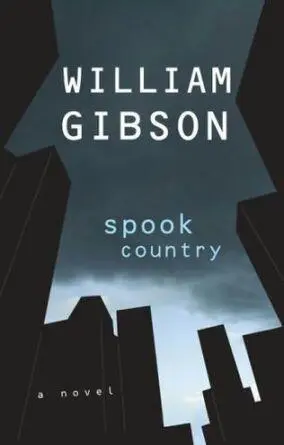
- Название:Spook Country
- Автор:
- Издательство:G. P. PUTNAM’S SONS
- Жанр:
- Год:2007
- Город:NEW YORK
- ISBN:нет данных
- Рейтинг книги:4 / 5. Голосов: 1
-
Избранное:Добавить в избранное
- Отзывы:
-
Ваша оценка:
Spook Country: краткое содержание, описание и аннотация
Предлагаем к чтению аннотацию, описание, краткое содержание или предисловие (зависит от того, что написал сам автор книги «Spook Country»). Если вы не нашли необходимую информацию о книге — напишите в комментариях, мы постараемся отыскать её.
, the challenge of writing about the present-day world drove him to create perhaps his best novel yet, and in
he remains at the top of his game. It's a stripped-down thriller that reads like the best DeLillo (or the best Gibson), with the lives of a half-dozen evocative characters connected by a tightly converging plot and by the general senses of unease and wonder in our networked, post-9/11 time.
Spook Country — читать онлайн бесплатно полную книгу (весь текст) целиком
Ниже представлен текст книги, разбитый по страницам. Система сохранения места последней прочитанной страницы, позволяет с удобством читать онлайн бесплатно книгу «Spook Country», без необходимости каждый раз заново искать на чём Вы остановились. Поставьте закладку, и сможете в любой момент перейти на страницу, на которой закончили чтение.
Интервал:
Закладка:
“Baghdad?”
“We sent nearly twelve billion dollars in cash to Iraq, between March 2003 and June 2004. That June shipment was intended to cover the transition of power from the Coalition Provisional Authority to the interim Iraqi government. The largest one-time cash transfer in the history of the New York Fed.”
“Whose was it?” It was the only question she could think of.
“Iraqi funds, generated mainly from oil revenues, and held in trust by the Federal Reserve, under the terms of a United Nations resolution. The Development Fund for Iraq. Under the best of circumstances, say in a country like this one, in peacetime, keeping track of the ultimate distribution of even one billion is practically impossible. Oversight of twelve billion, in a situation like the one in Iraq? It’s literally impossible, today, to say with any authority exactly where the majority of that money went.”
“But it was used to rebuild the country?”
“Does it look like it?”
“It kept the interim government afloat?”
“I suppose it did. Some of it.” He began to eat, carefully and methodically and with evident enjoyment.
She met the eye of the Englishman who’d found her in the alley. He had dark hair, cut very short, probably in an effort to get the stylistic jump on early-onset male pattern baldness. He looked bright, she thought. Bright and fit and probably funny. She could’ve fancied him, she thought, if he weren’t some kind of international criminal, terrorist, pirate. Whatever these employers of Bobby’s were. Or multicultural criminal, not to forget the dreamy-looking boy in black, indeterminately ethnic but somehow definitely not American. The old man was as American as it got, but in what she thought of as some very recently archaic way. Someone who would’ve been in charge of something, in America, when grown-ups still ran things.
“Join me,” invited Mr. Bright Fit Criminal, from across the table, indicating the chair beside his. The old man gestured with his hand, mouth full, indicating that she should. She took her plate and went around the end of the table, noticing a yellow, rectangular plastic box, featureless except for three short black antennas, each of slightly different length, an on-off switch, and a red LED. It was on, whatever it was.
She put her plate on the table and took the seat beside him.
“I’m Garreth,” he said.
“I didn’t think you used names, here.”
“Well,” he said, “not surnames. But that’s my actual given. One of them, anyway.”
“What did you do, Garreth, before you started doing whatever this is that you’re doing now?”
He considered. “Extreme sports. Some hospital, as a result. Fines and a little jail, likewise. Built props for films. Did stunts for them as well. And what did you do, between ‘Hard to Be One’ and what you’re doing now?” He raised his eyebrows.
“Did badly in the stock market. Invested in a friend’s music store. What do you consider ‘extreme’ sports?”
“BASE jumping, mainly.”
“‘Base’?”
“Acronym. B building, A antenna, S span, as in bridge, arch, or dome, E earth, a cliff or other natural formation. BASE jumping.”
“What’s the tallest thing you ever jumped from?”
“I can’t tell you,” he said, “you’d look it up.”
“I can’t just Google ‘Garreth’ and ‘BASE jumping’?”
“I used my BASE-jumping name.” He tore a long strip from a scorched-looking round of naan, rolled it, and used it to sop up his remaining tandoori and paneer.
“Sometimes I wish I’d used my indie rock singer name.”
“Tito, there,” indicating the boy in black, “he’s seen your poster on St. Marks Place.”
“‘Tito’ is his BASE-jumping name?”
“Maybe the only name he’s got. He has a very large family, but I’m yet to hear a surname from any of them.” He wiped his mouth with a paper towel. “Are you thinking of having children?” he asked her.
“Am I what?”
“Sorry,” he said. “Are you pregnant?”
“No.”
“How would you feel about being exposed to a certain amount of radiation? Make that an uncertain amount. Not really very much. Probably. Bit dicey, actually. But likely not too bad.”
“You aren’t kidding, are you?”
“No.”
“But you don’t know how much?”
“As much as a couple of serious X-rays. That’s if things go optimally, which we expect them to. If there were a problem, though, it could go higher.”
“What kind of problem?”
“A complicated one. And unlikely.”
“Why are you asking me this?”
“Because he,” indicating the old man, “wants you to go along and see me do what I’m here to do. There’s a degree of risk in that, as described.”
“Did it surprise you that he’d ask me?”
“Not really,” he said. “He makes it up as we go along, and he’s mostly been right so far. It’s stranger who you are than that he’d invite you, if you see what I mean. Hollis Henry. Who’d believe that. But if he wants you there, you’re welcome. You mustn’t distract me, or go into hysterics, but he says you’re not the type. I wouldn’t think you were myself. But I had to ask you about the radiation risk. Wouldn’t want that on my conscience if something goes wrong.”
“I don’t have to jump off of anything?” She remembered Inchmale describing Stockholm syndrome, the fondness and loyalty one could supposedly come to feel for even the most brutal captor. She wondered whether she might be experiencing something like that, here. Inchmale thought that America had developed Stockholm syndrome toward its own government, post 9/11. But then she thought that she really should have been more likely to develop it toward Bigend than toward these three. Bigend, her every gut instinct told her, was an infinitely spookier captor (ruling out Bobby, of course, though he scarcely seemed an actor in this now).
“Nothing at all,” he said. “And neither will I.”
She blinked. “When is it?”
“Tonight.”
“That soon?”
“Stroke of midnight. Literally. But setup, on site, requires some time.” He checked his watch. “We’ll be leaving here at ten. I have some last-minute preparations, then I’ll do some yoga.”
She looked at him. Never in her life, she thought, had she had less of an idea where she might be going, either in the short or the long term. She hoped the short term would allow for a long term, but somehow it was all so peculiar, since she’d entered this room, that she hadn’t had time to be frightened.
“Tell him I’m in,” she said. “Tell him I accept his terms. I’m going with you.”
72. EVENT HORIZON
T hat jacket we put you in, in New York, for the helicopter,” the old man said, walking around Tito, who had just put on a new black hooded sweatshirt that Garreth had given him.
“I have it,” Tito said.
“Wear that, over the sweatshirt. Here’s your hard hat.” He handed Tito a yellow helmet. Tito tried it on, removed it, adjusted the white plastic headband, put it back on. “Lose the hat and jacket on your way out, of course. And give me that New Jersey license now. Remember your name?”
“Ramone Alcin,” said Tito, taking the card from his wallet and handing it to the old man.
The old man handed him a transparent plastic bag containing a phone, two plastic cards, and pair of latex gloves. “No prints on the container, of course, or the magnets. You’re still Ramone Alcin. Alberta license and a citizenship card. These are only props, costume, not serious documents. Neither will stand up to a check. The phone will speed-dial either of two numbers of ours.”
Tito nodded.
“The man you’re meeting at the Princeton will have a neck tag, for Ramone Alcin, with your picture on it. It won’t stand up to a check either, but you’ll need to be seen wearing one.”
Читать дальшеИнтервал:
Закладка:
Похожие книги на «Spook Country»
Представляем Вашему вниманию похожие книги на «Spook Country» списком для выбора. Мы отобрали схожую по названию и смыслу литературу в надежде предоставить читателям больше вариантов отыскать новые, интересные, ещё непрочитанные произведения.

Обсуждение, отзывы о книге «Spook Country» и просто собственные мнения читателей. Оставьте ваши комментарии, напишите, что Вы думаете о произведении, его смысле или главных героях. Укажите что конкретно понравилось, а что нет, и почему Вы так считаете.