William Gibson - Spook Country
Здесь есть возможность читать онлайн «William Gibson - Spook Country» весь текст электронной книги совершенно бесплатно (целиком полную версию без сокращений). В некоторых случаях можно слушать аудио, скачать через торрент в формате fb2 и присутствует краткое содержание. Город: NEW YORK, Год выпуска: 2007, Издательство: G. P. PUTNAM’S SONS, Жанр: Современная проза, на английском языке. Описание произведения, (предисловие) а так же отзывы посетителей доступны на портале библиотеки ЛибКат.
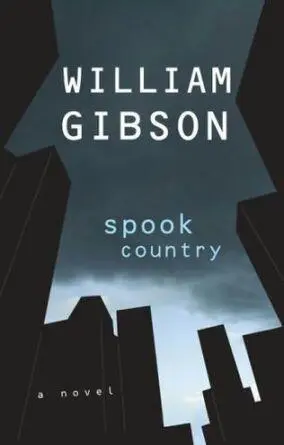
- Название:Spook Country
- Автор:
- Издательство:G. P. PUTNAM’S SONS
- Жанр:
- Год:2007
- Город:NEW YORK
- ISBN:нет данных
- Рейтинг книги:4 / 5. Голосов: 1
-
Избранное:Добавить в избранное
- Отзывы:
-
Ваша оценка:
Spook Country: краткое содержание, описание и аннотация
Предлагаем к чтению аннотацию, описание, краткое содержание или предисловие (зависит от того, что написал сам автор книги «Spook Country»). Если вы не нашли необходимую информацию о книге — напишите в комментариях, мы постараемся отыскать её.
, the challenge of writing about the present-day world drove him to create perhaps his best novel yet, and in
he remains at the top of his game. It's a stripped-down thriller that reads like the best DeLillo (or the best Gibson), with the lives of a half-dozen evocative characters connected by a tightly converging plot and by the general senses of unease and wonder in our networked, post-9/11 time.
Spook Country — читать онлайн бесплатно полную книгу (весь текст) целиком
Ниже представлен текст книги, разбитый по страницам. Система сохранения места последней прочитанной страницы, позволяет с удобством читать онлайн бесплатно книгу «Spook Country», без необходимости каждый раз заново искать на чём Вы остановились. Поставьте закладку, и сможете в любой момент перейти на страницу, на которой закончили чтение.
Интервал:
Закладка:
“‘Anticipate,’ in that context, isn’t so reassuring. And I don’t suppose you want to tell me what it is you’re up to.”
“We intend to damage a specific piece of property, and its contents. If we’re entirely successful”—and here he smiled briefly—“the damage will go unnoticed. Initially.”
“Do you have some optimal reason you’d prefer for me to suppose you’re telling me this? Maybe we could just cut to that. Save time. Otherwise, I see no reason for you to be telling me anything at all.”
He frowned. Uncrossed his legs. With the black priest shoes flat on the floor, he rocked back an inch or so on the chair’s rear legs. “If my associate weren’t so absolutely convinced of your identity, Miss Henry, things would be very different.”
“You didn’t answer my question.”
“Bear with me. There is public history, and there is secret history. I am proposing to make you privy to secret history. Not because you are a journalist, actually, but because you are, to whatever extent, a celebrity.”
“You want to tell me your secrets because I used to be a singer in a band?”
“Yes,” he said, “though not because you used to be a singer in a band, specifically. Because you are, by virtue of having been a popular singer—”
“Never that popular.”
“You already constitute a part of the historical record, however small you might prefer to see it. I’ve just checked the number of your Google hits, and read your Wikipedia entry. By inviting you to witness what we intend to do, I will be using you, in effect, as a sort of time capsule. You will become the fireplace brick behind which I leave an account, though it will be your account, of what we do here.”
She looked at him. “The scary thing is, I think you’re serious.”
“I am. But I want you to understand the price, before you agree.”
“Who says I’m agreeing?”
“If you’re to witness history, Hollis, you necessarily become a part of that which you witness.”
“Am I free to write about what I might see?”
“Of course,” he said, “although by freely agreeing to accompany us, in the eyes of the law you probably become an accessory. More seriously, though, the person we are about to interfere with is powerful, and has every reason to suppress knowledge of what you’d witness. But that will be your business. If you agree to go with us.”
“And if I don’t?”
“We will have someone take you to another location, and keep you there until we’re gone. That will complicate things for us, as it means moving Bobby and his equipment, since you already know about this place, but that should be no concern of yours. Should you choose that option, you won’t be harmed in any way. Blindfolded, but not harmed.”
The man from the alley, she saw, had closed the long case, and had been joined, further down the second long table, by the dark-haired boy. “I don’t see why you have any reason to trust my end of that,” she said. “Why would you trust me not to call the police, as soon as I’m free?”
“I was trained,” he said, “by the government organization of which I was a member, to assess character very quickly. My work involved making crucial personnel decisions, often literal snap judgments, under extremely difficult conditions.” He stood up.
“For that matter,” she said, looking up at him, “why should I believe you?”
“You won’t betray our agreement, should we reach one,” he said, “because you simply aren’t the type. By the same token, you’ll trust us. Because, in fact, you already do.”
He turned then, walked over to the man from the alley, and began a quiet conversation.
She heard the scratching of a cigarette lighter, as Bobby, on the floor, fired up a Marlboro.
Where would Bobby sleep, she wondered, without his gridlines? Then noticed, just in front of the old man’s chair, a thin, dusty-blue, perfectly straight line, the kind produced with carpenter’s chalk and a taut string.
Then saw another, crossing the first at right angles.
69. MAGNETS
G arreth took Tito to the far end of the second table, where ten disks, each no thicker than a small coin, and about three inches in diameter, were arranged on a half-sheet of fresh plywood.
Someone had sprayed these with turquoise-blue paint, then with a faint dusting of dark gray, then with a dull topcoat. Each one lay in its own blur of overspray. The three aerosol cans stood in a row at one end of the plywood. Putting on latex gloves, Garreth carefully picked one up, exposing the perfect round of unsprayed plywood beneath. He showed Tito its unpainted back, bright silver metal. “Rare-earth magnets,” he said, “painted to match the box as closely as possible.” He indicated two printouts, photographs of a shipping container, a dirty turquoise blue. “Once you place one on a flat steel surface, it’s difficult to remove, except with a knife or a thin screwdriver blade. We have ten, but you’ll have a maximum of nine holes to cover. The spare is in case you drop one, but try not to.”
“How do I carry them?”
“They either stick together, almost too firmly to separate, or they repel one another, depending on which way they’re facing. So you’ll use this.” He indicated a rectangle of stiff black plastic, covered with silver tape. A length of olive paracord was looped through two holes, at one end. “Soft plastic envelopes under the tape, one for each disk. You carry it in down the front of your jeans, then hang it around your neck for climbing. Slip them out one at a time as you cover the nine holes. They should cover any spalling completely, as well as sealing the hole.”
“What is ‘spalling’?”
“When the bullet pierces the painted steel,” Garreth said, “it bends the steel inward. The paint isn’t flexible, so it shatters. Some of it vaporizes. Result is bright, shiny steel, visible around the hole. The hole itself is no bigger than the tip of your finger. It’s the spalling that visually identifies a bullet hole, so we have to cover it. And we want as tight a seal as possible, because we don’t want to be setting off sensors.”
“And when they have been closed?”
“You have to find your own way out. The man who’ll take you in can’t help us with that. We’ll go over the maps and the satellite images one more time. Don’t climb until the midnight buzzer stops. When you’ve sealed it, get out. When you’re out, call us. We’ll pick you up. Otherwise, the phone’s only for an emergency.”
Tito nodded. “Do you know that woman?” he asked.
“I hadn’t met her before,” said Garreth, after a pause.
“I have seen posters of her, in shops on St. Marks Place. Why is she here?”
“She knows Bobby,” Garreth said.
“He is unhappy to see her?”
“He’s having a bit of a meltdown generally, isn’t he? But you and I, we have to keep this central to mission, right?”
“Yes.”
“Good. When you go up to the box, you’ll be wearing this.” He indicated a black filter-mask in a large Ziploc bag. “We don’t want you inhaling anything. When you get down from the stack, stick it somewhere it won’t be found for a while. And no prints, of course.”
“Cameras?”
“Everywhere. But our box is in the top tier of a stack, and if everything’s gone right, it’s in a blind spot. The rest of the time, you hood up and we hope for the best.”
“The woman,” Tito asked, concerned by what seemed a serious breach of protocol, “if she isn’t one of you, and you’ve never seen her before, how do you know she isn’t wearing a wire?”
Garreth indicated the three black antennas of the yellow-cased jammer Tito had seen him use in Union Square, further down the table. “Nothing here broadcasting,” he said, softly, “is there?”
Читать дальшеИнтервал:
Закладка:
Похожие книги на «Spook Country»
Представляем Вашему вниманию похожие книги на «Spook Country» списком для выбора. Мы отобрали схожую по названию и смыслу литературу в надежде предоставить читателям больше вариантов отыскать новые, интересные, ещё непрочитанные произведения.

Обсуждение, отзывы о книге «Spook Country» и просто собственные мнения читателей. Оставьте ваши комментарии, напишите, что Вы думаете о произведении, его смысле или главных героях. Укажите что конкретно понравилось, а что нет, и почему Вы так считаете.