William Gibson - Spook Country
Здесь есть возможность читать онлайн «William Gibson - Spook Country» весь текст электронной книги совершенно бесплатно (целиком полную версию без сокращений). В некоторых случаях можно слушать аудио, скачать через торрент в формате fb2 и присутствует краткое содержание. Город: NEW YORK, Год выпуска: 2007, Издательство: G. P. PUTNAM’S SONS, Жанр: Современная проза, на английском языке. Описание произведения, (предисловие) а так же отзывы посетителей доступны на портале библиотеки ЛибКат.
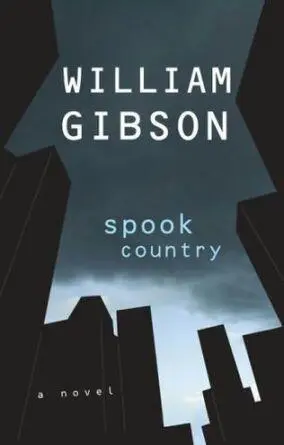
- Название:Spook Country
- Автор:
- Издательство:G. P. PUTNAM’S SONS
- Жанр:
- Год:2007
- Город:NEW YORK
- ISBN:нет данных
- Рейтинг книги:4 / 5. Голосов: 1
-
Избранное:Добавить в избранное
- Отзывы:
-
Ваша оценка:
Spook Country: краткое содержание, описание и аннотация
Предлагаем к чтению аннотацию, описание, краткое содержание или предисловие (зависит от того, что написал сам автор книги «Spook Country»). Если вы не нашли необходимую информацию о книге — напишите в комментариях, мы постараемся отыскать её.
, the challenge of writing about the present-day world drove him to create perhaps his best novel yet, and in
he remains at the top of his game. It's a stripped-down thriller that reads like the best DeLillo (or the best Gibson), with the lives of a half-dozen evocative characters connected by a tightly converging plot and by the general senses of unease and wonder in our networked, post-9/11 time.
Spook Country — читать онлайн бесплатно полную книгу (весь текст) целиком
Ниже представлен текст книги, разбитый по страницам. Система сохранения места последней прочитанной страницы, позволяет с удобством читать онлайн бесплатно книгу «Spook Country», без необходимости каждый раз заново искать на чём Вы остановились. Поставьте закладку, и сможете в любой момент перейти на страницу, на которой закончили чтение.
Интервал:
Закладка:
“What picture?”
“Untitled,” he said, “but it actually doesn’t have that shabby a budget. Not even by Hollywood standards.” He got out, so she did the same.
And was stunned to discover the brilliantly floodlit vastness of the port, right there, past twelve feet of chain-link and some railroad tracks. The lights were like the lights on a playing field, but taller. A grimly artificial daylight. Towering rows of concrete cylinders, smoothly conjoined, like abstract sculptures. Grain storage, she guessed. Some other, much more high-tech sculptor, had employed huge, strangely ephemeral-looking black tanks, one of which was steaming, cauldron-like, in the cool air. Beyond these, and far taller, were the titanic Constructivist cranes she’d glimpsed on her drive over. Between the tracks and these large-scale sculptures were windowless geometrics in corrugated metal, and a great many shipping containers, stacked like the blocks of some unusually orderly child. She imagined Bobby’s wireframe container suspended above it all, invisible, like Alberto’s fallen River on the sidewalk below the Viper Room.
It generated white noise, this place, she guessed, on some confusingly vast scale. Iron ambients, perceived in the bone. A day here and you’d stop noticing it.
She turned, looking up at the building he’d parked behind, and was again startled by scale. Eight tall stories, its footprint broad and deep enough to allow its mass to be read as a cube. The scale of an older Chicago industrial building, alien here.
“Live-work space,” he said, opening the van’s rear doors. “Studio rental.” He took out the bungee-wrapped dolly, unhooking them, unfolding and extending it. Then the long gray case, which he lay carefully on the pavement beside the dolly. He wasn’t moving too quickly, she thought, but he was moving just as quickly as he could without actually moving too quickly. “Would you mind carrying this tripod, and the bag?” He got a solid grip on the black case, grunting softly as he turned with it and lowered it onto the dolly. He put the gray case on top of it, angled against the extended handle, and began snapping it all together with bungees.
“What’s in it?” she asked, meaning the canvas bag, as she pulled the folded tripod out and put it under her arm.
“A spotting scope. And an apron.”
She picked it up by its canvas handles. “Heavy apron.”
He closed and locked the van’s rear doors, bent to grasp the dolly’s handle.
She looked back at the container stacks, thinking of Bigend’s pirate story. Some of them were close enough to read the names of companies. YANG MING.
CONTSHIP.
He hauled the loaded dolly up an incline, to a double door that reminded her of Bobby’s factory. She followed him, the heavy canvas bag bumping against her knee, as he used one of a ring of several keys to open one of the doors.
It swung shut behind her, locking, as she entered. Brown ceramic tile floor, crisp white walls, good light fixtures. He was turning another key, this one in a steel elevator panel. He pushed a button, which lit. Wide enameled doors jolted open, revealing a room-sized elevator walled with splintery, unpainted plywood. “Serious freight,” he said, approvingly, wheeling the dolly in, the gray and the black cases bound with black bungees. She put the canvas bag down on the paint-spotted floor of the elevator, beside it. He pushed a button. The doors closed and they began to rise.
“I loved the Curfew, when I was in college,” he said. “Still do, I mean, but you know what I mean.”
“Thanks,” she said.
“Why did you break up?”
“Bands are like marriages. Or maybe only good ones are. Who knows why a good one works, let alone why it stops working.”
The elevator stopped, its doors opening to reveal more of the brown tile. She followed him along a white corridor.
“Have you been here before?” she asked.
“No.” He parked the dolly beside a door and got out his keys. “I sent a friend to negotiate an evening’s rental. She’s in film production here, knows what to say. They think we’re scouting it for a night shoot, checking angles.” He turned the key. “But we really are checking angles, so keep your fingers crossed.” He opened the door and pulled the dolly inside. She followed. He found a light switch.
A tall, partially lofted white space, lit by halogen fixtures strung like stainless-steel clothespins along taut high cables. Someone worked here in glass, she saw. Massive fist-thick slabs of green-edged glass, some of them the size of doors, were racked like CDs in raggedly padded constructions of dull galvanized pipe. There were corrugated foil ducts, HEPA filters, exhaust fans. Live-work didn’t strike her as so attractive, if the work involved ground glass. She put the heavy bag down on a workbench, propped the tripod beside it, and scratched her ribs, under her jacket, thinking of ground glass.
“Excuse me,” he said, picking up the tripod, “while I play director of photography.” He crossed to a wide, steel-mullioned window and quickly set up the tripod. “Could you open the bag, please, and bring the scope?” She did, finding a sort of thickly truncated gray telescope atop smooth thick folds of pale blue plastic. She brought it to him, watched as he mounted it on the tripod, removed the black lens caps, and peered through it, making adjustments. He whistled. “Oh. Dear. Fuck.” He whistled. “Pardon me.”
“What?”
“Very nearly buggered. By that roof peak there. Look.”
She squinted through the scope.
The turquoise container seemed to float, just above the slanted metal roof of a windowless building. She assumed it must be stacked atop others, the way they did that.
“Shit out of luck, if that roof were a foot taller,” he said. “We’d no idea.” He was bending over the dolly, unhooking the bungees now. He carried the long case to the workbench and carefully put it down, beside the canvas bag. He returned to the dolly, which lay on the floor now, the black case on top of it. He knelt and took something iPod-sized and yellow from his jacket pocket. He held it near the case, pressed something, then brought it closer, reading a screen.
“What’s that?”
“Dosimeter. Russian. Surplus. Excellent value.”
“What did you just do?”
“Radiation count. All good.” He smiled at her, from where he knelt on the floor.
She was suddenly self-conscious, watching him. She glanced around, noting a zippered white tarp taped so that it sealed off the section under the loft. Pretending interest in this, she walked over and partially undid the white nylon zipper, a six-foot fly that curved to one side, near the bottom. She stuck her head through.
Into someone’s life. A woman’s. The contents of a small apartment had been shoehorned into this space. Bed, dresser, suitcases, bookcases, clothes sagging on a spring-loaded rod. Someone’s childhood staring out from a shelf, in stuffed acrylic fur. A lidded paper Starbucks cup forgotten on the corner of the Ikea dresser. The light, through the white tarp, was diffuse and milky. She felt suddenly guilty. Withdrew her head, zipped up.
He’d opened the long gray case.
It contained a rifle. Or some Surrealist’s take on one. Its wooden stock, in deliriously grained tropical hardwood, was biomorphic, counterintuitive somehow, like something from a Max Ernst landscape. The barrel, which she assumed must be blue steel, like the other metal parts, was encased in a long tube of lustrous gray alloy that reminded her of expensive European kitchenware. Like a rolling pin by Cuisinart. But still, somehow, quite undeniably a rifle, one with a scope, and something else slung beneath its Cuisinart muzzle.
He was unfolding a small black cloth bag that seemed to have its own internal plastic framework.
Читать дальшеИнтервал:
Закладка:
Похожие книги на «Spook Country»
Представляем Вашему вниманию похожие книги на «Spook Country» списком для выбора. Мы отобрали схожую по названию и смыслу литературу в надежде предоставить читателям больше вариантов отыскать новые, интересные, ещё непрочитанные произведения.



Обсуждение, отзывы о книге «Spook Country» и просто собственные мнения читателей. Оставьте ваши комментарии, напишите, что Вы думаете о произведении, его смысле или главных героях. Укажите что конкретно понравилось, а что нет, и почему Вы так считаете.