Malcolm Bradbury - Doctor Criminale
Здесь есть возможность читать онлайн «Malcolm Bradbury - Doctor Criminale» весь текст электронной книги совершенно бесплатно (целиком полную версию без сокращений). В некоторых случаях можно слушать аудио, скачать через торрент в формате fb2 и присутствует краткое содержание. Город: London, Год выпуска: 2000, ISBN: 2000, Издательство: Picador, Жанр: Современная проза, на английском языке. Описание произведения, (предисловие) а так же отзывы посетителей доступны на портале библиотеки ЛибКат.
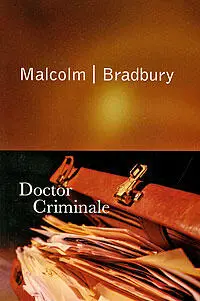
- Название:Doctor Criminale
- Автор:
- Издательство:Picador
- Жанр:
- Год:2000
- Город:London
- ISBN:978-0330390347
- Рейтинг книги:5 / 5. Голосов: 1
-
Избранное:Добавить в избранное
- Отзывы:
-
Ваша оценка:
Doctor Criminale: краткое содержание, описание и аннотация
Предлагаем к чтению аннотацию, описание, краткое содержание или предисловие (зависит от того, что написал сам автор книги «Doctor Criminale»). Если вы не нашли необходимую информацию о книге — напишите в комментариях, мы постараемся отыскать её.
Doctor Criminale — читать онлайн бесплатно полную книгу (весь текст) целиком
Ниже представлен текст книги, разбитый по страницам. Система сохранения места последней прочитанной страницы, позволяет с удобством читать онлайн бесплатно книгу «Doctor Criminale», без необходимости каждый раз заново искать на чём Вы остановились. Поставьте закладку, и сможете в любой момент перейти на страницу, на которой закончили чтение.
Интервал:
Закладка:
What for, though? She had many houses and a California beach life to think about. But in those days before the politically correct, American heiresses still did courses in Western literature. She remembered Vergil and Pliny and Byron and Lawrence, and decided to make it, again, a place of writing and humanism. Barolo would become a great-study and congress centre, where the world’s great scholars and authors could come to work. To promote the highest levels of creation, no expense was spared. The halls were filled with Cellini statues, Canaletto paintings, Gobelin tapestries, on a scale to mortify a Medici. In the rooms of the villa the walls gleamed with mirrors, the furniture with gold leaf. Even the fourposter beds had six posts. The modern scholar, coming on a Guggenheim or a McArthur ‘Genius’ grant, got everything: power showers and Jacuzzis, electronic typewriters and computer interfaces, fax facilities to keep inspiration in close contact with the office or home. Mrs Magno loved famous men around her, the geniuses of the age. No wonder Criminale became one of her prize specimens.
So when the press couldn’t find him, politicians lost track of him, this is where he was. Where could be better? The house-rule was that everyone should be able to work without interruption. Critics were bumrushed from the door, pressmen flushed out of the shrubbery. Telephone calls were blocked at the exchange, visitors kept on the far side of high walls and electric fences. Nowhere could have done more to nourish thought,and art. When the great scholars and writers woke in the morning, a lake lay in view of every window, framed by cypresses, backed by lush green hills. White doves flitted in the trees, white-sailed yachts sailed through the vista, fishermen plied their ancient trade in ancient waters. The scholars had small studios in the grounds – a classical belvedere, a romantic gazebo, each with a computer terminal. Fragrant perfumes blew from the gardens, distant churchbells on the hillsides tolled out the hours of the hardthinking day. Sixteen invisible gardeners worked like set-designers to ensure the grounds were perfect for each new dawn. Above the gardens, where the island came to its craggy peak, were wild woods. But here too nature had been turned to culture – every tree shaped, every cave refined, to form pleasing grottoes where scholars could retire to meditate or, in the softer moments even scholars have, engage in drip-threatened dalliance with some fellow meditator.
So the great scholars came, for one month, two. In perfect paradise, they produced. They produced avant-garde novels, speculative, disjunctive poems in projective verse, atonal musical compositions, studies of the defeat of the bourgeoisie, the end of humanism, the death of narrative, the disappearance of the self. Then, after a good morning of postmodern literary labour or hard deconstructive thought, they gathered for drinks on the terrace or, if wet, in the indoor bar, before taking a lunch of rare pastas served by the most civil of servants. Afterwards, if tennis or boating did not beckon, they went back to the chaotic delights of their speculations, until it was time, again, for evening drinks, followed by a rare dinner, where the wit flowed as free as the select Italian wine, and the wine as the wit, and another day of contemporary authorship and scholarship came towards its close. Even then, Barolo’s work was not yet done. In the Magno queendom it was as important to refine the night as the day. After dinner, as Italian darkness fell, the hills would resound with the sound of music, as some small chamber orchestra came by to play, or one of the American atonal composers offered his newest work. The guests down at the Gran Hotel Barolo, usually transient tourists who had tripped in by the hydrofoil for a day or two, would stop entranced over the tortellini to listen. Often you could see them peering in at the security gates of the villa, staring in a homage to pure wisdom and beauty, until the uniformed guards moved them on.
But perfection has one problem, as Ildiko and I found the first night, when our lovemaking was interrupted by Mrs Magno’s mechanical arrival. No matter how well protected, perfection is never eternally safe. Even here in paradise the scholars and writers suffered constant annoyance. There were the attempted intrusions of the tourists, occasional curiosity from the press. There was the endless irritating mechanical whine from Italian motorscooters on the autostrada across the lake; even from time to time a tempestuous Alpine storm, which could bring down trees, sink small boats, and send the paperwork and thought of days flying across the studio. But these interruptions were as nothing compared with the one for which the villa and the Magno Foundation was itself responsible: the coming of the great international conferences which the villa was also famous for hosting – like the congress on Literature and Power that had brought Ildiko and myself into their perfect domain.
At these times, Barolo showed its other face. The place where Pliny thought and Byron swam changed from perfect peace to world-shattering tumult. World leaders poured in: heads of state holding some mini-summit, foreign ministers of the European Community meeting in off-the-record session, negotiators trying to halt some tribal war, American peace missions dreaming of uniting Palestinians and Israelis, disarmament buffs trying to stop the spread of chemical weapons. With them came security teams and hangdog retinues. The place grew hellish with the sound of clattering photocopiers, chattering interpreters, motorbike couriers who came flying up to the villa with news of the collapse of some government or country, the clickety-clacking of helicopters, especially when Mrs Magno chose, as she often did, to revisit her paradisial domain. Meals were ruined with toasts, after-dinner speeches, and endless announcements – especially if the conference organizer happened to be Professor Massimo Monza, Mrs Magno’s favoured consultant. Then the resident scholars would retire, hurt, to their rooms. The newcomers would see them just occasionally, wandering like monks observing vows of silence and solitude, praying that this too would pass, like all the false glories of the world, and Barolo would return to the state of pristine perfection for which it was always intended.
But visiting conferees, too, expected their own share of paradise. And over the days that followed Criminale’s edgy, difficult speech, we began demanding ours. Carefully steered by Monza, the conference began to acquire what, wiser and older now, I see is a familiar congress sensation – the strange feeling that no other world exists, this is the one human reality, that problems left behind were never real problems anyway, that every convenience, pleasure and delight is yours by absolute right. Then conference personalities begin to emerge, conference friendships – more than friendships – begin to develop, conference hostilities begin to grow: in our case, between French and Italians, Indians and British, novelists and poets, postmoderns and feminists, critics and creators, writers and politicians, and, of course, visiting conferees and the regular scholars.
Yet there was always Bazlo Criminale, who proved to be the one reconciling figure. He was resident scholar and conference visitor. He was writer and politician, critic and creator. He was with us, but more than us; he was almost the spirit of the place itself. If his opening speech had at first disappointed, it had the desired effect of setting us disputing about the coming crises of the Nineties. On this everyone had a prophecy and an opinion, but they always checked it with Criminale. If East fell out with West, South with North, Marx with Freud, he understood both angles, and had a suggestion or a solution. He expressed internationality, he was the spirit of contemporaneity. He was of his time, he was also eternal. And he never seemed mean, hostile, parti pris . His presence, even when it was his absence, always somehow blessed the occasion. If he was the grand authority, he was also kindness itself. He was benign to everyone, he seemed to listen to anybody. Whatever you said to him, he responded. ‘Good, that is good, that is interesting,’ he would say reflectively, ‘But now let me put this point back to you. Let us suppose . . .’
Читать дальшеИнтервал:
Закладка:
Похожие книги на «Doctor Criminale»
Представляем Вашему вниманию похожие книги на «Doctor Criminale» списком для выбора. Мы отобрали схожую по названию и смыслу литературу в надежде предоставить читателям больше вариантов отыскать новые, интересные, ещё непрочитанные произведения.




Обсуждение, отзывы о книге «Doctor Criminale» и просто собственные мнения читателей. Оставьте ваши комментарии, напишите, что Вы думаете о произведении, его смысле или главных героях. Укажите что конкретно понравилось, а что нет, и почему Вы так считаете.