Malcolm Bradbury - Doctor Criminale
Здесь есть возможность читать онлайн «Malcolm Bradbury - Doctor Criminale» весь текст электронной книги совершенно бесплатно (целиком полную версию без сокращений). В некоторых случаях можно слушать аудио, скачать через торрент в формате fb2 и присутствует краткое содержание. Город: London, Год выпуска: 2000, ISBN: 2000, Издательство: Picador, Жанр: Современная проза, на английском языке. Описание произведения, (предисловие) а так же отзывы посетителей доступны на портале библиотеки ЛибКат.
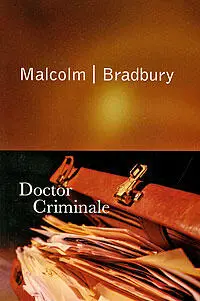
- Название:Doctor Criminale
- Автор:
- Издательство:Picador
- Жанр:
- Год:2000
- Город:London
- ISBN:978-0330390347
- Рейтинг книги:5 / 5. Голосов: 1
-
Избранное:Добавить в избранное
- Отзывы:
-
Ваша оценка:
Doctor Criminale: краткое содержание, описание и аннотация
Предлагаем к чтению аннотацию, описание, краткое содержание или предисловие (зависит от того, что написал сам автор книги «Doctor Criminale»). Если вы не нашли необходимую информацию о книге — напишите в комментариях, мы постараемся отыскать её.
Doctor Criminale — читать онлайн бесплатно полную книгу (весь текст) целиком
Ниже представлен текст книги, разбитый по страницам. Система сохранения места последней прочитанной страницы, позволяет с удобством читать онлайн бесплатно книгу «Doctor Criminale», без необходимости каждый раз заново искать на чём Вы остановились. Поставьте закладку, и сможете в любой момент перейти на страницу, на которой закончили чтение.
Интервал:
Закладка:
‘British, how strange,’ said Criminale, ‘I am standing here thinking why Graham Greene has never won the Nobel Prize for Literature. You know the story?’ This seemed an odd diversion, but great men must, I’m told, be humoured. ‘No.’ I said, ‘Tell me, why hasn’t Greene won the Nobel Prize for Literature?’ ‘It may not be true, but I tell it to you anyway,’ said Criminale, turning to look over the lake again, ‘Once Greene went to Sweden and he slept there with a certain woman. Why not? We all go to Sweden to be modern, no?’ ‘I suppose,’ I said agreeably. ‘The woman had a relative, a professor who belonged to the Swedish Academy, which chooses of course the Prizewinner,’ said Criminale. ‘This man was outraged, he swore an oath that as long as he lived Greene would never win the trophy.’ ‘Isn’t this romantic?’ asked Ildiko. ‘I think so,’ nodded Criminale, ‘Both men have lived and lived, to a great old age. Maybe that is what keeps them going, one cannot die before the other. The Prize has gone everywhere, Pearl Buck, Bertrand Russell, even your famous Winston Churchill, never to Greene. One of the greatest writers of our century, and he misses the Prize because one night he has a little joy with a certain woman. I was asking myself, if it was I, and if I knew what would happen, which would I choose, the Prize or the woman? A difficult question, don’t you think?’ ‘So how do you answer?’ asked Ildiko. ‘I don’t know, my dear,’ said Criminale, ‘Fame is good but love is wonderful. You sound Hungarian.’ Ildiko answered in her own language; they talked for a moment. In the villa behind us, the lights were going out. Someone, a woman, walked across the terrace and disappeared. Criminale dropped his cigar butt and ground it into the gravel. ‘Now I think we must get ready for morning, alive for another congress. A pleasure to meet you both. Enjoy your paradise,’ he said, nodding his great head. We watched him as he made his way back, in his shiny blue suit, towards the villa.
‘He didn’t recognize you,’ I said to Ildiko, as we went on down the steep lighted path towards the Old Boathouse. ‘He lives in a world up there,’ she said, ‘He doesn’t recognize anyone. Tomorrow he will not even know you.’ Ildiko’s manner had changed, and her anger appeared to have gone. ‘He seemed rather depressed, I thought.’ ‘Oh, now you have met him, you understand him completely?’ she asked. ‘You didn’t think so?’ I asked. ‘I tell you what I think,’ she said, ‘I think Criminale Bazlo is in love. I have seen him in love before,’ she said, ‘Remember, he is Hungarian, very romantic. Someone has charmed him, and now he is thinking about power and women. So, I hope I have pleased you now. I have introduced you.’ ‘I’m very pleased,’ I said. ‘And I brought you to a very nice place, no?’ said Ildiko, ‘Paradise, in fact. And we have our very nice room. And remember, in Paradise it is always all right to be naked together.’
So that is how, a little later, Ildiko and I found ourselves very naked together, in the great Euro-bed of the Old Boathouse, a vast Gobelin tapestry, packed with Bacchic revelry, hanging over our heads, moonlight coming through the curtains and falling across our bodies. Ildiko lay there, shaking out her blonde hair and looking at me with bright eyes. ‘And what about you, how would you choose?’ she asked. ‘Choose what?’ I asked. ‘If like Criminale you were choosing between the Nobel Prize and the woman.’ ‘Forget Criminale,’ I said, ‘Anyway, it would depend on the woman.’ ‘Okay, to take an example, the Nobel Prize or me.’ ‘No contest,’ I said, ‘You, of course.’ ‘Really, you would give up the Nobel Prize like that, for me ?’ cried Ildiko, ‘I think you are wonderful. Not such a nasty pig after all. And you do like shopping, a bit?’ ‘A bit,’ I said. ‘Benetton, Next, New Man, River Island, you would take me to those places?’ ‘One day,’ I said. ‘More like that, oh, paradise, paradise, isn’t it nice?’ said Ildiko, ‘So, goodbye Nobel Prize.’
Our folded bodies had almost joined, the thrill in our skins had become intense, the Nobel Prize was almost gone for good, when a sudden violent burst of motor noise shook the quiet room and wild flashing spotlights beamed in, flaring angrily, lighting the tapestry over our heads, illuminating first this corner, then that. ‘Oh God, what is it?’ cried Ildiko, pulling her body loose from mine. ‘Stay there, I’ll go and look,’ I said, and hurried naked to the window. ‘Oh Francis, I’m frightened,’ said Ildiko, coming naked to the window too, and clutching me. Outside, offshore, and not so many yards away from us, a huge birdlike object was hovering over the stirred waters of the black lake. It spun and tilted, spotlights in its metal belly turning and probing. In front of the boathouse, on the grass meadow, cars and trucks had been parked. Their headlights illuminated a gravelled arena, where men in dark clothes ran here and there. Like some enormous dragonfly, the great machine moved slowly in off the water, suspended itself for a moment over the meadow, then sank down and came to rest on the gravel.
‘Is it police, do they want us?’ asked Ildiko, holding me tight. From under the rotors of the white helicopter two figures in overalls ran, and piled into one of the waiting cars. Then I saw, on the helicopter’s side, a giant painted symbol; it was the logo of the Magno Foundation. ‘It must be our padrona, Mrs Valeria Magno,’ I said, ‘She’s come home late to check what’s going on in her paradise,’ I said. The car drove at speed away from us, up the winding road towards the Villa Barolo. ‘Oh, I am glad you are with me,’ said Ildiko. ‘Everything’s all right,’ I said, The boss is here, that’s all. Forget it, come back to bed.’ So, in the great imperial bed at the paradise of Barolo, on the fortunate fair lake of Pliny and Vergil, in beautiful surroundings both classical and romantical, Ildiko and I held each other. She shivered and shook and then slowly we moved together again, body into body, thought into thought, and forgot, for the usual eternal short while, about power, literature, and ideas, about Monza and Nobel and Mrs Magno, even about the stocky, lonely figure of Bazlo Criminale.
9
The Villa Barolo has long been associated with writing . . .
As I found over the next busy, happy days, our Literature and Power congress was far from being the first major literary event to occur on the Isola Barolo. From the Age of Antiquity on, the guidebooks told me, Barolo had always been associated with the satisfaction of life’s most gratifying act, which, according to writers, is writing. Vergil, exiled here, had written an eclogue or two and pronounced the place the home of humanism. Pliny, spotting that Barolo lay midpoint in a five-armed lake, had felicitously called it the fecund crotch of the world. Dante had found it purgative; Boccaccio had a tale or two to tell about it. In the age of Romanticism travellers from the chill north – Madame de Stael, Goethe, and Byron and Shelley, the terrible travelling twins – had come, swum in the lake, fallen in love with its romantic beauties, and written verse on the subject, none of it very good.
Our congress group was not by a long way the first to settle here, though earlier visitors would not have enjoyed the modern delights we had. Villas had graced the spot for centuries, but this one was nineteenth-century, raised by the Kings of Savoy, a.k.a. ‘Gatekeepers to the Alps’, in their heyday. When that heyday became a low day, it declined with the family. By Mussolini’s Thirties it was neglected, in the postwar disorder it turned into a ruin. That would have been that but for Mrs Valeria Magno, California socialite, heiress to several fortunes in cosmetics, oil, and weaponry. Following the old rule of American dynasties, she had married an Italian count, who inherited the villa. He died, she remarried, divorced, remarried, in the familiar Californian ritual. But she never forgot Barolo. She came back and back, restored it, made it splendid. She flew in designers from here, art historians from there; she repurchased or replaced its fine furniture, rehung its paintings, summoned back the gardeners, brought it back to life.
Читать дальшеИнтервал:
Закладка:
Похожие книги на «Doctor Criminale»
Представляем Вашему вниманию похожие книги на «Doctor Criminale» списком для выбора. Мы отобрали схожую по названию и смыслу литературу в надежде предоставить читателям больше вариантов отыскать новые, интересные, ещё непрочитанные произведения.




Обсуждение, отзывы о книге «Doctor Criminale» и просто собственные мнения читателей. Оставьте ваши комментарии, напишите, что Вы думаете о произведении, его смысле или главных героях. Укажите что конкретно понравилось, а что нет, и почему Вы так считаете.