Malcolm Bradbury - Doctor Criminale
Здесь есть возможность читать онлайн «Malcolm Bradbury - Doctor Criminale» весь текст электронной книги совершенно бесплатно (целиком полную версию без сокращений). В некоторых случаях можно слушать аудио, скачать через торрент в формате fb2 и присутствует краткое содержание. Город: London, Год выпуска: 2000, ISBN: 2000, Издательство: Picador, Жанр: Современная проза, на английском языке. Описание произведения, (предисловие) а так же отзывы посетителей доступны на портале библиотеки ЛибКат.
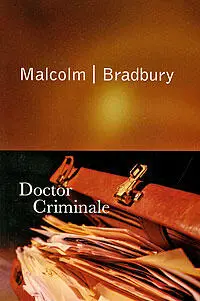
- Название:Doctor Criminale
- Автор:
- Издательство:Picador
- Жанр:
- Год:2000
- Город:London
- ISBN:978-0330390347
- Рейтинг книги:5 / 5. Голосов: 1
-
Избранное:Добавить в избранное
- Отзывы:
-
Ваша оценка:
Doctor Criminale: краткое содержание, описание и аннотация
Предлагаем к чтению аннотацию, описание, краткое содержание или предисловие (зависит от того, что написал сам автор книги «Doctor Criminale»). Если вы не нашли необходимую информацию о книге — напишите в комментариях, мы постараемся отыскать её.
Doctor Criminale — читать онлайн бесплатно полную книгу (весь текст) целиком
Ниже представлен текст книги, разбитый по страницам. Система сохранения места последней прочитанной страницы, позволяет с удобством читать онлайн бесплатно книгу «Doctor Criminale», без необходимости каждый раз заново искать на чём Вы остановились. Поставьте закладку, и сможете в любой момент перейти на страницу, на которой закончили чтение.
Интервал:
Закладка:
I soon saw that I could never have a better opportunity than here to read, see, and study the nature of Bazlo Criminale, and I began to map his daily life and follow him. The congress day started early, especially if you were Criminale. He always rose close to dawn, like a monk called by matins, and worked for an hour or so in the lighted window of his suite in the villa. Then, if the weather permitted (and at the start of the congress it did), he went out and wandered the landscape, of which Barolo had no shortage, evidently sorting his mind. The grounds were vast: a maze of plant-lined walks and rocky climbs, each finally leading to a shrine, a formal glade, a trysting place, a chapel, a belvedere or pier with a view. In the early morning they were his. In one of these spots you could generally find him, posed to perfection: Criminale in a dappled glade, Criminale in a prospect of flowers, Criminale gazing on a mountain view, Criminale beside a statue of Jove, Criminale by a balustrade, Criminale thinking.
As I’ve told you, I’m not myself a morning person. Nor, as it turned out, was Ildiko, who in any case seemed, rather oddly, to have no great desire to intrude on Criminale now she had caught up with him. As she explained to me, she wanted to wait for the right moment to approach him on the small publishing matter that bothered her. But, while she turned irritably over in the great emperor bed, and dived back into sleep again, I made a point of rising early, just as the great man himself did. I may have been in paradise, and Ildiko made it more paradisial; there was no doubt of that. But I also had a job to do. I also took to walking, or sometimes jogging, in the grounds in the early morning; often, of course, I saw Criminale. From time to time we would exchange a passing word or two, as one congress visitor to another. But he hardly noticed me; he was plainly abstracted. Meanwhile I observed him. In fact with each passing day of the congress I felt I was coming just a little closer toward understanding the Great Thinker of the Age of Glasnost.
Breakfast at Barolo was a movable feast, but I made a point of taking it at the same time as Bazlo Criminale. It was a meal no less perfect than the others; the coffee was ideally brewed, the breakfast rolls were marvels of bakery. Each crackled like twigs, and split open to reveal, inside, an airblown, conch-like spiral of nothingness, a grotto-like core as ornate as those on the hillside above. ‘Once more quite a perfect morning,’ he would say, coming in, sitting down, his square features suggesting without vanity that he had already done as much thinking since sun-up as the rest of us would manage in a year. The other members of the congress, emerging from their various residences within the villa or around the estate, would sit down near him, as if he were a natural magnet: Martin Amis, Hans Magnus Enzensberger, Susan Sontag and the others would gather round in unaccustomed silence as he began to talk. Then, after a while, Sepulchra would come sailing in. ‘Coffee, dearling?’ she would say, and Criminale would turn for a moment and watch her pour the hot milk, until, with the lift of one of his fine, gold-ringed fingers, he would give her the signal to stop.
Meanwhile, as the group around him grew bigger, Criminale would begin to chase some complicated or curious line of thought. I sat a little way off, at rimes even jotting down the odd note in my notebook. I began to see a pattern or two. For instance, Criminale would often mention Lukacs, as if that relationship was obsessive. ‘We know of course he was man of many contradictions,’ he would say, ‘He had the mind of a Hegel, the historical sense of a Napoleon . . .’ ‘Dearling, that man would not have given one backside glance if all of his friends were shot,’ Sepulchra would interrupt, ‘Eggs two?’ ‘Yes, two,’ Criminale would say, ‘He sacrificed individuals to thought, yes. But he also considered it better to live under the very worst of communism than under the best of capitalism. Let us ask: Why?’ ‘Dearling, because they gave him good job and nice apartment,’ Sepulchra would say, ‘Do you need clean spoon?’ ‘Because he truly believed in the progress of history, the great work of the philosophical idea, and he wanted to be there at history’s making,’ said Criminale. ‘He sold his soul,’ Sepulchra said, ‘Now dearling, please, talk less, eat your eggs two.’ And Criminale would smile, look round, and say to the others, ‘Now you know why God or maybe history gave men wives. So that, whenever they wished to interpret an important thing, there would always be a dialectic opposite there to correct it.’ ‘Eat, or you will die,’ Sepulchra would say, ‘Then you will blame me.’
After breakfast, carrying a cup of coffee, Criminale would always retire to the lounge. I wouldn’t be far behind, keeping my observer’s distance; he was the great man, I the nonentity. Here he would go round the room and gather up all the papers that lay there: Oggi , La Repubblica , Le Monde , Neue Zürcher Zeitung , The International Herald Tribune , The New York Times . News, the world of big events, seemed a world away from Barolo, and the papers were often a day old at least by the time they arrived. It made no difference; Criminale would sit down and impatiently gut them for world news like some tough old journalist, keeping up an audible commentary. All things seemed to interest him. ‘I see the Russians claim there is an international plot to destabilize their economy,’ he would say, ‘We know that. It is called Marxism.’ Or, ‘Another piece about the enigma of Islam. Why is Islam always thought such an enigma? After all, they chador their women, but we all know very well what is underneath, I think.’ Or, ‘They are asking again who killed Kennedy. We know who killed Kennedy. Why do we all love these theories of conspiracy? What is wrong with the end of our nose?’
I watched: the thinker was dealing with the world. Next he would turn to the book reviews. He seemed especially fond of the bestseller lists (‘Hip and Thigh Diet doing well again,’ he would say, ‘Why is it only fatties who read?’), perhaps because he was quite frequently on them, though he showed no great vanity about the many mentions of his own name. Afterwards it would be the financial pages, which he read like some old man in a café, running his fine fat finger down lists of share prices, checking on bids and takeovers, frauds and scandals. ‘Insider trader put inside,’ he would say, ‘Isn’t it coals to Newcastle? What else? Drugs money laundered, offshore accounts seized, bankers jailed, junk bonds worthless, of course, or they wouldn’t be junk. What a wonderful world, money. All the sins of the world are there. How lucky we have philosophy.’ ‘You can say this of money because you have some,’ Sepulchra would observe, sitting in the chair beside him, combing her hair and reading some glossy magazine. ‘Marxist,’ Criminale would say. ‘Same of you,’ Sepulchra would say.
Lastly Criminale would turn to the advertisement pages, which for some reason seemed to give him the greatest delight. ‘Sale at Bloomingdales,’ he would suddenly announce, ‘Sepulchra, look, a big deal on bras I think would very much interest you.’ Sepulchra, in the chair beside him, would look up and say, ‘I have enough of those thing to last at least two lifetime.’ ‘Not like these,’ he would say, ‘Ah, special offer on garden recliners.’ ‘No garden,’ Sepulchra would say. ‘Ninety-nine cents off tin of peas,’ he would say, ‘Life of Michael Dukakis reduced. Ah, shopping, shopping, shopping.’ ‘You seem very interested in shopping,’ I risked saying once, looking up from some article on the growing Gulf crisis that I was reading. ‘Of course,’ he said, ‘At the theoretical level only.’ ‘He never buys a thing,’ said Sepulchra. ‘You see, now sexual eroticism is exhausted, this is the one eroticism we have left.’ ‘You think sexual eroticism is exhausted?’ I asked. ‘Naturally,’ said Criminale, turning over the pages, ‘Women are upping their ante, isn’t that what you say, and in any case we know so much about the body now it has nothing,else left to give. But shopping, now that is different.’
Читать дальшеИнтервал:
Закладка:
Похожие книги на «Doctor Criminale»
Представляем Вашему вниманию похожие книги на «Doctor Criminale» списком для выбора. Мы отобрали схожую по названию и смыслу литературу в надежде предоставить читателям больше вариантов отыскать новые, интересные, ещё непрочитанные произведения.




Обсуждение, отзывы о книге «Doctor Criminale» и просто собственные мнения читателей. Оставьте ваши комментарии, напишите, что Вы думаете о произведении, его смысле или главных героях. Укажите что конкретно понравилось, а что нет, и почему Вы так считаете.