Malcolm Bradbury - Doctor Criminale
Здесь есть возможность читать онлайн «Malcolm Bradbury - Doctor Criminale» весь текст электронной книги совершенно бесплатно (целиком полную версию без сокращений). В некоторых случаях можно слушать аудио, скачать через торрент в формате fb2 и присутствует краткое содержание. Город: London, Год выпуска: 2000, ISBN: 2000, Издательство: Picador, Жанр: Современная проза, на английском языке. Описание произведения, (предисловие) а так же отзывы посетителей доступны на портале библиотеки ЛибКат.
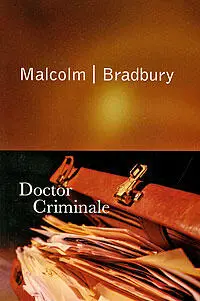
- Название:Doctor Criminale
- Автор:
- Издательство:Picador
- Жанр:
- Год:2000
- Город:London
- ISBN:978-0330390347
- Рейтинг книги:5 / 5. Голосов: 1
-
Избранное:Добавить в избранное
- Отзывы:
-
Ваша оценка:
Doctor Criminale: краткое содержание, описание и аннотация
Предлагаем к чтению аннотацию, описание, краткое содержание или предисловие (зависит от того, что написал сам автор книги «Doctor Criminale»). Если вы не нашли необходимую информацию о книге — напишите в комментариях, мы постараемся отыскать её.
Doctor Criminale — читать онлайн бесплатно полную книгу (весь текст) целиком
Ниже представлен текст книги, разбитый по страницам. Система сохранения места последней прочитанной страницы, позволяет с удобством читать онлайн бесплатно книгу «Doctor Criminale», без необходимости каждый раз заново искать на чём Вы остановились. Поставьте закладку, и сможете в любой момент перейти на страницу, на которой закончили чтение.
Интервал:
Закладка:
There is no doubt she was an impressive sight. She wore some low, loose, splendid Italian designer creation – I suspected that this purchase was what had kept her late the night before, while we all sat waiting for her arrival at the banquet – and had one of those perfect timeless, transcendental faces that between them surgeons and beauticians have somehow secured in perpetuity. I immediately saw from her manner – the way her eyes slid across me and many others and then turned quickly away – that, like most celebrities, she was looking round for some topshot company. ‘Scusi, the padrona,’ said Monza, leaving me immediately, and rushing over to kiss her hand. Mrs Magno glanced at him, then pushed him aside. She had found what she was looking for. ‘Hey man!’ she cried, throwing her arms wide, ‘How are you, buddy?’
‘Hey there, my dear lady,’ said Bazlo Criminale, the object of this attention, walking over to enjoy an embrace and a round of kisses. ‘You know I wouldn’t have come if it hadn’t been for you, honey,’ said Mrs Magno, ‘So how’s it buzzing? Good congress?’ ‘Believe me, Valeria, quite excellent,’ said Criminale, ‘Our Monza has surpassed himself. Talent is everywhere, wisdom abounds.’ ‘My God,’ said Mrs Magno, ‘Listen, I’m not going to eat a thing unless you sit beside me, okay?’ ‘Okay, of course,’ said Criminale. ‘And how’s Madame Criminale,’ asked Mrs Magno, turning to Sepulchra. ‘So-so,’ said Sepulchra, ‘Maybe I miss lunch. I am putting it on.’ And so when lunch was served a little later, Mrs Magno and Criminale, padrona and protégé, the American cosmopolite and the big gun of culture, sat side by side, their warm chatter, smiles and laughter delighting the entire international gathering. Ildiko had cut morning session, but now she appeared. ‘Oh, aren’t they happy!’ she cried, looking at them, ‘And they even got rid of Sepulchra!’
That afternoon I slipped down to the village to call Lavinia. ‘Darling, I went to the most wonderful marriage last night,’ she said. ‘Who got married?’ I asked. ‘Figaro, of course, marvellous production,’ said Lavinia, ‘What’s happening, Francis, you’ve been suspiciously quiet.’ I told her about the charming atmosphere of Barolo, the connubial bliss of the Criminale menage. ‘Francis, Francis, connubial bliss is no good at all,’ she said, ‘This is television. May I remind you of your magnificent treatment, I managed to read it the other day: “Criminale is evidently a man of gargantuan appetites and great lust for life, indeed lust for everything. Political contradictions and secrets litter his path.”’ ‘Yes, I know,’ I said uncomfortably, ‘I was younger then.’ ‘Better get after it, Francis,’ said Lavinia, ‘Remember, plot, crisis, difficulty. You’re not on holiday. You’re an investigator. This is all a façade.’ ‘So what do I do?’ I asked. ‘Penetrate it,’ said Lavinia, ‘Search his room. Make something happen.’
But the first few days of the congress passed in the same peaceful way. For the season, the weather was remarkably good. The mornings began clear; then, after lunch, there came as if under contract a sudden sharp downpour of rain. The long, well-lit classical views down the lake would close in, and become enclosed gloomy romantic views. The mists shut out the further mountains, the nearer ones would huddle in closer, the cypresses grew darker, the rocks above us blacker. The rain fell in fecund sheets, sweeping through the grounds, overflowing the drains and watercourses. The green grottoes dripped, the spewing fountains ejaculated uselessly against the downpour. The lake bounced, lightning flashed in a great display of daytime fireworks, perhaps revealing a villa no one had noticed creased into a hillside, or a sudden glimpse of some mountaintop monastery far away. Then the rain stopped, the lake settled, the mountains cleared, the birds resumed. ‘God is a gardener,’ the waiters in their Italian wisdom would explain at dinner in the evening, as the writers and politicians ate pasta and drank wine by candlelight and grew, every day, in every way, closer to each other.
Then each new morning, at least for the first four days, another fine day would show again, shyly, like a maiden. Or shyly the way maidens must once have been, before they all became accountants, heads of hi-tech corporations, or Euro-executives, like the severe Cosima Bruckner. I had not spoken to her again, but each day I saw her there, inspecting me, closely, suspiciously, across the congress room or else the dinner table. She seemed to be watching me, just as much as I was watching Criminale. For, never moving too close, never staying too far away, I was coming ever nearer to Bazlo. And the nearer I got, the more I started suspecting, not him, but my own suspicions, born in Ros’s little house behind Liverpool Street station. They were formed by Codicil’s book, but I now knew it was unreliable, so unreliable it wasn’t even by Codicil at all. Yes, there was a mystery to Criminale, but not the one I’d been looking for.
Maybe, I thought, the real mystery of Criminale was not political deceits, strange loves, celebrity follies. Maybe it was simply the kind of man he was: the odd and inescapable charisma, the strange intellectual power he exerted, the glimpse he gave of offering some answer to the chaotic times we lived in. As I’d confessed to Monza, he was impressive; he impressed others, distinguished figures from around the world, and he even impressed me, sceptical, doubting, Oedipal. He was a true writer among the writers, a true politician among the politicians, but he also seemed more than either, and better than both. Even his mixture of presence and absence made perfect sense. He was no conference trendy, but he was also effortlessly the core or magnet of the whole conference community. Everyone gathered round, everyone needed him; if he had not been there, somehow nor would they. He held with rocklike splendour to his own positions, kept his independence plainly on display.
And above all, for someone of his complex political background, he displayed no ideological party line. ‘My theory?’ I heard him say, almost mystified, to someone who asked him, ‘What theory? I am a philosopher against theory. I am not a Karl Marx. For me the problem is not to change the world, it is to understand it. I try to help us understand it.’ From his speech on the first night (the people who attacked it had now come to love it), he showed himself open: anxious, provisional, sceptical, above all ironical. (He had called philosophy ‘a form of irony’, I recalled.) This suited me, a late liberal humanist; I love the stuff. Liking my convictions soft, my faiths put to doubt, my gods upset, my statues parodied, my texts deconstructed, I took to his tone at once. He did the same thing, but for reasons far higher than my own. So the less I grew suspicious, the more I grew interested.
Of course (as you’ll see later), I didn’t really understand him. But like a portrait painter who starts off with a sketch, I was just beginning to get the shape of his head, the line of his style, the outline of his story. Now conferences have an odd way of breeding trust among those whom chance, travel-grants and handy APEX flights happen to throw together, as they constantly do these days. Even when lovers betray you (as they also constantly do these days), there never seems anything malign about a fellow conferee. I took advantage of this, of course, always watching at his elbow. I was able to see his strengths: his great courtesy, his intellectual force, his commanding presence. I could see some of his weaknesses: his obvious arrogance, his ironic evasiveness, his cosmic indifference. I saw he was both tolerant and brusque, generous and brutal. Despite what Lavinia said when I called her (‘Life and loves, Francis, life and loves,’ she cried, ‘Plot, crisis, difficulty!’), I started seeing him for what he must have been all the time without my knowing: a person.
Читать дальшеИнтервал:
Закладка:
Похожие книги на «Doctor Criminale»
Представляем Вашему вниманию похожие книги на «Doctor Criminale» списком для выбора. Мы отобрали схожую по названию и смыслу литературу в надежде предоставить читателям больше вариантов отыскать новые, интересные, ещё непрочитанные произведения.




Обсуждение, отзывы о книге «Doctor Criminale» и просто собственные мнения читателей. Оставьте ваши комментарии, напишите, что Вы думаете о произведении, его смысле или главных героях. Укажите что конкретно понравилось, а что нет, и почему Вы так считаете.