Malcolm Bradbury - Doctor Criminale
Здесь есть возможность читать онлайн «Malcolm Bradbury - Doctor Criminale» весь текст электронной книги совершенно бесплатно (целиком полную версию без сокращений). В некоторых случаях можно слушать аудио, скачать через торрент в формате fb2 и присутствует краткое содержание. Город: London, Год выпуска: 2000, ISBN: 2000, Издательство: Picador, Жанр: Современная проза, на английском языке. Описание произведения, (предисловие) а так же отзывы посетителей доступны на портале библиотеки ЛибКат.
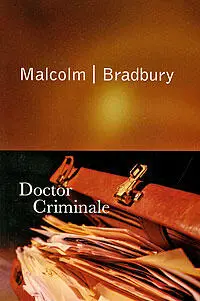
- Название:Doctor Criminale
- Автор:
- Издательство:Picador
- Жанр:
- Год:2000
- Город:London
- ISBN:978-0330390347
- Рейтинг книги:5 / 5. Голосов: 1
-
Избранное:Добавить в избранное
- Отзывы:
-
Ваша оценка:
Doctor Criminale: краткое содержание, описание и аннотация
Предлагаем к чтению аннотацию, описание, краткое содержание или предисловие (зависит от того, что написал сам автор книги «Doctor Criminale»). Если вы не нашли необходимую информацию о книге — напишите в комментариях, мы постараемся отыскать её.
Doctor Criminale — читать онлайн бесплатно полную книгу (весь текст) целиком
Ниже представлен текст книги, разбитый по страницам. Система сохранения места последней прочитанной страницы, позволяет с удобством читать онлайн бесплатно книгу «Doctor Criminale», без необходимости каждый раз заново искать на чём Вы остановились. Поставьте закладку, и сможете в любой момент перейти на страницу, на которой закончили чтение.
Интервал:
Закладка:
The meal proceeded: through pastas that were fine beyond belief, tortes beyond description, wines that were pure nectar. Then, as the plates were removed, Monza rose to his feet with a happy expression on his face, tapped his glass with his knife, and turned to look at his guest of honour. ‘Basta, enough of me,’ he said, ‘Now I like to introduce the guesta for whom you have all been waiting, we have all been waiting. I mean the leadinga thinker of our postmodern day, Dottore Bazlo Criminale, who will set our congressa in motion. I have asked him to say a fewa words about our main thema, the relation of literature and power in the changed world of today.’ There was a stir in the room as Bazlo Criminale rose to his feet, for some reason holding a tattered magazine in his hand.
When people have travelled a long way to a distant conference and sat down to the fine foods and wines of the first night, they like to be given a conviction of strenuousness, to be cheered up and set to ennobling work, even though they know that over the next days they have no intention of doing it. If Criminale knew that too, he seemed that night to have no intention of satisfying the need. I knew from my reading that he was known as a maker of gadfly speeches, and that was how he set off. ‘Thank you, Professor Monza,’ he said, beginning to talk even before the microphone had been set in front of him, ‘The relationship of literature and power, well, let us settle that matter immediately. There is no proper relationship of literature and power. Power manages, and art decreates. Power seeks a monologue and art is a dialogue. Art destroys what power has constructed. So these two can never discuss properly with each other, as you will have found out already tonight if you have tried to talk to your neighbour.’
There was some nervous laughter at this, but I saw Monza looking dismayed, as well as many of the participants, who had, after all, overflown several continents in order to discuss this very topic. ‘Of course you know my renowned Hungarian colleague György Lukacs took the other view,’ said Criminale (bringing in that name again), ‘For him art was ideas, ideas construct politics, politics construct reality, and it must be the correct reality. Only if the idea was correct was the art correct. And where today are Lukacs’s correct ideas, his correct reality? Floated away down the Danube to nowhere. Today we see the end of that oppressive monologue called Marxism. Now we say we live in the age of pluralism, the age without what Hegel called an Absolute Idea. For once we are adventuring into history without an idea, and this is like trying to sail the Atlantic without a map. You can do it, but will you survive, never mind get anywhere worth going to?
‘You ask me, a philosopher, to come here, and tell you how to live in the world without an idea. Well, let me admit that Lukacs was right in one thing. Art, literature, always occurs at a certain time in history, and cannot be free of it. So let us ask, what is our time in history? In the courtyard of the Beaubourg in Paris – you know that building, it does for architecture what God could have done for us, if he had put our intestines on the outside of our bodies, instead of the other way – is a clock, the Genitron. Perhaps you have seen it, it clocks down all the seconds left to the year 2000. I stand there sometimes, with all those fire-eaters, and I ask, what happens when the clock stops? Do we put on year 2001 tee-shirts and sing the “Ode to Joy”, or does the world go down the plug? And if we want an answer, who is trying to tell us? Do we have a Nietzsche, a Schopenhauer, a Hegel, a Marx? Is there perhaps a prophet somewhere?
‘Well, I found you some,’ said Criminale, standing there and waving his tattered magazine, ‘This is an airline magazine, compliments of Alitalia, I read it on the flight from, where was that?’ ‘Rangoon, dearling,’ said Sepulchra loudly. ‘Rangoon, was it really?’ said Criminale, to some laughter, ‘This magazine asked a group of thinkers, II Papa himself was one, to tell us about the world after the year 2000. Here is one prophet, the British novelist, Anthony Burgess, I quote him. “I think we will discover new worlds, and learn to move about in the universe and carry on the great experiment of life in another dimension.” Quite good, perhaps, now we know he has read Teilhard de Chardin. But here is another view, this time the diva Tina Turner, you know her, I hope. “I want the next ten years to be full of love and music. And another book, /, Tina , will be coming out and is going to be made into a movie.” From this I deduce it takes all sorts to make a new world.’
There was more laughter, but the guests were looking at each other, wondering where Criminale was going. ‘Very well, which is true?’ said Criminale, ‘150 years ago, The Communist Manifesto appeared, and the first sentence read, you all remember, “A spectre haunts Europe – the spectre of Communism.” Well, no more, I think. But what spectre does haunt Europe, or the rest of the world? The spectre that haunts us is the spectre of too much and too little. It is an age of everything and nothing. It is culture as spectacle, designer life, the age of shopping. It is both Burgess floating loose in cosmic space and Turner madly in love with her smart self. So, my friends, if in a week at Barolo you can reconcile Burgess and Turner, literature and power, idea and chaos, and if by the way you can also prevent collapse at the European fringes, stop mad nationalisms, avoid collision with Islam, and solve the problems of the Third World, you will have done well and your time will not be wasted. This is all, thank you.’
There was applause, of course, when Criminale sat down. He was a famous man, and he had, in the end, turned up to grace the occasion. But I sensed a kind of dismay as I went in to coffee in the lounge next door; it was as if the philosopher had descended amongst them and had refused to be a philosopher and chosen not to think. Ildiko joined me, in an angry temper. Her dinner had not gone well; the American State Department official on one side had told her all about the Uruguay Round of the GATT talks, and the Scandinavian poet on the other had tried to delight her with photographs of his penis, and she was not sure which was the more boring. And she was not at all pleased by Criminale’s oration. ‘But why does he talk like that?’ she asked. ‘Perhaps to make us think about whether we need a great idea or not,’ I said. ‘But he attacked always the wrong things,’ said Ildiko. ‘You mean Lukacs?’ I asked. ‘No, not Lukacs, who cares any more about Lukacs?’ said Ildiko, ‘I mean shopping. What is wrong with shopping?’
Ildiko was still angry when, later on, the tired conferees began saying their goodnights to each other, and we set off through the gardens to make our way down to the Boathouse. The night was not, after all, one to look forward to. We walked, apart, along the terrace, still lit by flickering torches; the moon shone, and the wind lightly shook the trees. Ildiko suddenly stopped. Beside a bare white statue of Minerva, a lone stocky human figure stood on the terrace, smoking a cigar, looking out over the black lake. ‘Criminale!’ said Ildiko, ‘Why does he do like that? Is he waiting someone?’ I looked around; there was no one else in sight. ‘Here’s your chance to go and talk to him,’ I said. ‘No, I don’t like, he is thinking,’ said Ildiko. ‘We’ve come all this way to talk to him,’ I said, ‘Now you can introduce me.’ ‘I really don’t like,’ said Ildiko; but just then Criminale turned, saw us, and waved his cigar. ‘A splendid speech, Dr Criminale,’ I called. ‘Not I think my best,’ said Criminale, looking first at me, then at Ildiko; there was no shock of recognition. ‘But not nice about shopping,’ said Ildiko, ‘This is Francis Jay from England.’
Читать дальшеИнтервал:
Закладка:
Похожие книги на «Doctor Criminale»
Представляем Вашему вниманию похожие книги на «Doctor Criminale» списком для выбора. Мы отобрали схожую по названию и смыслу литературу в надежде предоставить читателям больше вариантов отыскать новые, интересные, ещё непрочитанные произведения.



Обсуждение, отзывы о книге «Doctor Criminale» и просто собственные мнения читателей. Оставьте ваши комментарии, напишите, что Вы думаете о произведении, его смысле или главных героях. Укажите что конкретно понравилось, а что нет, и почему Вы так считаете.