Malcolm Bradbury - Doctor Criminale
Здесь есть возможность читать онлайн «Malcolm Bradbury - Doctor Criminale» весь текст электронной книги совершенно бесплатно (целиком полную версию без сокращений). В некоторых случаях можно слушать аудио, скачать через торрент в формате fb2 и присутствует краткое содержание. Город: London, Год выпуска: 2000, ISBN: 2000, Издательство: Picador, Жанр: Современная проза, на английском языке. Описание произведения, (предисловие) а так же отзывы посетителей доступны на портале библиотеки ЛибКат.
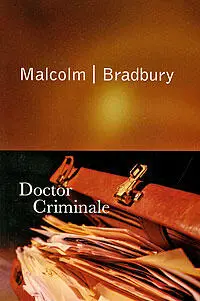
- Название:Doctor Criminale
- Автор:
- Издательство:Picador
- Жанр:
- Год:2000
- Город:London
- ISBN:978-0330390347
- Рейтинг книги:5 / 5. Голосов: 1
-
Избранное:Добавить в избранное
- Отзывы:
-
Ваша оценка:
Doctor Criminale: краткое содержание, описание и аннотация
Предлагаем к чтению аннотацию, описание, краткое содержание или предисловие (зависит от того, что написал сам автор книги «Doctor Criminale»). Если вы не нашли необходимую информацию о книге — напишите в комментариях, мы постараемся отыскать её.
Doctor Criminale — читать онлайн бесплатно полную книгу (весь текст) целиком
Ниже представлен текст книги, разбитый по страницам. Система сохранения места последней прочитанной страницы, позволяет с удобством читать онлайн бесплатно книгу «Doctor Criminale», без необходимости каждый раз заново искать на чём Вы остановились. Поставьте закладку, и сможете в любой момент перейти на страницу, на которой закончили чтение.
Интервал:
Закладка:
That was the moment when I learned a further new lesson about Bazlo Criminale. If he was a man who was difficult to find, he was also a man who was easy to lose again. I turned and looked for the Misses Belli and Uccello; they were standing round Monza, flashing their eyes as only they knew how, and waving their arms furiously in a familiar kind of Italian frenzy. ‘What’s happened to him?’ I asked Miss Belli, detaining her for a moment. ‘He has done it again, he has blasted disappeared again,’ said Belli, looking frantic. ‘You mean he’s done this sort of thing before?’ I asked. ‘Of course, he does it all the blasted time,’ said Miss Uccello. ‘We are supposed to look after him, you see,’ said Miss Belli, ‘So we take him when he asks to go to the newspaper shop down in Barolo.’ ‘One minute he is there, the next he is gone,’ said Miss Uccello, ‘Then you don’t see him again for perhaps a whole day.’ ‘And he carries no money and he doesn’t know where he stays,’ said Miss Belli. ‘But usually the police find him somewhere, anywhere, and bring him back again in their van,’ said Miss Uccello, ‘But where now?’
‘Why does he do it?’ I asked. ‘I don’t know,’ said Miss Uccello, ‘Sometimes he thinks he is in Rangoon. I don’t know why Rangoon.’ ‘He went there,’ said Miss Belli. ‘You don’t mean he’s a little . . .,’1 asked, tapping my head. ‘Naiou,’ cried Miss Belli impatiently, ‘He is better sane than the rest of us.’ ‘He is just thinking,’ said Miss Uccello, ‘He is a philosopher.’ ‘But this time we hope he has not gone so far,’ said Miss Belli. ‘Tonight he must give the after-dinner speech,’ said Miss Uccello, ‘If we can’t find him this time Monza will really kill us.’ In the middle of the lobby, Monza, who had descended from his chair to give some frantic instructions to the servants, had recovered his organizational abilities and remounted his podium. ‘Prego, achtung!’ he was shouting, clapping his hands again, ‘I like to maka you a few more announcaments!’
Miss Belli groaned. ‘Announcaments!’ she said, ‘I think that is what did it. Bazlo cannot stand Monza’s announcaments.’ A moment later, I began to grasp what she meant. Things always have to be announced at conferences; Monza had chosen to make an art form of it. No doubt this was why they got him to organize great congresses; he was a world-class clapper of hands and tapper of glasses, a virtuoso of banging hard on desks and knocking knives on tables. In fact I was later to learn, as events progressed, that Monza’s conference announcements were often remembered worldwide for many years – long after the lectures, events and receptions they referred to had passed into collective oblivion.
So, gathering his wits about him, Monza announced. The world of congress had clearly begun. First he announced his future schedule of announcements. He announced he would announce his daily announcements each morning at ten, before the daily sessions began. Because without announcements no congress could function, everyone should be present, even if they chose to miss the sessions. If there should happen to be no announcements on any particular day, he would of course announce that then, though it was highly unlikely. Then he announced to us the conference schedule, the plan of daily sessions, the proposed times of relaxation, the hour of pre-lunch and pre-dinner drinks, the various pleasures that had been so thoughtfully contrived for us at various points during our stay: a tour of the lake, for instance, a trip to ancient Bergamo, a candlelight dinner midweek, a night-time concert of chamber music, which would be held at the nearby Villa Bellavecchia, just on the other side of the lake, forming a nice excursion, and so on.
After that he announced that there would be a Grand Reception this same evening in the Salon of the Muses, to be followed by a Great Opening Banquetta in the Lippo Lippi Dining-Room. This would be attended by the padrona of the Magno Foundation, Mrs Valeria Magno, who would be joining us specially from the United States, once she had found a satisfactory landing slot for her private 727. Finally he announced that because, unfortunately, the announcements had somehow gone on for so long, the reception was due to start in less than half an hour. And since we would all want to change, and our rooms were scattered at wide distances all over the great grounds, we should delay no longer but hurry to the Secretariat to pick up our keys and room assignments. I looked at my watch. ‘We’re already half an hour late,’ I said to Miss Belli. ‘Only in Britain,’ said Miss Belli, ‘In Italy when you are an hour late, you are already half an hour early.’
And it was at the Secretariat, where I stood in line to collect our keys, that I discovered the first of my several Barolo confusions. Whether it was because of the brevity of my cable, international language difficulties or sheer natural Italian generosity I do not know, but Ildiko and I had been assigned to the same room. I had no real complaints about this myself (you would understand if you had seen Ildiko) but I rather thought she might have. ‘So where do we go?’ she asked, when I found her waiting for me on the terrace outside, staring delightedly at the view up the lake. ‘We’re both down in the Old Boathouse,’ I said. ‘A Boathouse?’ asked Ildiko, ‘We sleep in the water?’ ‘I don’t think we’ll actually be in the water,’ I said, ‘But they have put us together in one room. I could complain, if you like.’
Ildiko looked at me. ‘You want to complain?’ she asked. ‘Not necessarily,’ I said, ‘I thought you might want to complain.’ ‘But with officials it is always a very bad thing to complain,’ said Ildiko, ‘They can keep you for many days. No, I suppose this is the custom in the West.’ ‘Not always,’ I said, ‘But maybe in Italy. So it’s all right?’ ‘Of course all right,’ said Ildiko, ‘It is wonderful here. Just like a place for Party members, but even better. So is all the West like this?’ ‘I’m afraid not,’ I said, ‘Some of it’s pretty miserable. In fact most of it, compared with this.’ ‘So who pays all this?’ asked Ildiko. ‘An American patron,’ I said, ‘I think she made her money in planes and pharmaceuticals. So you could say this is the smiling face of American capitalism.’ ‘You mean I am looked after like this by American capitalism?’ asked Ildiko. ‘Yes,’ I said, ‘I hope you don’t mind.’ ‘Of course not, about time,’ said Ildiko, putting her arm through mine, ‘I think it is just like Paradise, here. So let us go and find our nice little room.’
Following the map we had been given, Ildiko and I walked along the path that led downwards, through the great gardens of the villa, towards the Old Boathouse, which was, as you’d think, set by the lakeside below. Looking round, I realized that Ildiko was right: paradise was no bad name for it after all. For, inside the villa and outside it, Barolo seemed a place where nothing could be faulted, except for the sheer absence of fault itself. No doubt its very confusions were intentional. The gardens we now walked through were themselves art-objects, just like the ones in the house. Every single terrace had been cultivated, every bed laboured over, every hedge and bush seemed to have been trimmed. Every tree was intentional, every rock had become a step to somewhere, and every woodland path led to some dramatic revelation – a grotto, a belvedere, a gazebo, a long view, a statue of a glancing nymph or indeed a hefty philosopher of the classical age, when they knew you thought much better naked.
Even the wilderness was tamed. Up the wooded and craggy mountainside that rose up above the formal gardens, every nook and cranny, every cleft and orifice, had been worked for some purpose – planted with ferns, turned into a grotto, shaped into a shrine, sculpted into a waterfall. The nooks and crannies, the clefts and orifices, of the great stone statues of nymphs, gods, athletes and bacchantes that stood everywhere were just as worked and crafted. Breasts and bottoms, mouths and penises, turned into spurting outlets of aquatic fecundity that sprayed into fountains, watered the fish-ponds, or fed the rivulets that coursed down the mountainside, through the gardens, and down into the lake in front of us. As for the lake, as we came to it down lighted steps, it had been carefully coloured dark magenta, and been decorated with fireflies. In a true paradise nothing is overlooked.
Читать дальшеИнтервал:
Закладка:
Похожие книги на «Doctor Criminale»
Представляем Вашему вниманию похожие книги на «Doctor Criminale» списком для выбора. Мы отобрали схожую по названию и смыслу литературу в надежде предоставить читателям больше вариантов отыскать новые, интересные, ещё непрочитанные произведения.








Обсуждение, отзывы о книге «Doctor Criminale» и просто собственные мнения читателей. Оставьте ваши комментарии, напишите, что Вы думаете о произведении, его смысле или главных героях. Укажите что конкретно понравилось, а что нет, и почему Вы так считаете.