Malcolm Bradbury - Doctor Criminale
Здесь есть возможность читать онлайн «Malcolm Bradbury - Doctor Criminale» весь текст электронной книги совершенно бесплатно (целиком полную версию без сокращений). В некоторых случаях можно слушать аудио, скачать через торрент в формате fb2 и присутствует краткое содержание. Город: London, Год выпуска: 2000, ISBN: 2000, Издательство: Picador, Жанр: Современная проза, на английском языке. Описание произведения, (предисловие) а так же отзывы посетителей доступны на портале библиотеки ЛибКат.
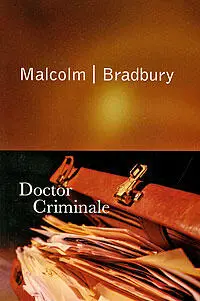
- Название:Doctor Criminale
- Автор:
- Издательство:Picador
- Жанр:
- Год:2000
- Город:London
- ISBN:978-0330390347
- Рейтинг книги:5 / 5. Голосов: 1
-
Избранное:Добавить в избранное
- Отзывы:
-
Ваша оценка:
Doctor Criminale: краткое содержание, описание и аннотация
Предлагаем к чтению аннотацию, описание, краткое содержание или предисловие (зависит от того, что написал сам автор книги «Doctor Criminale»). Если вы не нашли необходимую информацию о книге — напишите в комментариях, мы постараемся отыскать её.
Doctor Criminale — читать онлайн бесплатно полную книгу (весь текст) целиком
Ниже представлен текст книги, разбитый по страницам. Система сохранения места последней прочитанной страницы, позволяет с удобством читать онлайн бесплатно книгу «Doctor Criminale», без необходимости каждый раз заново искать на чём Вы остановились. Поставьте закладку, и сможете в любой момент перейти на страницу, на которой закончили чтение.
Интервал:
Закладка:
So it went on. Miss Makesuma from Japan, who had now changed her charming pink kimono for a charming blue one, spoke scarcely any English; but I discovered from her companion that she was not, after all, an heiress to the tradition of Mishima, but an economic adviser working on long-term industrial goals for the Keifu government. When I approached one of the East European dissidents to ask him about his tricky relations with the regime, he proved to be Professor Rom Rum, Minister of what he called Strange Trade of the former People’s Republic of Slaka, which had lately overthrown its brutal hardline dictator General Vulcani and was now fallen into the hands of the free market. (I saw the other day in the paper that Rum, after some more recent coup, had become the nation’s President.) In fact very few of the writers I talked to proved to be writers at all. One of the laughing Africans, who had changed his multi-coloured tribal dress for a startling robe of pure white, was Justice Minister of his nation, while the group of deconstructionist critics from Yale proved in actual fact to be a posse from the US state Department.
In the end I did of course find some writers. I met a literary editor from Paris who was heavily into random signs; the President of the Indian Writers’ Union, who demanded my signature on some petition; a Nobel prizewinner from a small North African country in which he was, he explained, not just the most famous but the only writer. I spotted Martin Amis, an old acquaintance, across the room, talking to Günter Grass; they were soon joined by Susan Sontag and Hans Magnus Enzensberger. Gradually, working the room (Ildiko was still out on the terrace), I began to understand that the Barolo Congress was wide-ranging in several ways. Not only had its organizer, Monza, balanced West and East, Europe and Asia, the United States and the South Pacific; he had also balanced Literature and Power. And, as usual when there is an attempt at dialogue across difficult borders, there was already proof of difficulty. The half of the group who were politicos were talking only to other politicos; the half who were writers were talking only to other writers. No wonder they needed someone to bridge the difficulty, somebody of the calibre of Bazlo Criminale.
I looked round; there was still no sign of him. I gathered my courage and went over to Professor Monza. ‘What’s happened to Criminale?’ I asked him. ‘Prego, please, do not mention this mana to me,’ said Monza grimly, ‘I have servants everywhere looking for him. I depend on him for the speecha tonight. He is like some prima donna. And now Mrs Magno is not here either, I hope nothing goes wrong with her plana. Now scusi, I must make an announcament. Achtung prego!’ Monza climbed on a chair and clapped his hands; the party noise faded. ‘This is an emergency announcament!’ he said, ‘I am afraid both our guests of honour are missing, but the chef cannot delay any longer. Now we must starta to eata! Please check your places on the plana by the door, and take you places for the banquetta!’ Writers of the world, politicos of the world, we surged forward; there were some unseemly moments as one hundred people tried to read their names on a very small list. Then we moved as from turbulence into perfect calm, as we entered the noble dining-room and took our places for the opening banquet.
And so at last, in the great Lippo Lippi room of the Villa Barolo, with Michelangelo paintings on the ceiling above, I did sit down to eat with the big people. The room was perfect beyond perfection. The cloths were of real damask, the silver really was silver, the Venetian glassware shimmered and glimmered as brightly as the suit of the absent Doctor Criminale. I checked on either side to see my company. To my right was the Japanese lady economist (name badge: Chikko Makesuma, Tokyo) who worked for the Keifu government. To my left was a dark-haired German lady in shiny black leather trousers (name badge: Cosima Bruckner, Brussels). I turned first to Miss Makesuma, but she answered my questions by putting her finger delicately to her lips and smiling demurely. I then remembered she spoke almost no English. I turned to my other side, and addressed myself to Miss Cosima Bruckner.
‘Did you have a good journey here?’ I asked. ‘Nein, it was terrible,’ said Cosima Bruckner, ‘Are you also one of these writers?’ ‘A journalist,’ I said, ‘Are you a writer?’ ‘I work in the Beef Mountain of the European Community,’ she said. ‘Really, how fascinating,’ I said, ‘How do you like the villa?’ ‘Bitte?’ ‘Do you like it here?’ I asked. ‘I don’t know,’ said Bruckner, ‘Maybe.’ ‘Have you a good view?’ I asked. ‘Of what?’ asked Bruckner. ‘From your window,’ I asked, ‘Is your room nice?’ ‘It is so-so,’ said Bruckner, ‘Why do you ask me this?’ ‘It’s just small-talk,’ I said. ‘Small-talk, yes, I think so,’ said Cosima Bruckner, turning to tap her neighbour on the other side with her fork to demand his attention.
And if I was having social problems, I saw that Ildiko Hazy, seated much further down the table, was having them too. She was stuck between a grim-looking American and a grim-looking Scandinavian, and kept grimacing furiously at me. But our own small problems in bridging literature and power were as nothing compared to those of Professor Massimo Monza. I looked over and saw he was sitting in lonely state in the middle of the top table, with three empty places beside him – awaiting, presumably, the arrival of Sepulchra, Criminale, and our padrona Mrs Valeria Magno, whose plane had evidently still not landed. Servants kept rushing in to whisper messages into his ear; he waved them away irritably. A splendid meal began to be set before us; magnificent wine began to flow. Yet somehow it felt like a dinner heading towards disaster. The absences at the top table began to penetrate the entire room; it was as if all our conversation, all our congregation, was lacking one essential voice – as if we were an orchestra performing a piano concerto without just one musician, who unfortunately happened to be the solo pianist himself.
It was some time after we had consumed the delicious cucumber soup, and when we were well into the admirable Parma ham with melon, that there was a sound of disturbance in the doorway. There, with her hair drawn even higher onto her head than before, and wearing an enormous full-length kimono-style dress, stood Sepulchra. Behind her it was just possible to glimpse the much smaller figure of Bazlo Criminale. A butler hurried over to them, and brought them to their places on the top table. ‘But you started,’ we could all hear Sepulchra say as she said down. ‘A hundred people waiteda,’ said Monza, ‘Wherea were you?’ ‘Bazlo was working,’ said Sepulchra. ‘I had just a small article to write,’ said Criminale, sitting down, in a more apologetic fashion; I was later to discover that it was Miss Belli who had discovered him at last, seated in the darkness in a gazebo by the lakeshore, quietly listening to a recording of Kierkegaard’s Either/Or on his Sony Walkman.
Within minutes it was clear that Criminale’s arrival had somehow transformed the entire occasion. There was relief and pleasure on Monza’s face, and a mood of satisfaction spread through the entire room. The atmosphere suddenly eased; literature began talking to power, and vice versa. ‘Did you?’ asked Cosima Bruckner, suddenly leaving her neighbour and now tapping me with her fork. ‘Did I what?’ I asked. ‘Have also a good journey?’ she asked. ‘Yes, I did,’ I said, ‘Fine.’ ‘So you work for a paper,’ she said, ‘What is the paper?’ I told her; it proved to be an act of folly. She stared at me. ‘It doesn’t exist any more,’ she said, ‘I know, I am with the European Community. In Brussels we know everything.’ ‘I’d rather you didn’t say anything,’ I said, ‘That was just the cover for a larger project.’ ‘You are here under cover?’ asked Cosima Bruckner, ‘That is very interesting. I will talk to you later.’ Anxious, I looked down the table at Ildiko, who made a face at me, and turned laughing to her neighbour.
Читать дальшеИнтервал:
Закладка:
Похожие книги на «Doctor Criminale»
Представляем Вашему вниманию похожие книги на «Doctor Criminale» списком для выбора. Мы отобрали схожую по названию и смыслу литературу в надежде предоставить читателям больше вариантов отыскать новые, интересные, ещё непрочитанные произведения.



Обсуждение, отзывы о книге «Doctor Criminale» и просто собственные мнения читателей. Оставьте ваши комментарии, напишите, что Вы думаете о произведении, его смысле или главных героях. Укажите что конкретно понравилось, а что нет, и почему Вы так считаете.