Michael Chabon - Telegraph Avenue
Здесь есть возможность читать онлайн «Michael Chabon - Telegraph Avenue» — ознакомительный отрывок электронной книги совершенно бесплатно, а после прочтения отрывка купить полную версию. В некоторых случаях можно слушать аудио, скачать через торрент в формате fb2 и присутствует краткое содержание. Город: New York, Год выпуска: 2012, ISBN: 2012, Издательство: Harper, Жанр: Современная проза, на английском языке. Описание произведения, (предисловие) а так же отзывы посетителей доступны на портале библиотеки ЛибКат.
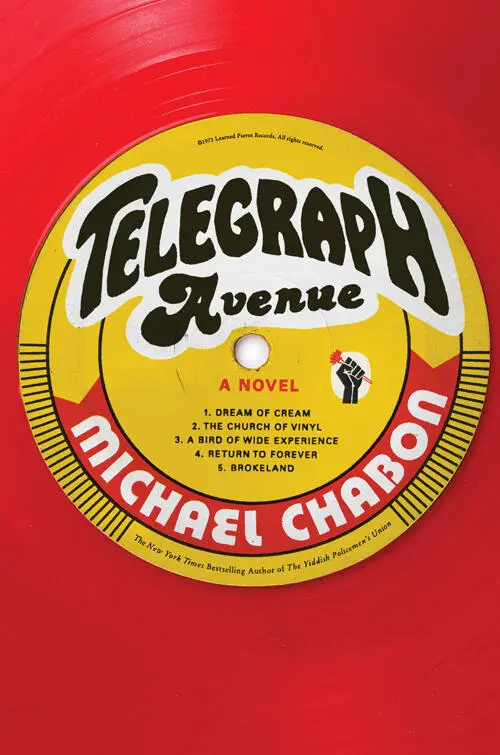
- Название:Telegraph Avenue
- Автор:
- Издательство:Harper
- Жанр:
- Год:2012
- Город:New York
- ISBN:978-0-06-149334-8
- Рейтинг книги:3.5 / 5. Голосов: 2
-
Избранное:Добавить в избранное
- Отзывы:
-
Ваша оценка:
Telegraph Avenue: краткое содержание, описание и аннотация
Предлагаем к чтению аннотацию, описание, краткое содержание или предисловие (зависит от того, что написал сам автор книги «Telegraph Avenue»). Если вы не нашли необходимую информацию о книге — напишите в комментариях, мы постараемся отыскать её.
When ex–NFL quarterback Gibson Goode, the fifth-richest black man in America, announces plans to build his latest Dogpile megastore on a nearby stretch of Telegraph Avenue, Nat and Archy fear it means certain doom for their vulnerable little enterprise. Meanwhile, Aviva and Gwen also find themselves caught up in a battle for their professional existence, one that tests the limits of their friendship. Adding another layer of complication to the couples’ already tangled lives is the surprise appearance of Titus Joyner, the teenage son Archy has never acknowledged and the love of fifteen-year-old Julius Jaffe’s life.
An intimate epic, a NorCal
set to the funky beat of classic vinyl soul-jazz and pulsing with a virtuosic, pyrotechnical style all its own,
is the great American novel we’ve been waiting for. Generous, imaginative, funny, moving, thrilling, humane, triumphant, it is Michael Chabon’s most dazzling book yet.
Telegraph Avenue — читать онлайн ознакомительный отрывок
Ниже представлен текст книги, разбитый по страницам. Система сохранения места последней прочитанной страницы, позволяет с удобством читать онлайн бесплатно книгу «Telegraph Avenue», без необходимости каждый раз заново искать на чём Вы остановились. Поставьте закладку, и сможете в любой момент перейти на страницу, на которой закончили чтение.
Интервал:
Закладка:
“What they want?”
Valletta Moore stood in the second garage bay. She had her hand tucked inside her red handbag.
“Archy’s my father,” Titus said.
“Archy Stallings?”
“Yes, sir.”
“For real? You my grandson?”
Titus nodded.
“Boy got kids all over town,” Valletta said.
Luther came in a hurry, with a destination. Titus went stiffly into his grandfather’s arms. Holding back. But he went. Luther Stallings—at one time, many, many years earlier, a viable pretender to the fiercely disputed title of Toughest Black Man in the World—brushed away a few ill-suited tears.
“Well, goddamn.”
He let go of Titus, stepped away, and cleared his throat. He took hold of the silver-tipped head of his cane with both hands and planted it square on the ground in front of him. Looked down the avenue across the barren expanse of the old depot, then up the other way where there was not much to see, at first glance, but razor wire and morning glory in wild contention. And sky. Lots of sky, torn into scraps of silver and blue. Eighteen-wheelers like beads on an endless strand, creeping along the flyovers toward the docks. And containers stacked everywhere you looked, painted with names that sounded to Julie like the names of opponents in Street Fighter : “K” Line, Yang Ming, Maersk, Star. Beyond that the gray planes and facets of San Francisco.
“Best get inside,” Luther said.
Titus started toward the garage. Stallings turned to Julie, who hesitated, paralyzed by a ridiculous fear that Valletta Moore might be keeping a gun in her handbag. Afraid, too, of the man with the cane, of this nether zone of Oakland, of certain shadows in the garage that he saw gathering into the shape of man, large and portly, with fearsome mustaches somewhere between biker king and generalissimo.
“What?” Luther Stallings said to Julie. “You want a hug, too?”
“Okay,” said Julie. Then he realized that Luther Stallings had only been joking, and even before the man turned and loped, without looking back, into the garage bay of Motor City Auto Body and Custom Jobs, he felt sharply bereft.
“Oh, look at that cute little boy,” Aviva said bitterly. Frog Park, lunchtime, babies and herders of babies pastured in the sunshine. The boy was as strawberry blond as Julie had been once. He lounged against his mother with his toddler overalls unsnapped and flapping, feeding her a garbanzo bean. “Could you die?”
The boy looked nothing like Julie had looked, apart from the hair. It was the angle of his slouch, the way he carelessly depended on his mother to hold him up, that killed her. Or maybe it was simply the avalanche of years. She looked away. She almost regretted having proposed to Nat that instead of eating at the store, they find someplace nice to sit and have an early lunch together. A bag of sandwiches from Genova Deli, some fried artichokes, a pair of Aranciatas. Her last meal, she had styled it, aiming for wry, hitting brittle. Taken aback when Nat only assented to her terminology, hunched over the counter of Brokeland, chin in hand, flying black sails from every mast like the ship in Greek mythology. Sailing as ever toward her, from yet another labyrinth, aboard the Moody Dude . No sign of Archy. Explanation of that absence, of what was wrong around or between the partners, awaited only a formal request from Aviva; but she had withheld it. For once, let Nat do the listening. Let him look for something to grab on to, someplace to hunker down and watch as she unstoppered a genie of panic and did whatever it was that you called the opposite of wishing.
“If I go to prison,” she said.
“Ho, boy,” Nat said, fishing Möbius strips of onion out of his sandwich with a feline prissiness, piling them on the white sandwich wrapper spread between them on the bench. “Here we go.”
“You’re going to have to make Julie come visit me.”
“Aviva.”
“He won’t want to come,” Aviva said. “He’ll be too angry.”
“You aren’t going to prison.”
“Oh, no?”
The boy reclined against his mother the way a god might recline in an Italian fresco, against a favorite cloud, in the heaven of his mother and her bare brown shoulder. Maybe around his eyes, too, there was a touch of Julie, a histamine puffiness in the cheeks.
“Aviva, it’s a hearing in a hospital. Not a courtroom trial. And it’s about something that Gwen did. You’re just along for the ride.”
“Gwen didn’t do anything, Nat.”
“No, of course, I’m just saying—”
“That’s the point . Gwen’s real mistake wasn’t mouthing off to a doc. I mean, it was a mistake. But she was tired. She was drained. It was a really long day. And the guy totally, totally provoked her.”
“Had to be,” Nat said. “Gwen Shanks losing her cool is kind of hard to imagine.”
“It was unreal. Impressive.” Delicious, sickening, like eating an entire birthday cake between them. Aviva had found herself reveling in Gwen’s outburst with all the horror of fifteen years spent putting up with the highhandedness and disdain of doctors, dusting it like dander from her shoulders. Fifteen years of valorous discretion, unspoken retorts, and trepverter. “But a mistake.”
“It’s always a mistake to lose control like that,” Nat said without apparent self-irony.
“Huh,” Aviva said.
“Shut up.”
“Anyway. This fucked-up hearing we have to endure today? It’s not happening because Gwen lost her shit in the ER. And Gwen’s blowup won’t be the reason when I have to go to prison.”
“Good to know.”
“Gwen thinks Lazar disrespected her because she’s black. And look, I mean you’re aware of my policy when it comes to that type of situation.”
“Your policy is ‘What do I know about being black?’”
“What do I know about being black? I’m sure that when she went after him, calling him names, pointing her finger at him? To Lazar, it was just another stereotype from the ER deck of cards, you know, the Angry Black Woman. But being a black woman wasn’t Gwen’s big mistake, either. Her big mistake was being a midwife . A nurse-midwife who does home births and hospital births.”
“They hate that.”
“They hate all midwives, but they especially hate the ones who do home births. They want to make us go away. They want to say to us, ‘Pick. You can do births here in the hospital, or you can do them at home with your patchouli, and your placenta-eating, and your mandala tramp stamps. But if you choose to keep doing those home births, ladies? Then you lose your privileges.’”
She became aware that some of the women around them, moms, babysitters, were looking to see who was ranting on this fine August afternoon at some poor old slumped guy in a pool-hall suit, picking at a sandwich. At least one of the moms was a patient of the Birth Partners, Dina or Deanna, looking half embarrassed and half entranced, the way you looked at your rabbi when you saw him mowing his lawn in a pair of Bermuda shorts.
“I mean,” Aviva said, lowering her voice, “we know this. This is a proven, established fact. Every other hospital in the East Bay has already done it. Chimes is the last one that still lets midwives do both home and hospital births. They’re just looking for an excuse to go the same direction. And, of course, they have all the power, right?”
“Right.”
“Meanwhile, if they have a birth that goes like Lydia’s? It’s ‘Oh, hey, shit happens. Mom’s fine, baby’s fine, let’s move on.’ I don’t know, maybe if Gwen didn’t lose her temper, maybe we would have been able to skate past. But Gwen did lose her temper, and when it came time to say she was sorry for losing her temper, God bless her, she didn’t want to do that. So now? Today, at this hearing?”
Читать дальшеИнтервал:
Закладка:
Похожие книги на «Telegraph Avenue»
Представляем Вашему вниманию похожие книги на «Telegraph Avenue» списком для выбора. Мы отобрали схожую по названию и смыслу литературу в надежде предоставить читателям больше вариантов отыскать новые, интересные, ещё непрочитанные произведения.








Обсуждение, отзывы о книге «Telegraph Avenue» и просто собственные мнения читателей. Оставьте ваши комментарии, напишите, что Вы думаете о произведении, его смысле или главных героях. Укажите что конкретно понравилось, а что нет, и почему Вы так считаете.