Michael Chabon - Telegraph Avenue
Здесь есть возможность читать онлайн «Michael Chabon - Telegraph Avenue» — ознакомительный отрывок электронной книги совершенно бесплатно, а после прочтения отрывка купить полную версию. В некоторых случаях можно слушать аудио, скачать через торрент в формате fb2 и присутствует краткое содержание. Город: New York, Год выпуска: 2012, ISBN: 2012, Издательство: Harper, Жанр: Современная проза, на английском языке. Описание произведения, (предисловие) а так же отзывы посетителей доступны на портале библиотеки ЛибКат.
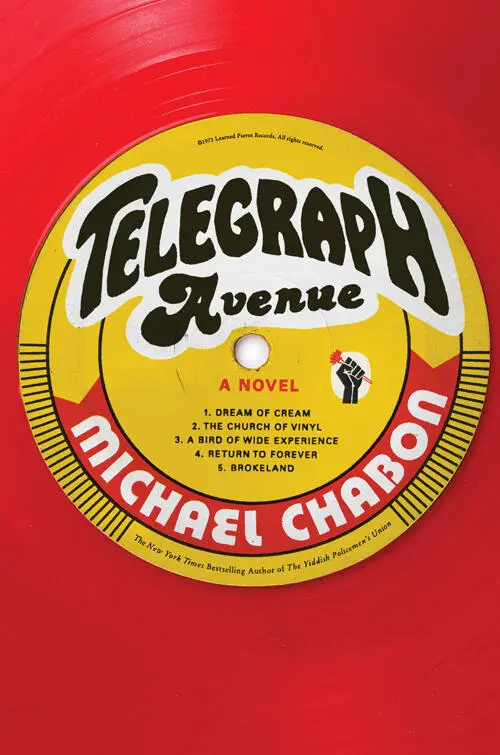
- Название:Telegraph Avenue
- Автор:
- Издательство:Harper
- Жанр:
- Год:2012
- Город:New York
- ISBN:978-0-06-149334-8
- Рейтинг книги:3.5 / 5. Голосов: 2
-
Избранное:Добавить в избранное
- Отзывы:
-
Ваша оценка:
Telegraph Avenue: краткое содержание, описание и аннотация
Предлагаем к чтению аннотацию, описание, краткое содержание или предисловие (зависит от того, что написал сам автор книги «Telegraph Avenue»). Если вы не нашли необходимую информацию о книге — напишите в комментариях, мы постараемся отыскать её.
When ex–NFL quarterback Gibson Goode, the fifth-richest black man in America, announces plans to build his latest Dogpile megastore on a nearby stretch of Telegraph Avenue, Nat and Archy fear it means certain doom for their vulnerable little enterprise. Meanwhile, Aviva and Gwen also find themselves caught up in a battle for their professional existence, one that tests the limits of their friendship. Adding another layer of complication to the couples’ already tangled lives is the surprise appearance of Titus Joyner, the teenage son Archy has never acknowledged and the love of fifteen-year-old Julius Jaffe’s life.
An intimate epic, a NorCal
set to the funky beat of classic vinyl soul-jazz and pulsing with a virtuosic, pyrotechnical style all its own,
is the great American novel we’ve been waiting for. Generous, imaginative, funny, moving, thrilling, humane, triumphant, it is Michael Chabon’s most dazzling book yet.
Telegraph Avenue — читать онлайн ознакомительный отрывок
Ниже представлен текст книги, разбитый по страницам. Система сохранения места последней прочитанной страницы, позволяет с удобством читать онлайн бесплатно книгу «Telegraph Avenue», без необходимости каждый раз заново искать на чём Вы остановились. Поставьте закладку, и сможете в любой момент перейти на страницу, на которой закончили чтение.
Интервал:
Закладка:
Titus put in an order for six egg rolls and two glazed raised donuts; Julie paid the bill. Valletta Moore, taking no notice of either boy, ordered a chicken chow mein and a dozen egg rolls to go.
She paid for her food using coins of small denomination, slowly, seeming to get angrier with each one that she snapped down on the counter, as though the Asian lady at the cash register were rushing her or fouling up her math. The Asian lady said nothing at all, and her face gave away little, but in her very silence and patience, there was something that might have passed for contempt. Settling the tab took every nickel that Valletta Moore could raise in the clatter of her handbag. When the Asian lady offered to make up the four cents’ change, Valletta stared at the proffered pennies with distaste, as though they were something the Asian lady ought to take care of with a Handi Wipe. Then she carried her white paper bag out to the sidewalk, where the boys, cleverly, were already hot in advance on her trail. Their cover: two boys patronizing Loving Donut. Easy to remember, diabolic in its simplicity.
Julie declined to touch the paper bag that Titus held out to him, let alone its contents, whose reek of cabbage and burnt sugar caused his stomach, already twisted by the dread and bus-borne hand job and the thrill of pursuit, to seethe. “Did you see the oil they had those things cooking in?” he said.
“Biodiesel,” Titus said. “Run a Jetta.”
If you recorded Titus eating the six egg rolls and two donuts on film, Julie thought, and then ran the film in reverse, it would look as though he were firing them out of his mouth, pop, pop, like cannonballs from the mouth of a cannon. Thirty seconds after commencing his meal, he went inside to wash it down with a half pint of milk, also on Julie.
When Titus came back out of Loving Donut, he was just in time to witness the arrival of a very unfortunate Toronado. It juddered, and heaved, and disputed with unseen antagonists like some kind of Telegraph Avenue hobo. Rust had left bloody tooth marks along its underbelly and wheel beds. It might once have been gray or green, but since that remote era, the most irresolute painter in the history of automotives appeared to have tested out every known make and formulation of primer on all of its surfaces. Its driver slowed without stopping and leaned over to unhook a loop of yellow nylon that connected the right-side grab handle to the lock button of the passenger door. The door groaned open. Valletta effected a kind of flying hurdle into the passenger seat. She slammed the door shut and relooped the nylon cord over the lock button. Without missing a beat, she and the driver seemed immediately to resume some earlier argument, the report of which contended, as the car pulled away from the curb, with the hawking and rattling of the car’s emphysema, arthritis, TB.
At the wheel, indisputably, unmistakably: Luther Stallings.
“Damn,” said Titus, not without an air of truest wonder.
The hunt would have ended there, with the boys left to find their way back from Franklin Street, if Julie had not happened to spot a man in a turban coming out of the one-story office building next door to Loving Donut. He was holding a package of Rolaids and a small spray bottle of Febreze.
“This is going to be incredibly racist,” Julie warned Titus, or himself, or the censorious gods of his hometown.
The pathetic Toronado hit a red light at the corner of Twelfth and Broadway. Julie approached the gentleman in the turban and asked if he was, by any chance, a taxi driver, and if so, did he happen to have his taxicab handy?
Julie was to be spared having the racist underpinnings of the structure of his consciousness exposed to the world, at least for now, because it turned out that the door from which the man in the turban had emerged belonged to the dispatch center and main office of Berkeley-Oakland Yellow Cab of Oakland, Inc. Thus Julie’s rude and bigoted inquiry was transformed by chance proximity into a reasonable if not logical inference.
The man in the turban looked them up and down, holding the bottle of deodorant spray with a hint of admonishment, as though to suggest that he might be obliged, if they were planning to fuck with him, to Febreze them. “Who is wanting to know?” he said.
They found Mr. Singh’s Crown Victoria parked around the corner, bearing across the bottom of its doors, under the stenciled logo of Berkeley-Oakland Yellow Cab of Oakland, Inc., in slanted capital letters, the surprisingly furious legend GOD DAMN INDIA IMPERIALIST DESTROYER OF PURISTAN! The boys got into the back. Julie had twenty-one dollars left in his wallet. He hoped it would be enough to get them wherever they were going.
“Follow that car,” Titus said. There were a lot of ways to play the line; Titus chose to go with a touch of BBC, John Steed from The Avengers. That left Julie to fill out the role, at least in his mind, either of Mrs. Peel or of Tara King. It was not an easy decision to reach; each had its appeal.
“No, no. No games,” said Mr. Singh. “No, no, no. When you are getting onto an airplane, you do not tell the pilot, ‘Follow that Boeing.’”
“Maybe I might,” Titus said. “You don’t know.”
“I know this, ‘Follow that car,’ that is the way a taxi driver gets shot. No, no. No ‘Follow that car.’ Leave that car alone .”
“No, that lady left her wallet on the bus,” Julie said, brandishing his yellow plastic 21 Jump Street number. “We just want to give it back to her.”
“This is clearly a lie.”
“Seriously, yo,” Titus said, assuming a ghetto accent as freely and sincerely as he had the voice of Patrick Macnee. “Tha’s my moms in that car, aight ? She been drinkin and dopin all day, and she don’t really, like, know that guy she with? And he be all dangerous and shit? Come on, man. We just trying to keep an eye out for my moms .”
A quaver came into his voice as he made the speech, authentic enough to spook Julie. The scenario came to Titus’s lips with a freedom, a note of faithfulness to lived experience, that made Julie ache as surely as the little boy with his one-armed gargoyle on the bus.
“That is sounding to me like a police matter,” Mr. Singh said.
“Nah. They just gon say it a waste of they valuable time. Know’m sayin?”
Mr. Singh considered Titus’s reflection in the rearview. Mr. Singh’s eyes in the mirror, in Julie’s opinion, were of a doleful beauty.
“I will try to catch up with them,” Mr. Singh said, putting the car in gear. “But I will not exceed the speed limit.”
“Yeah, okay,” Titus said. “Not too close, though.”
Mr. Singh looked disgusted. “Playing games,” he said.
Ghost Town, Dogtown, Jingletown, there were large swaths of Oakland all but unknown to Julie, among them that ragged old ill-used selvage between the bay and the tangles of the 880 and 980: abandoned army bases and naval stations, depopulated blocks where everything seemed to have been flattened by some economic meteor impact, tattered wetlands ribboned with egret. And, of course, the string of loading cranes massed along the westernmost edge of town, the 1st Oakland Cavalry readying a charge on San Francisco, shipping containers stacked around their feet, like bales of hay by giant quartermasters, to fuel the final assault. The container boxes of the port of Oakland, as seen from the Bay Bridge, were a lifelong source of fascination to Julie, monster piles of colored brick like stabs at some ambitious Lego project left unfinished, interchangeable as casino chips and yet each filled potentially with something new and surprising, soccer balls, polyurethane replicas of sushi, blue lasers, Santa hats, twenty-pound bags of chicharrones . In theory they were in constant motion, imports, exports, transshipments caught, swung, and dangled over the beds of trains and eighteen-wheelers and over the decks of the dull ships that brought and carried them away. Julie could never seem to catch the cranes in motion, and the loose but tidy piles of containers never seemed to move, as if the business of the port were a magical one like that of the toys in Toy Story , a secret work that would be spoiled if he observed it.
Читать дальшеИнтервал:
Закладка:
Похожие книги на «Telegraph Avenue»
Представляем Вашему вниманию похожие книги на «Telegraph Avenue» списком для выбора. Мы отобрали схожую по названию и смыслу литературу в надежде предоставить читателям больше вариантов отыскать новые, интересные, ещё непрочитанные произведения.








Обсуждение, отзывы о книге «Telegraph Avenue» и просто собственные мнения читателей. Оставьте ваши комментарии, напишите, что Вы думаете о произведении, его смысле или главных героях. Укажите что конкретно понравилось, а что нет, и почему Вы так считаете.