Michael Chabon - Telegraph Avenue
Здесь есть возможность читать онлайн «Michael Chabon - Telegraph Avenue» — ознакомительный отрывок электронной книги совершенно бесплатно, а после прочтения отрывка купить полную версию. В некоторых случаях можно слушать аудио, скачать через торрент в формате fb2 и присутствует краткое содержание. Город: New York, Год выпуска: 2012, ISBN: 2012, Издательство: Harper, Жанр: Современная проза, на английском языке. Описание произведения, (предисловие) а так же отзывы посетителей доступны на портале библиотеки ЛибКат.
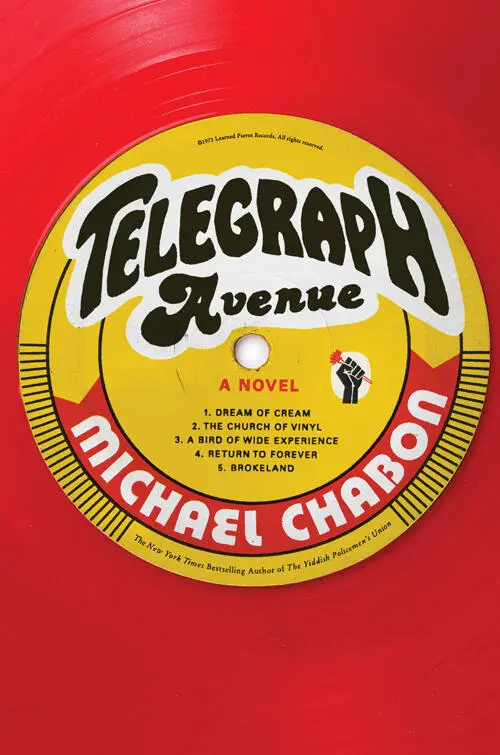
- Название:Telegraph Avenue
- Автор:
- Издательство:Harper
- Жанр:
- Год:2012
- Город:New York
- ISBN:978-0-06-149334-8
- Рейтинг книги:3.5 / 5. Голосов: 2
-
Избранное:Добавить в избранное
- Отзывы:
-
Ваша оценка:
Telegraph Avenue: краткое содержание, описание и аннотация
Предлагаем к чтению аннотацию, описание, краткое содержание или предисловие (зависит от того, что написал сам автор книги «Telegraph Avenue»). Если вы не нашли необходимую информацию о книге — напишите в комментариях, мы постараемся отыскать её.
When ex–NFL quarterback Gibson Goode, the fifth-richest black man in America, announces plans to build his latest Dogpile megastore on a nearby stretch of Telegraph Avenue, Nat and Archy fear it means certain doom for their vulnerable little enterprise. Meanwhile, Aviva and Gwen also find themselves caught up in a battle for their professional existence, one that tests the limits of their friendship. Adding another layer of complication to the couples’ already tangled lives is the surprise appearance of Titus Joyner, the teenage son Archy has never acknowledged and the love of fifteen-year-old Julius Jaffe’s life.
An intimate epic, a NorCal
set to the funky beat of classic vinyl soul-jazz and pulsing with a virtuosic, pyrotechnical style all its own,
is the great American novel we’ve been waiting for. Generous, imaginative, funny, moving, thrilling, humane, triumphant, it is Michael Chabon’s most dazzling book yet.
Telegraph Avenue — читать онлайн ознакомительный отрывок
Ниже представлен текст книги, разбитый по страницам. Система сохранения места последней прочитанной страницы, позволяет с удобством читать онлайн бесплатно книгу «Telegraph Avenue», без необходимости каждый раз заново искать на чём Вы остановились. Поставьте закладку, и сможете в любой момент перейти на страницу, на которой закончили чтение.
Интервал:
Закладка:
“You see those?” said Mr. Singh as they followed the Toronado down a broad avenue that cut across the former site, according to a historical marker at the old entry gate (tagged with an orc-ish graffiti rune), of the Oakland Naval Depot. Immense railway buildings of concrete and gray stucco awaited damnation on the east side of the avenue. Along the harbor side, a fence of steel unscrolled in woven sheets, topped with razor wire, beyond which the steel cavalry readied its attack. “The big metal things, some people say they are looking like horses?”
“George Lucas,” Julie predicted under his breath. “AT-ATs.”
“You know in Star Wars ?” Mr. Singh said. “Those big walking things. Big walking robots.”
“AT-ATs,” Julie said. “In the snow.” He knew that his father, were he present, would feel compelled to point out that this was an urban myth of the East Bay, like the claim that the name itself had been bestowed upon the region by a pioneering coven of Satanists who spoke pig latin. It was very difficult for Julie, committed as he was to being like his father in no respect or particular, to resist the temptation to correct Mr. Singh.
Titus didn’t say anything. He just kept watching the back of the Toronado, the same way he watched the back of Valletta Moore’s head on the bus.
“Exactly! And there! Look at them! You see? George Lucas used very often to drive, you know, back and forth across the Bay Bridge, from what I have been told, he came originally from Stockton or Fresno.”
“Modesto,” Julie said.
“Modesto, still worse. Driving up to San Francisco as a young man to drink espresso coffee and experience French cinema, then returning in the small hours of the night to Modesto, which is a real armpit, I am attesting personally to that. And this, you see, was the inspiration for the AT-AT walking machines of the Star Wars films.”
“Cool,” Titus said, taking his eyes off the Toronado long enough to relive those giant legs astride the ice of Hoth, those darting starfighters trailing cable from their spinnerets. “Hold, hold up.”
They had come to a stretch of old rail yard where the buildings had been maintained and even renewed. In the trackless void of concrete, a number of metal sheds and depots huddled together around one immense train barn, like a feudal stronghold. A totem pole of signs advertised the services of welders, makers of specialty furniture, tool cutters, fiberglass fabricators and, at the foot of the pole, Motor City Auto Body and Custom Jobs. As the Toronado rolled, popping gravel, into the commons and slowed, its fits and spasms increased. It executed a kind of drunken rumba toward one of three open bay doors in the front of Motor City Auto Body, heaved itself halfway into the bay, and then, with one final shake of its castanets, died. The Toronado’s driver got out, and the shadow of Valletta Moore slid across the front bench to take the wheel.
He wore a Raiders jersey, number 78 with the name SHELL across the shoulders. Kung fu pants, some kind of sandals or leather flip-flops. He was carrying a long billy club, a kung fu bo —no, it was a walking stick—twirling it like an old-school beat cop.
“Okay. I am now leaving,” Mr. Singh announced as Stallings emerged from the car swinging his truncheon thing. “And I am taking you with me, no charge.”
Stallings did not look in their direction or appear to notice the taxicab at all. He came around the back of the spavined Toronado and studied its trunk for an instant. Then he raised the walking stick, reared back on his long scarecrow shanks, and gently thrust the stick against the circular keyhole in the lid of the trunk. He bent one knee, gave his wrist a twist, and either by means of qi or pure panache—should there prove any difference—gave the Toronado a baby push. It rocked back, then surged forward and rolled the rest of the way into the body shop. With Blofeldian alacrity, a steel door rolled down behind it. Luther Stallings stood studying the sealed steel door as though it allegorized something. Then he whipped around and pointed the end of his cane at the Crown Victoria.
“Ho, shit,” Titus said.
Mr. Singh and Julie came to rapid agreement on the advisability of their turning around now and driving as far as Mr. Singh felt twenty-one dollars would go.
Before Mr. Singh could put the car in drive, Titus got out. He took from his shirt pocket a small number of bills folded tight with origami precision. It might have been a packet containing some kind of sterilized pad. He unpleated a twenty and handed it, halfway to a peace crane, to Mr. Singh. “I got this,” he said.
Julie climbed out of the taxi. Titus had never paid for anything before.
“Here is my card,” Mr. Singh said, passing an oblong imprinted with his name, his contact information, and the surprising avocation of PUNJABI CHEF.
“Okay,” Julie said, too awed or afraid or embarrassed to mention that while he traveled with a portable eight-track player, he did not own a cell phone. “Thanks.”
He reached into his Johnny Depp wallet and pulled out one of his business cards at random and had already handed it to Mr. Singh before he noticed it was the one that read:
This was a word he had encountered in the pornographic Victorian novels kept by his mother in a shoebox in her closet, among the ordinary shoeboxes. It was less pragmatic though no less hopeful a declaration of calling than Mr. Singh’s. The Punjabi chef eyed the card, then glanced over at Luther Stallings. Leaning on the cane, Stallings had begun slowly to walk in the general direction, without any set goal, of Titus. Mr. Singh’s mustache did a slow hula over his pursed lips as he contemplated Julie’s card. Then, with a number of backward looks, Mr. Singh turned his taxicab around and drove away.
The libertine without portfolio came up alongside his friend, who had fallen, perhaps helplessly, into an arrant imitation of his grandfather’s trademark gait, intensified by whatever injury or infirmity required the use of a cane, so accurate it verged on mockery. Stallings angled his head to one side, sizing Titus up; Titus hitched his to the same inquisitive angle. Neither of them appeared to notice that Titus was running a Harpo Marx on Stallings.
“Huh,” Stallings said, and Titus duly said, “Huh.”
Stallings’s hair was densely threaded with ashy gray. There was a good deal less flesh on him than in his heyday. His teeth had not done well; some were lost. Otherwise he seemed okay, not obviously fucked up or sick, and if he was not looking quite so fine as his former costar, he was in far better shape than his Oldsmobile; a state fairly close, all in all, to the original, right down to the chill twinkle in the conman eye. The shoes on his sockless feet were not sandals, Julie saw, or flip-flops, but Chinese cloth slippers, the kind sold out of tubs in Chinatown for five dollars a pair. The kung fu pants had the sheen of doll pajamas or a cheap Halloween costume. Without taking his eyes off Titus, he raised the outstretched walking stick. Leveled it, in a broad sweep, at Julie, the tip of it unwavering, locked as though dowsing at Julie’s soul, a move right out of Witchfinder General . Julie found himself blushing deeply, as if his pockets held henbane and mandragora.
“Who’s the white boy?” Stallings asked Titus.
Julie did not catch the reply, it was tendered so softly.
“It’s who ?” Stallings said. Not angry, not impatient, not unwilling yet to suffer fools or boys who muttered, but ready to go in any of these directions if need be.
“My friend ,” Titus said loudly, ashamed.
Stallings lowered the cane and checked Julie out, once vertically, once horizontally, the process leaving him unconvinced if not outright skeptical. “Your ‘friend,’” he said, as if Titus had claimed that Julie was his invisible potato or his talking blue ankylosaurus.
Читать дальшеИнтервал:
Закладка:
Похожие книги на «Telegraph Avenue»
Представляем Вашему вниманию похожие книги на «Telegraph Avenue» списком для выбора. Мы отобрали схожую по названию и смыслу литературу в надежде предоставить читателям больше вариантов отыскать новые, интересные, ещё непрочитанные произведения.




Обсуждение, отзывы о книге «Telegraph Avenue» и просто собственные мнения читателей. Оставьте ваши комментарии, напишите, что Вы думаете о произведении, его смысле или главных героях. Укажите что конкретно понравилось, а что нет, и почему Вы так считаете.