Michael Chabon - Telegraph Avenue
Здесь есть возможность читать онлайн «Michael Chabon - Telegraph Avenue» — ознакомительный отрывок электронной книги совершенно бесплатно, а после прочтения отрывка купить полную версию. В некоторых случаях можно слушать аудио, скачать через торрент в формате fb2 и присутствует краткое содержание. Город: New York, Год выпуска: 2012, ISBN: 2012, Издательство: Harper, Жанр: Современная проза, на английском языке. Описание произведения, (предисловие) а так же отзывы посетителей доступны на портале библиотеки ЛибКат.
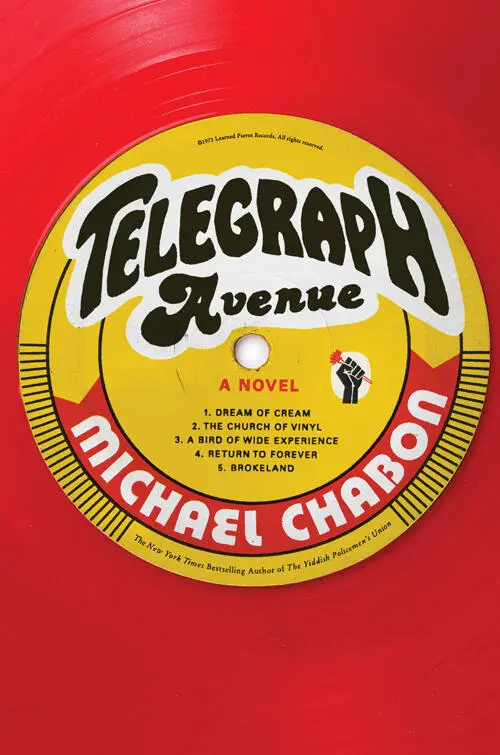
- Название:Telegraph Avenue
- Автор:
- Издательство:Harper
- Жанр:
- Год:2012
- Город:New York
- ISBN:978-0-06-149334-8
- Рейтинг книги:3.5 / 5. Голосов: 2
-
Избранное:Добавить в избранное
- Отзывы:
-
Ваша оценка:
Telegraph Avenue: краткое содержание, описание и аннотация
Предлагаем к чтению аннотацию, описание, краткое содержание или предисловие (зависит от того, что написал сам автор книги «Telegraph Avenue»). Если вы не нашли необходимую информацию о книге — напишите в комментариях, мы постараемся отыскать её.
When ex–NFL quarterback Gibson Goode, the fifth-richest black man in America, announces plans to build his latest Dogpile megastore on a nearby stretch of Telegraph Avenue, Nat and Archy fear it means certain doom for their vulnerable little enterprise. Meanwhile, Aviva and Gwen also find themselves caught up in a battle for their professional existence, one that tests the limits of their friendship. Adding another layer of complication to the couples’ already tangled lives is the surprise appearance of Titus Joyner, the teenage son Archy has never acknowledged and the love of fifteen-year-old Julius Jaffe’s life.
An intimate epic, a NorCal
set to the funky beat of classic vinyl soul-jazz and pulsing with a virtuosic, pyrotechnical style all its own,
is the great American novel we’ve been waiting for. Generous, imaginative, funny, moving, thrilling, humane, triumphant, it is Michael Chabon’s most dazzling book yet.
Telegraph Avenue — читать онлайн ознакомительный отрывок
Ниже представлен текст книги, разбитый по страницам. Система сохранения места последней прочитанной страницы, позволяет с удобством читать онлайн бесплатно книгу «Telegraph Avenue», без необходимости каждый раз заново искать на чём Вы остановились. Поставьте закладку, и сможете в любой момент перейти на страницу, на которой закончили чтение.
Интервал:
Закладка:
The discourse had been riding this particular local for most of the past fifteen, twenty minutes, The Secret History of the Black Man in California According to Luther Stallings , the old man backing up his claims with cites and quotes drawn from irrefutable authorities whose names always seemed to be on the verge of being divulged or else, when spoken aloud, meant nothing to Titus. Claim Number One, front and center, being something along the lines of how, when you tunneled deep, the way the old man had done during the long years of his exile, going way on down into the mines of knowledge, Oakland was literally the Land of Dreams. After that, well, between the growling and barking of the air compressor, the ceaselessness of the trash being talked by the Motor City crew, the sight of what appeared to be the right (i.e., Robin-side) door of the Batmobile from the old-school TV show hanging hooked like a side of beef in the far corner of the garage, and the undersea world whose gates parted every time Valletta Moore bent over to French the tip of another fingernail, frankly, Titus did not follow it too closely, though he understood and even felt prepared to endorse the view that the Secret History of the Black Man in California truly was all tied up with the sleep and sleeplessness, the insomnia and dreams of the white man. Because, because, hmm, something about how white folks back in the day, needing to catch their beauty sleep as they traveled west subjugating and conquering, turned to a man named Pullman. And this one white dude, Joe, no, George Pullman, turned right around and, not out of any kind of wanting to do the right thing but only because he was cheap and needed an instant pool of skilled but low-pay servants, started hiring up free black men of the time and setting them to work tending to the slumber of white people. Punctuated by grunts that at times seemed to elide or bleep out the parts of what he was saying that would help it make some kind of sense, the old man evoked the nightly scene, vigilant black men studying the sonorous nocturnal rumblings of wealthy sleepers in the sleeper cars, dreamers rocking through the great western darkness toward the land of sunset, the far shore of the American Dream, which for reasons no doubt made clear during a particularly loud grunt, was all because the word “America” was actually a broken-down version of “Amenthe-Ra,” the Land of the West in Ancient Egypt, where you went when you died, though not in a train, of course, but in a boat, a westbound boat like those that had freighted the sorrows of the Pullman porters’ African ancestors, even though to the ancient Egyptians, the death journey to Amenthe-Ra was only a kind of sleep, in fact a dream—not Dream as in “I Have a Dream” but, rather, the strange journey taken every night by the sleeping human brain, although, as an aside, the connections were interesting, you had to wonder why Dr. King, whose father was a Prince Hall Mason, had chosen to couch his message using a term so central to the Secret History of Black Men in California, the language of the Pullman porter, raised up and set to rights and liberated while the white man was literally asleep.
“The freest black men that ever lived,” Luther Stallings told the boys, “but it was like a kind of secret freedom.”
He described the Pullman porters in terms that conjured up giant sleek-haired warriors of the night, armored in smiles, how they went from place to place, all these little backwoods, boondocks towns, seeing the world, carrying like undercover spies, hidden about their persons, all the news of the clandestine world of black America, the latest records, gossip, magazines, hairstyles, spreading the lore and the styles across the country, to every place where black people lived, and most of all singing the song of California, to be specific the city of Oakland, where Pullman porters got off the trains to rest on their sunset couches in the houses they bought with the money they wrestled loose from Mr. George Pullman, houses in which they built up families that sent children and grandchildren to college and trade school and eventually to the United States Congress, then getting back onto the trains in the morning to ride south and east, spreading the news of their own prosperity, so that by the time World War II blew up, Oakland was the Hollywood of middle-class black aspiration, except that unlike in Hollywood, once you got to Oakland, you actually stood a chance of making good.
“Hollywood,” Titus said, feeling like he was expected to say something. “Well, all right.”
The Secret History came off kind of boring in its particulars, truthfully, built on events and details and historical phenomena whose obscurity to Titus only deepened as his grandfather strung them together: strikes and black labor unions, bourgeoisie and Seventh Street nightclubs, shipyards, the Klan marching down Broadway in broad daylight as white Oakland lined the streets cheering, and yet the arc of the narrative, the sense of sweep across time and territory, stirred, in Titus’s mind, a sense of revelation.
“That was the real underground railroad, a railroad underneath, inside another railroad. And this here was the terminus. This building you in, it was a train barn. You see that line there in the cement, crack like a big circle going all the way around? That’s where the turntable is. Big old concrete turntable, spinning the music of dreams.”
The old man seemed to have concluded his remarks. He sat up, winded, shining from his hairline to his shins.
“Only it don’t turn no more,” Eddie said.
Luther Stallings looked from Titus to Julie and back, wanting to know what they thought, how they were handling it, what they were going to do with their little minds now that they had been blown.
Julie glanced at Eddie. “Is that from the real Batmobile?” he said.
Valletta Moore said, “Huh.” She shook her head. “Luther, they are not listening to you.” She was tucking little foam spacers between the fingers of her left hand. “Nobody is listening to you.”
“Man should have got a Oscar,” Eddie said. “Always playing the silent type.”
He and Valletta Moore fell out laughing.
“ I’m listening,” Titus said, trying not to sound contradictory, since contradicting Valletta Moore was painful to him and, in the movies of hers that he had seen, occasionally dangerous.
“All right,” Luther said, firing off a scowl at his old lady, then giving Eddie the other barrel, mopping his face with a ragged but clean square of polishing cloth. “There you go. Now,” he told Titus, “boy, what you got to do, if you want to absorb knowledge, you have to ask questions. So go on. Go ahead.”
Titus understood that he was meant to build off the lecture just completed, but that understanding was unable to outrun the natural impulse of his true curiosity. He knew he should ask a question about Egyptian funeral traditions and Prince Hall Freemasons, but to his dismay, he heard himself saying, “Why you have to live in a garage?”
Another laugh arose irresistibly from the neighborhood of Eddie Cantor, a repressed, apologetic series of semi-coughs. This time Valletta Moore contented herself with studying her own reflection in the clear-coat shimmer of her left index fingernail and muttering a few words to herself in a parody of a stage whisper, hard to make out, something along the lines of Oh, now, I want to hear this.
The old man sat, long arms hugging knees to chest. He pursed his lips and gave his head a slight shake, leading with his jaw. Closed his eyes, opened them again. For what felt like a long time, he said nothing. Titus began to regret the question, particularly when he saw a brief upwelling in the old man’s eyes, though it passed without a tear having been permitted to fall. Titus was on the verge of withdrawing the question and shifting about for a replacement when his grandfather said, “I did some stupid shit in my life. That is the truth.”
Читать дальшеИнтервал:
Закладка:
Похожие книги на «Telegraph Avenue»
Представляем Вашему вниманию похожие книги на «Telegraph Avenue» списком для выбора. Мы отобрали схожую по названию и смыслу литературу в надежде предоставить читателям больше вариантов отыскать новые, интересные, ещё непрочитанные произведения.







Обсуждение, отзывы о книге «Telegraph Avenue» и просто собственные мнения читателей. Оставьте ваши комментарии, напишите, что Вы думаете о произведении, его смысле или главных героях. Укажите что конкретно понравилось, а что нет, и почему Вы так считаете.