Michael Chabon - Telegraph Avenue
Здесь есть возможность читать онлайн «Michael Chabon - Telegraph Avenue» — ознакомительный отрывок электронной книги совершенно бесплатно, а после прочтения отрывка купить полную версию. В некоторых случаях можно слушать аудио, скачать через торрент в формате fb2 и присутствует краткое содержание. Город: New York, Год выпуска: 2012, ISBN: 2012, Издательство: Harper, Жанр: Современная проза, на английском языке. Описание произведения, (предисловие) а так же отзывы посетителей доступны на портале библиотеки ЛибКат.
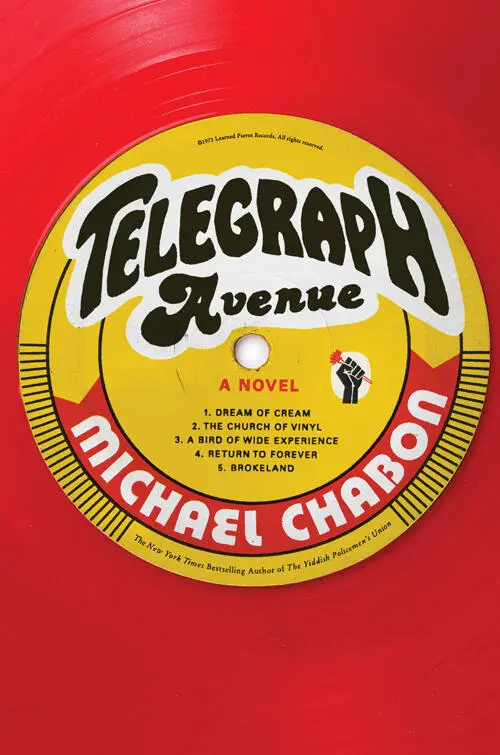
- Название:Telegraph Avenue
- Автор:
- Издательство:Harper
- Жанр:
- Год:2012
- Город:New York
- ISBN:978-0-06-149334-8
- Рейтинг книги:3.5 / 5. Голосов: 2
-
Избранное:Добавить в избранное
- Отзывы:
-
Ваша оценка:
Telegraph Avenue: краткое содержание, описание и аннотация
Предлагаем к чтению аннотацию, описание, краткое содержание или предисловие (зависит от того, что написал сам автор книги «Telegraph Avenue»). Если вы не нашли необходимую информацию о книге — напишите в комментариях, мы постараемся отыскать её.
When ex–NFL quarterback Gibson Goode, the fifth-richest black man in America, announces plans to build his latest Dogpile megastore on a nearby stretch of Telegraph Avenue, Nat and Archy fear it means certain doom for their vulnerable little enterprise. Meanwhile, Aviva and Gwen also find themselves caught up in a battle for their professional existence, one that tests the limits of their friendship. Adding another layer of complication to the couples’ already tangled lives is the surprise appearance of Titus Joyner, the teenage son Archy has never acknowledged and the love of fifteen-year-old Julius Jaffe’s life.
An intimate epic, a NorCal
set to the funky beat of classic vinyl soul-jazz and pulsing with a virtuosic, pyrotechnical style all its own,
is the great American novel we’ve been waiting for. Generous, imaginative, funny, moving, thrilling, humane, triumphant, it is Michael Chabon’s most dazzling book yet.
Telegraph Avenue — читать онлайн ознакомительный отрывок
Ниже представлен текст книги, разбитый по страницам. Система сохранения места последней прочитанной страницы, позволяет с удобством читать онлайн бесплатно книгу «Telegraph Avenue», без необходимости каждый раз заново искать на чём Вы остановились. Поставьте закладку, и сможете в любой момент перейти на страницу, на которой закончили чтение.
Интервал:
Закладка:
Titus glanced at Julie, whose face grew solemn and knowing, a touch pious. “Drugs,” Julie said.
“Even stupider shit than drugs,” the old man said. “And that’s saying a lot, y’all can take my word. But I’m clean and sober, thirteen months, one week, and two days. I have my shit together. I officially have a movie in the active stages of preproduction—”
Valletta Moore pronounced another observation whose syllables hovered just that side of audible. She was like the magic harp from that Disney movie The Black Cauldron , popping a string every time the harp-playing dude, the bard, came up with some new exaggeration of his exploits or abilities.
“Strutter 3?” Titus said.
“You guessed it. But uh, something of that nature, independent type of venture, operating on the kind of small nonstudio level that Stallings Productions operating at, you have to, look here, sometimes you need to get a little creative in your financing. That’s why, to try to answer your question, wasn’t exactly the question I was expecting, but uh, I came up with a way to, uh, make one of those stupid things I did a long time ago, way to turn it around a little bit. Hook up to a major player in the industry.”
“Or so you thought,” said Valletta Moore.
“Goddammit, Valletta—”
“Thinking you could shake down that—”
The old man was up and on his feet like an umbrella opening. In the passage of another half second, he had organized his arms and legs according to a logic more direct than whatever had guided his verbal teaching. There was an impression of wind and gyration contained within a modest ambit, like the procedures of the Tasmanian Devil in cartoons, and then, as with the push given to the back of the Toronado by the tip of his walking stick, it all came down to the point of his left foot, one square inch of contact. The steel drum pitched over, resounding against the cement floor with a Chinese-gong finality. All of Valletta’s little bottles and implements went flying. Over in the bay, the hydraulic pump cut off with a gasp.
“Uh?” Julie said to Valletta Moore. “You okay?”
They were the first words he had directed toward her since the minute they walked into the garage.
“Oh, I’m fine, honey,” Valletta said, all cheerful. She crept around on her hands and knees, trying to put things right, checking bottles for cracks and spills. “Thank you.”
“Well, I better go check on those yo-yos,” Eddie said.
The fighting fish flitted back and forth behind the panes of their aquarium as Eddie surveyed the mess he had permitted in his otherwise spotless body shop, looking like his reasons for having permitted it were no longer apparent to him. Figure his eyes must be trained by now to gauge possibilities for recovery, salvation, hidden in the ruin of a once fine machine. Titus tried to read those eyes for signs of hope, but Eddie was looking at him; Julie; him.
“You boys need a ride anywheres?”
“Uh, well—”
Julie got to his feet, hugging himself, used to hanging with the kind of people who talked it out, shared their feelings, everybody circling up like Care Bears for a big hug when it was through, nobody kicking shit over, spattering the walls and floor with bloody nail polish.
Luther Stallings reached for his walking stick and leaned on it with both hands, watching his grandson but not giving any indication of what he wanted Titus to do or to say.
“We’re fine,” Titus said.
Eddie nodded and, yelling in a contemptuous dialect of Spanglish, went over to critique the efforts of his crew. Luther’s stick banged against the concrete floor as he padded in his Bruce Lee slippers across the stained seas and continents that mapped it, toward the Toronado in the nearest bay. He reached in through the driver’s window to take the keys from the ignition, then went around to the back and popped the trunk. He took a plastic bin with two lids that interfolded out of the trunk, huffed it over to one of the workbenches. He looked at Titus.
“Thought your ass wanted to see my movie,” he said.
She would do what she had to do; staying fly, alas, might not be an option. It implied the sustainment of a metaphysical state from which Gwen, a house on a rain-swollen hillside, had long since slid. But she gave it her best shot, determined to quit sneaking around, put an end to the hiding, all the craven marital and professional ninjutsu. To come on as straight and strong and brazen as Candygirl Clark, unreachable as that aspiration might remain to a woman in her thirty-seventh week who had spent the past three days with a suitcase for a wardrobe and a foam pad for a bed.
With three hours to go before the showdown at Chimes, Gwen drove through the tunnel to the Land of the White People. Her BMW faded incrementally into the local autosphere as the freeway stretched and flexed for its run toward the Sierra foothills. Shadows sharpened, and the afternoon took on a desert shimmer. Sprinklers chittered. Titleists traced white rainbows against the blue Contra Costa sky. Along the forearms of hard-shopping women in tennis skirts, sunshine lit the golden down.
At A Pea in the Pod, Gwen consigned her cubiformity to a simple A-line dress of stretchy gray jersey with a matching gray blazer. The jacket came with shoulder pads that lent her an uncomfortable resemblance to the flight deck of an aircraft carrier. Because it rode up so high on her belly, the dress appeared to hang down at the back a good three or four inches in a kind of impromptu train. She would spend the rest of the day tugging her dress down at the front like a half-bold teenage girl in a micromini.
Up at the cash register, she asked for a pair of scissors to cut out the shoulder pads, which, given the shock on the face of the downy golden salesgirl as Gwen vandalized a dress on which she had dropped $175, felt like kind of a kick-ass thing to do. Then it was on to the Easy Spirit store, where, employing a pair of vanadium tongs and a portable blast shield, she consigned her depleted espadrilles to a trained hazmat team and walked out in a stolid gray pair of modified Mary Janes. They had the charm of cement and the elegance of cinderblocks, but they held her feet without pain or structural failure, and it seemed to her that the librarian-nun vibe they exuded was also not incompatible with the kicking of ass.
Thus equipped, she returned through the Caldecott Transdimensional Portal to Oakland, to submit her hair to the subtle if not silent artistry of Tyneece Fuqua at Glama. To meet Gwen’s hair emergency, Tyneece had been obliged—she explained in irritable detail—to reschedule a telephone consultation with a psychic in Makawao, Hawaii, a woman who, during their prior phone session, had come close to locating the two bars of looted Reich gold that Tyneece’s great-grandfather had brought home from the war and buried, it was said, in one of three backyards belonging to three different Oakland women who were the mothers of his nineteen children. While she lectured Gwen on the intricacies of Nazi gold registration numbers and of her abundant and goldless cousinage, Tyneece serviced Gwen’s worn-out locks, picking out slackers, stragglers, and lost souls, then twisting them tight, as if winding the very mainsprings of Gwen’s resolve. She massaged Gwen’s scalp, neck, and shoulders and put the new girl on Gwen’s sore feet. Finally, having done what she could, she called in Mr. Robert, whom she had sent for as soon as she learned what Gwen was up against today.
Mr. Robert came in wheeling a scuffed pink plastic art box on an airline-stewardess luggage trolley. He was a dapper little gentleman in green plaid pants, a short-sleeve lime turtleneck, and zip-up white ankle boots, with Sammy Davis hair. Nowadays he mostly worked weddings, proms, and the odd quinceañera, but at one time he had been the go-to Hollywood black makeup man, relied upon by an entire vanished generation of television actresses, from Diahann Carroll to Roxie Roker, to combat the visual and technical biases of white cameramen and lighting directors. After a few seconds of intense scrutiny, Mr. Robert shrugged and looked confused.
Читать дальшеИнтервал:
Закладка:
Похожие книги на «Telegraph Avenue»
Представляем Вашему вниманию похожие книги на «Telegraph Avenue» списком для выбора. Мы отобрали схожую по названию и смыслу литературу в надежде предоставить читателям больше вариантов отыскать новые, интересные, ещё непрочитанные произведения.









Обсуждение, отзывы о книге «Telegraph Avenue» и просто собственные мнения читателей. Оставьте ваши комментарии, напишите, что Вы думаете о произведении, его смысле или главных героях. Укажите что конкретно понравилось, а что нет, и почему Вы так считаете.