Michael Chabon - Telegraph Avenue
Здесь есть возможность читать онлайн «Michael Chabon - Telegraph Avenue» — ознакомительный отрывок электронной книги совершенно бесплатно, а после прочтения отрывка купить полную версию. В некоторых случаях можно слушать аудио, скачать через торрент в формате fb2 и присутствует краткое содержание. Город: New York, Год выпуска: 2012, ISBN: 2012, Издательство: Harper, Жанр: Современная проза, на английском языке. Описание произведения, (предисловие) а так же отзывы посетителей доступны на портале библиотеки ЛибКат.
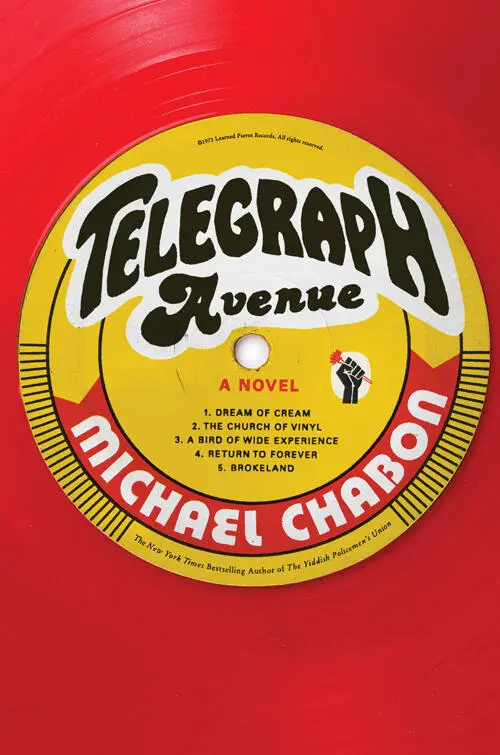
- Название:Telegraph Avenue
- Автор:
- Издательство:Harper
- Жанр:
- Год:2012
- Город:New York
- ISBN:978-0-06-149334-8
- Рейтинг книги:3.5 / 5. Голосов: 2
-
Избранное:Добавить в избранное
- Отзывы:
-
Ваша оценка:
Telegraph Avenue: краткое содержание, описание и аннотация
Предлагаем к чтению аннотацию, описание, краткое содержание или предисловие (зависит от того, что написал сам автор книги «Telegraph Avenue»). Если вы не нашли необходимую информацию о книге — напишите в комментариях, мы постараемся отыскать её.
When ex–NFL quarterback Gibson Goode, the fifth-richest black man in America, announces plans to build his latest Dogpile megastore on a nearby stretch of Telegraph Avenue, Nat and Archy fear it means certain doom for their vulnerable little enterprise. Meanwhile, Aviva and Gwen also find themselves caught up in a battle for their professional existence, one that tests the limits of their friendship. Adding another layer of complication to the couples’ already tangled lives is the surprise appearance of Titus Joyner, the teenage son Archy has never acknowledged and the love of fifteen-year-old Julius Jaffe’s life.
An intimate epic, a NorCal
set to the funky beat of classic vinyl soul-jazz and pulsing with a virtuosic, pyrotechnical style all its own,
is the great American novel we’ve been waiting for. Generous, imaginative, funny, moving, thrilling, humane, triumphant, it is Michael Chabon’s most dazzling book yet.
Telegraph Avenue — читать онлайн ознакомительный отрывок
Ниже представлен текст книги, разбитый по страницам. Система сохранения места последней прочитанной страницы, позволяет с удобством читать онлайн бесплатно книгу «Telegraph Avenue», без необходимости каждый раз заново искать на чём Вы остановились. Поставьте закладку, и сможете в любой момент перейти на страницу, на которой закончили чтение.
Интервал:
Закладка:
He glanced at the stenographer as if considering whether he ought to ask her to strike or let him rephrase his rhetorical question.
“Belligerent, aggressive, maybe,” said Dr. Soleymanzadeh, a handsome, hawk-faced man with preposterously beautiful brown eyes. He flipped through Lazar’s statement on the table before him, two double-spaced pages more or less free of specific detail or, for that matter, readerly interest. All of it heavily distorted but, in essence, Gwen supposed, true. “Threatening, I’m having a hard time, Paul.”
“That’s the heart of the matter, isn’t it?” said Dr. Leery, an old guy, the sweetest and least competent of the doctors in the room. “Aggressivity, belligerence, it’s hard to know whether—”
“You say Ms. Shanks threatened you,” Bernstein said, “but in your account, Paul, I can’t really say I—”
“Not physically, okay.”
“But she did threaten you.”
“I guess it was more like she menaced me.”
Gwen could feel Aviva and Moby watching her, waiting for her to interrupt, to deny, to argue. But she had not come here to argue with these motherfuckers. She waited, looking for her chance.
“Okay,” Bernstein said. “That’s sounding pretty much like a semantic shading to me. Could you, could we get you to possibly be more specific?”
It was weird; Lazar seemed abruptly to lose all interest in the proceedings that he had instigated. He sat under the humming CFL lights, looking wearier and more dead-eyed than ever. He shrugged, utterly bored by himself and all of them. “She got in my face,” he said, as if definitively, and though they waited for him to continue—even Gwen found herself perversely hoping for more—he seemed to have arrived at his conclusion.
Bernstein turned to Gwen. “Ms. Shanks, would you like to respond?”
Gwen made a show of checking with her attorney, who sat up straighter in his chair, mildly panicked. Patting his mental pockets as if he had left his wallet on some bus. His eyes reminding her, Silent and badass. Then, slowly, seeing she expected it, he nodded. Gwen rose as if obediently to her feet, knowing what she had to do and, worse, knowing how to do it, telling herself that it needed to be done.
“Thank you, Dr. Bernstein,” Gwen said. “Yes, I would like to respond. Dr. Leery, Dr. Soleymanzadeh, I’m not going to lie. I was very angry at the time. I’m sure that I was standing pretty close to the man, maybe even ‘in his face.’ But look at me.”
She stood up and completed one languid rotation on her own axis, reveling in her bulk. “First of all, I’d like to point out, I could plant my feet as appropriately far away from Dr. Lazar as he might want me to get. Large tracts of me would still be ‘ in his face.’” A string of laughter cinched up the doctors; even the grim stenographer parted instantaneously with a smile. “Second,” Gwen went on, “do I look dangerous to you? Menacing?” No need, at this juncture, to go into her black belt, how, if she wanted to, even giving up a foot of height to Lazar and with all the litheness of a sandbag, she could snap any bone in the OB’s body. She glanced at Moby, the big man loving it, nodding, jowls shaking, as proud as if he had coached her every step of the way. “All that aside, fine, let’s give it to him. Let me concede his point.” Moby stopped nodding. “Aggressive. Belligerent. Menacing .” Old Moby wishing he had stuck to orcas. “Like I said, I was angry. Doctors, I had a right to be angry. I had just been subjected to the kind of vile, ugly treatment by that man, Paul Lazar, that I know, I would like to hope, would have made you angry, too.” She kept her gaze steady on the faces of the three inquisitors, fearing that if she glanced at Aviva, she might lose her nerve. “This man, Paul Lazar—I know you don’t want to hear this. And I didn’t want to tell you. I didn’t want to tell anyone, not even my lawyer, because I knew that if I did, he would advise me to file a complaint with the EEOC. But I can’t just stand by in the end and let the man get away with it. Not when he is guilty of the worst kind of racist—”
“Ho,” Lazar said. “Whoa, hold on—”
“The worst kind of derogatory racial remarks.”
“Oh, come on , lady.”
“He made a crack about my hair. About black people’s hair, about processed hair.”
“I…”
The memory, then; a pinprick, the air whistling out of him, while understanding, troubled and shifty-eyed, flowed into the faces of Leery, Bernstein, and Soleymanzadeh. Seeped like the stain from a teabag darkening a cup of hot water. Gwen turned to Aviva, daring her partner to back her up or back away. The doctors—Lazar, too—turned to see what she would say, Aviva Roth-Jaffe, the Alice Waters of midwives, the rock upon which modern East Bay midwifery had been founded.
Aviva looked shocked; as shocked as Aviva ever looked. She hesitated for a long second, her full lips flatlined with unhappiness. Finally, she nodded. “That is true,” she said.
“He called me a witch doctor.”
“I never said that!”
“He accused me of practicing voodoo.”
“Ary, that’s not true,” Lazar said to Bernstein. Awake now, alive, working as much truthfulness into his voice as he could, more than was compatible with telling the truth. “I didn’t mean—”
“There was a waiting room full of witnesses,” Gwen said. “They all heard what you said. These people checked in with the intake clerk, I’m sure they can be tracked down. They’ll all verify it. You said, ‘Five more minutes of burning that incense, or whatever voodoo you were up to, and that mom doesn’t make it.’”
Lazar opened his mouth as if to protest, then closed it again.
Bernstein turned to Aviva, who shot a look at Gwen, hoping and doubting and most of all, Gwen thought, fearing that her partner knew what she was doing.
“I do remember that,” Aviva said. “I’m not sure those were the exact words, but Dr. Lazar did say something about us practicing voodoo.”
Bernstein looked at Lazar. “Paul?”
“How is voodoo racist?” Lazar said. “I just meant, like, you know, all that bullshit new age aromatherapy crap.”
“If you meant ‘aromatherapy,’” said Moby, going with it, ready to help Gwen press the advantage, “why did you say ‘voodoo’?”
“Why, indeed?” Gwen said.
“Maybe we ought to get general counsel in here,” Moby said.
“I really don’t think—” Bernstein began.
“I wish I had done a better job of controlling my temper,” Gwen said. “I truly do. I have devoted my entire professional life, my entire life period , to maintaining a consistently calm demeanor. I have always fought successfully to rise above. But when people start getting into that kind of rhetoric, that kind of hate speech, I’m sorry—in my view, I have an obligation to stand up to it.”
“We all do,” Moby said.
“Of course,” Bernstein said. “Gwen, nobody expects you to put up with that kind of talk. Paul, I have to say, I’m very surprised by this.”
“I’m sure,” said Leery, “that it was all a big misunderstanding of some kind. A misjudgment.”
“It was the end of his shift,” Soleymanzadeh said. “Clearly, the man was tired.”
Gwen saw that Aviva was chewing on a fingernail, a habit she reviled in herself and had struggled for years to defeat. She looked like she was feeling ill, about to get up and walk out of the room.
“Okay, here’s what I’d like to propose,” Bernstein said. “I’m going to say we review this, in light of what we’ve just heard. Take the matter under advisement for the time being, and—”
Читать дальшеИнтервал:
Закладка:
Похожие книги на «Telegraph Avenue»
Представляем Вашему вниманию похожие книги на «Telegraph Avenue» списком для выбора. Мы отобрали схожую по названию и смыслу литературу в надежде предоставить читателям больше вариантов отыскать новые, интересные, ещё непрочитанные произведения.







Обсуждение, отзывы о книге «Telegraph Avenue» и просто собственные мнения читателей. Оставьте ваши комментарии, напишите, что Вы думаете о произведении, его смысле или главных героях. Укажите что конкретно понравилось, а что нет, и почему Вы так считаете.