Arthur Hailey - Strong Medicine
Здесь есть возможность читать онлайн «Arthur Hailey - Strong Medicine» весь текст электронной книги совершенно бесплатно (целиком полную версию без сокращений). В некоторых случаях можно слушать аудио, скачать через торрент в формате fb2 и присутствует краткое содержание. Жанр: Современная проза, на английском языке. Описание произведения, (предисловие) а так же отзывы посетителей доступны на портале библиотеки ЛибКат.
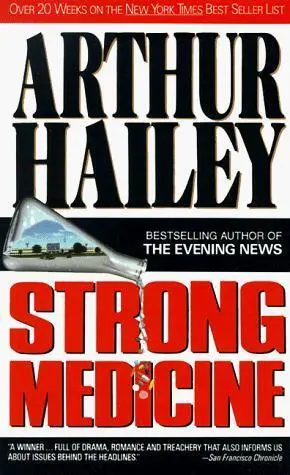
- Название:Strong Medicine
- Автор:
- Жанр:
- Год:неизвестен
- ISBN:нет данных
- Рейтинг книги:5 / 5. Голосов: 1
-
Избранное:Добавить в избранное
- Отзывы:
-
Ваша оценка:
Strong Medicine: краткое содержание, описание и аннотация
Предлагаем к чтению аннотацию, описание, краткое содержание или предисловие (зависит от того, что написал сам автор книги «Strong Medicine»). Если вы не нашли необходимую информацию о книге — напишите в комментариях, мы постараемся отыскать её.
Strong Medicine — читать онлайн бесплатно полную книгу (весь текст) целиком
Ниже представлен текст книги, разбитый по страницам. Система сохранения места последней прочитанной страницы, позволяет с удобством читать онлайн бесплатно книгу «Strong Medicine», без необходимости каждый раз заново искать на чём Вы остановились. Поставьте закладку, и сможете в любой момент перейти на страницу, на которой закончили чтение.
Интервал:
Закладка:
That same someone, aware of which generic company was about to receive approval of an ANDA, could make a lot of money quickly by buying the company's shares low before FDA made the ANDA announcement and selling them high immediately after. Dr. Gideon Mace, inside FDA and privy to confidential information, had done just that. Twice. The proof was in photocopies which Vincent Lord held in his hand. It was all there: -broker's "buy" and "sell" transaction slips on which the customer's name appeared as Marietta Mace. Lord had already learned from Redmond that this was Mace's spinster sister, obviously a stand-in for Mace as a precaution, but one which hadn't worked; -two dated FDA announcements of ANDA approvals affecting generic companies called Binvus Products and Minto Labs. Both names corresponded to shares described on the brokerage slips; -two cancelled checks of Gideon Mace's, payable to his sister and for the exact bottom-line amounts on the two brokerage "buy" ordem, -two bank statements belonging to Gideon R. Mace, showing large deposits shortly after the dates of the "sell" orders. Lord had done a quick penciled calculation on the envelope in front of him. Mace, after his sister had deducted what appeared to be a ten percent commission, had reaped a total net profit of some sixteen thousand dollars. Perhaps more. It was possible that Mace had done something similar, more often-this being something a criminal investigation would reveal. "Criminal" was the operative word. Precisely as Redmond had promised in his original phone call, if Dr. Mace were exposed, he would almost certainly go to jail. Lord had been about to ask Redmond how all the material was obtained, then changed his mind. The answer was not hard to guess. Most likely, Mace had kept everything in his desk at FDA, perhaps believing it to be a safer place than at home. But Redmond, who was clearly resourceful, could have found a way of getting into the desk in Maee's absence. Of course, Redmond must have had suspicions to begin with, but an overheard phone call would have been sufficient to set them off. How could Gideon Mace, Lord wondered, have been so incredibly stupid? Stupid in believing he could do what he had and not be caught. Stupid in trading shares in a name identical with his own, then keeping incriminating papers in a place where someone like Redmond could reach and copy them. But then, clever people often did foolish thing. Lord's thoughts were interrupted by Redmond's voice, petulant. "Well, do you want all that stuff? Do we do business, or don't we?" Without speaking, Lord reached into his jacket for the envelope containing the money and handed it to Redmond. The younger man lifted the envelope flap, which was unsealed. As he withdrew the cash and handled it, his eyes and face lighted with pleasure. "You'd better count it," Lord said. "I don't need to. You wouldn't cheat me. This is too important.”
For some time Lord had been conscious of another young man, seated on a bar stool a few yards distant, who had occasionally glanced their way. Now he looked at them again, and this time Redmond returned the look and smiled, holding up the money before putting it away. The other smiled back. Lord felt a sense of distaste. Redmond said cheerfully, "I guess that's it, then.”
"I just have one question," Vincent Lord told him.”It's something I'm curious about.”
"Ask away.” Lord touched the manila envelope whose contents he had bought.”Why did you do this to Dr. Mace?" Redmond hesitated.”Something he said to me.”
"Like what?" "If you must know," Redmond said, his voice shrill and spiteful, "he called me a lousy fag.”
"What's wrong with that?" Lord said as he rose to go.”You are one, aren't you?" Before leaving the bar, he glanced back. Tony Redmond was glaring after him, his face contorted, white with rage.
For a week Vincent Lord debated within himself what to do, or not to do. He had still not decided when he encountered Sam Hawthorne. "I hear you were in Washington," Sam said.”I presume it had something to do with that money I authorized.”
Lord nodded.”Presumption right.”
"I'm not one for playing games," Sam said.”And if you think you're protecting me, forget it! I've a natural curiosity. I want to know.”
"In that case I need to get some papers from my office safe," Lord told him.”I'll bring them to you.”
A half hour later, when he had finished reading, Sam whistled softly. His face was troubled.”You realize," he told the research director, "that if we don't do something about this immediately, we're accessories to a crime.”
"I suppose so," Lord said.”But whatever we do, if it comes out in the open it will be messy. We'd have to explain how we got those papers. Also, at FDA, no matter who was right or wrong, they'd hate us and never forget.”
"Then why in hell did you get us into this?" Lord answered confidently, "Because what we have here will be useful, and there are ways of handling it.”
Lord was unperturbed; for reasons he was unclear about, he felt at ease in this situation, and in control. He had decided now, within the past few minutes, what was the best course to pursue. He told Sam, "Look, there was a time when I thought something like this would help move Staidpace along, but that problem is behind us. There will be other problems, though, and other drugs, and other NDA's we'll want approved without the unreasonable delay we had with Staidpace.”
Sam said, shocked, "Surely you're not suggesting...”
"I'm not suggesting anything. Except that sooner or later we're certain to come up against Mace again and, if he gives us trouble, we've ammunition we can use. So let's do nothing now, and save it until then.”
Sam was already standing. While considering what had just been said, he moved restlessly around the room. At length he growled, "You may be right. But I don't like it.”
" Neither will Mace," Lord said.”And permit me to remind you that he is the criminal, not us.”
Sam seemed about to say something more, but Lord spoke first.”When the time comes, let me do the dirty work.”
As Sam nodded reluctantly, Lord added silently to himself, I might even enjoy it.
Early in 1975, Celia was again promoted. Her new job was as director of pharmaceutical sales, a post that made her a divisional vice president and positioned her one notch below the vice president for sales and marketing. For anyone who had begun working in sales as a detail person, it was an excellent achievement. For a woman it was extraordinary. But there was one thing Celia noticed nowadays. Within Felding-Roth, the fact that she was a woman no longer seemed to matter. Her sex was taken for granted. She was judged-as she had always wanted to be-on how well she performed. Celia had no illusions that this acceptance held true in a majority of business firms, or for women generally. But it showed, she believed, that a woman's chances of reaching the top echelons of business were growing and would improve still more. As with all social changes, there had to be pioneers, and Celia realized that she was one. However, she still took no part in activist movements, and some of the newcomers to women's rights groups embarrassed her with their stridency and clumsy political pressures. They appeared to view any questioning of their rhetoric--even an honest difference of opinion by a man-as chauvinist. Also apparent was that many such women, without achievements of their own, were using women's activism as substitute careers. Although, in her new job, Celia would have less direct contact with Sam Hawthorne than she'd had for the preceding three years, Sam made it clear that she still had access to him at any time.”If you see something in the company that's important and wrong, or think of something we ought to be doing and aren't, I want to hear about it, Celia," Sam told her during her last day as special assistant to the president. And Lilian Hawthorne, during a pleasant dinner for Celia and Andrew at the Hawthornes' home, had raised a glass and said, "To you, Celia-though selfishly I wish you weren't moving on because you made life easier for Sam, and now I'll worry about him more.”
Читать дальшеИнтервал:
Закладка:
Похожие книги на «Strong Medicine»
Представляем Вашему вниманию похожие книги на «Strong Medicine» списком для выбора. Мы отобрали схожую по названию и смыслу литературу в надежде предоставить читателям больше вариантов отыскать новые, интересные, ещё непрочитанные произведения.










Обсуждение, отзывы о книге «Strong Medicine» и просто собственные мнения читателей. Оставьте ваши комментарии, напишите, что Вы думаете о произведении, его смысле или главных героях. Укажите что конкретно понравилось, а что нет, и почему Вы так считаете.