Arthur Hailey - Strong Medicine
Здесь есть возможность читать онлайн «Arthur Hailey - Strong Medicine» весь текст электронной книги совершенно бесплатно (целиком полную версию без сокращений). В некоторых случаях можно слушать аудио, скачать через торрент в формате fb2 и присутствует краткое содержание. Жанр: Современная проза, на английском языке. Описание произведения, (предисловие) а так же отзывы посетителей доступны на портале библиотеки ЛибКат.
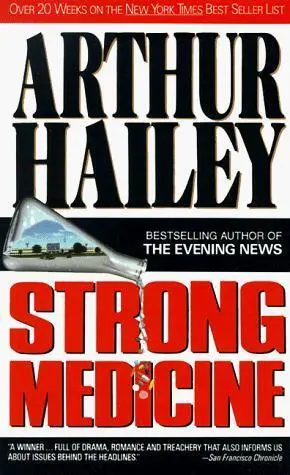
- Название:Strong Medicine
- Автор:
- Жанр:
- Год:неизвестен
- ISBN:нет данных
- Рейтинг книги:5 / 5. Голосов: 1
-
Избранное:Добавить в избранное
- Отзывы:
-
Ваша оценка:
Strong Medicine: краткое содержание, описание и аннотация
Предлагаем к чтению аннотацию, описание, краткое содержание или предисловие (зависит от того, что написал сам автор книги «Strong Medicine»). Если вы не нашли необходимую информацию о книге — напишите в комментариях, мы постараемся отыскать её.
Strong Medicine — читать онлайн бесплатно полную книгу (весь текст) целиком
Ниже представлен текст книги, разбитый по страницам. Система сохранения места последней прочитанной страницы, позволяет с удобством читать онлайн бесплатно книгу «Strong Medicine», без необходимости каждый раз заново искать на чём Вы остановились. Поставьте закладку, и сможете в любой момент перейти на страницу, на которой закончили чтение.
Интервал:
Закладка:
"Well...”
Lord looked surprised, though not displeased.”I hadn't thought of it that way. All I've wanted is to nail that bastard, and have Staidpace approved. But maybe you're right.”
Vincent Lord, reflecting later, supposed that what Sam had said about his being a company man was true. Lord was now in his eighteenth year at Felding-Roth and, even if you didn't expect it to happen, in that length of time certain loyalties built up. Also, nowadays, introspective thoughts about whether he had been right or wrong in leaving academia for industry occupied him less than they once had. Much more of his thinking was directed toward his continuing research on the quenching of free radicals-whenever he could free himself from other responsibilities in the department. The answers Lord sought were still elusive. But he knew they were there. He would never, never give up. And there was a new incentive to his research. That was the company's institute in Britain where Peat-Smith, whom Vincent Lord had not yet met, was concentrating on the mental aging process. It was a competition. Who-Lord or Peat-Smith-would achieve a breakthrough first? It had been a disappointment to Lord when he had not been given authority over Felding-Roth research in Britain as well as in the United States. But Sam Hawthorne had been adamant about that, insisting that "over there" be independent and operate on its own. Well, Lord reasoned, as things had turned out, perhaps that was best after all. From rumors seeping back from Britain, it seemed that Peat-Smith was getting nowhere, had come up against a scientific brick wall. If true, Lord was divorced from any responsibility. Meanwhile, on the American pharmaceutical scene there was much to do. As to Dr. Gideon Mace, the opportunity Vincent Lord had hoped for-to "get" Mace--did arrive eventually, though not soon enough to help Staidpace which, after more delays and quibbling, was at last approved and went on sale in 1974. It was in January 1975, a day after he had returned from Washington, having been there to visit FDA about another matter, that Lord received an unusual telephone call.”There's a man on the phone," his secretary announced, "who won't give his name. But he's persistent and says you'll be glad if you speak to him.”
"Tell him no go to-no, wait!" Curiosity was inbred in Lord.”Put him on.”
Into the phone he said curtly, "Whoever you are, say what you want quickly, or I'll hang up.”
"You've been collecting information about Dr. Mace. I have some.”
The male voice sounded young, also educated. Lord was instantly curious.”What kind of information?" "Mace has broken the law. With what I have, you could send him to jail.”
"What makes you think I'd want to?" "Look," the voice said,- "you wanted me to be quick, but you're the one who's futzing around. Are you interested or not?" Lord was cautious, remembering that telephone conversations could be taped.”How has Dr. Mace broken the law?"
"He used confidential FDA information to make a profit for himself on the stock market. Twice.”
"How can you prove that?" "I have papers. But if you want them, Dr. Lord, I'll expect to be paid. Two thousand dollars.”
"Doesn't peddling that kind of information make you as bad as Mace?" The voice said calmly, "Perhaps. But that isn't the issue.”
Lord asked, "What's your name?" "I'll tell you when we meet in Washington.”
The bar was in Georgetown. It was elegantly decorated in subtle shades of red, beige and brown, with handsome bronze accoutrements. It was also, plainly, a rendezvous for homosexuals. Several faces looked up interestedly as Vincent Lord came in; he sensed himself being appraised and it made him uncomfortable. But before the feeling could persist, a young man who had been seated alone in a booth got up and came toward him. "Good evening, Dr. Lord. I'm Tony Redmond.”
He smiled knowingly.”The voice on the telephone.”
Lord muttered an acknowledgment and allowed his hand to be shaken. He had instantly recognized Redmond as an FDA employee; Lord recalled having seen him several times during other trips to Washington, though could not remember precisely where. Redmond, in his mid-twenties, had short, curly brown hair, baby blue eyes with prominent lashes, and was in other ways good-looking. He led the way back to the booth where they sat down, facing each other. Redmond already had a drink. Motioning, he asked, "Will you join me, Doctor?" Lord said, "I'll order myself " He had no intention of making this a friendly occasion. The sooner he finished what he had come here to do, the better he would like it.
"I'm an FDA medical technician," Redmond volunteered.”I've seen you come in and out of our department several times.”
Now Lord had the younger man pinpointed. He worked in the same general area as Gideon Mace. It would explain, in part, how he had come by the information he had been touting. Since the original call from the person now revealed as Redmond, there had been two further phone conversations. In one they discussed money. Redmond had been firm in repeating his original demand for two thousand dollars in exchange for documents he claimed to have. During the last call they had arranged this meeting, Redmond choosing the place. A few days before, at Felding-Roth headquarters, Lord had gone to see Sam Hawthorne in the president's office.”I need two thousand dollars," the research director had said, "and I don't want to have to account for it.”
When Sam raised his eyebrows, Lord continued, "It's for some information I believe the company should have. If you insist, I'll give you details, but in my opinion you're better off not knowing.”
"I don't like this kind of thing," Sam objected, then asked, "Is anything dishonest involved?" Lord considered.”I suppose it's unethical-a lawyer might say borderline-illegal. But I assure you we're not stealing anything like another company's secrets.”
Sam still hesitated, and Lord reminded him, "I said I'd tell you if you wish.”
Sam shook his head.”Okay, you'll have the money. I'll authorize it.”
"When you do," Lord said carefully, "it would be best if as few people as possible were involved. I was thinking that Mrs. Jordan doesn't need to know.”
Sam said irritably, "I'll decide that.”
Then he conceded, "All right, she won't know.”
Lord was relieved. Celia Jordan had a way of asking penetrating questions. Also, she might disagree with what he proposed to do. Later the same day Vincent Lord received a company check. A voucher showed the amount to be reimbursement for "special travel expenses.”
Lord converted the check to cash before leaving Morristown for Washington, and had brought the cash with him to this bar. It was in a pocket of his jacket, in an envelope. A waiter came to the booth. His manner matched that of Redmond, whom he addressed as "Tony.”
Lord ordered himself a gin and tonic. "A nice place, don't you think?" Redmond observed when the waiter had gone.”It's considered chic. People who come here are mostly from government and the university.”
"I don't give a damn who comes here," Lord said.”Let me see those papers.”
Redmond countered with, "Did you bring the money?" Lord nodded curtly and waited. "I suppose I can trust you," Redmond said. There was a briefcase on the seat beside him which he opened; from it he removed a large manila envelope. He passed the envelope to Lord.”It's all in there.” Lord's drink arrived as he began to study the envelope's contents. He sipped twice while reading. Ten minutes later he looked across the table and said grudgingly, "You've been thorough.”
"Well," Redmond acknowledged, "that's the first nice thing you've said to me.”
His face creased in a knowing smile. Lord sat silently, weighing possibilities. The scenario concerning Dr. Gideon Mace was clear. Redmond had sketched in some of it during the phone talks. The papers Lord was reading explained the rest. It hinged on United States patent laws, generic drugs, and FDA procedures. Vincent Lord was familiar with all three. When the patent on any major pharmaceutical drug expirednormally seventeen years after patent registration-a number of small manufacturers sought to produce that drug in generic form, afterward selling it at a cheaper price than the originating company. When that happened, the cash rewards to a generic company could be counted in the millions. However, before any generic drug could be manufactured, application had to be made to the FDA, and approval given. This held true even if the same type of drug was already on the market, with FDA approval long since given to its original developer. The procedure by which a generic company was authorized to manufacture and sell a previously patented drug was known as an abbreviated new drug application-ANDA for short. For any important drug whose patent was about to run out, a dozen or more ANDA's, from different generic manufacturers, might be filed with FDA. And, as with regular NDA's, such as Felding-Roth's for Staidpace, ANDA processing took time. Exactly how FDA dealt with all of these ANDA's internally was never entirely clear, What was clear was that one approval was usually announced first. The others followed later, usually singly, sometimes at widely spaced intervals. Thus, the manufacturing company that was first to receive approval of an important ANDA had an enormous advantage over competitors, with the probability of matching rewards. Also if that company's stock happened to be traded, it could jump in value, sometimes doubling overnight. However, because small generic companies were not listed on major exchanges, such as the New York Stock Exchange, their shares were traded on the Over-the-Counter market. Thus while professional traders might notice a sudden price surge in an O-T-C stock, the public mostly didn't, and individual O-T-C stocks rarely garnered headlines in daily newspapers or The Wall Street Journal. For all these reasons it was a situation made to order for someone dishonest and "in the know.”
Читать дальшеИнтервал:
Закладка:
Похожие книги на «Strong Medicine»
Представляем Вашему вниманию похожие книги на «Strong Medicine» списком для выбора. Мы отобрали схожую по названию и смыслу литературу в надежде предоставить читателям больше вариантов отыскать новые, интересные, ещё непрочитанные произведения.









Обсуждение, отзывы о книге «Strong Medicine» и просто собственные мнения читателей. Оставьте ваши комментарии, напишите, что Вы думаете о произведении, его смысле или главных героях. Укажите что конкретно понравилось, а что нет, и почему Вы так считаете.