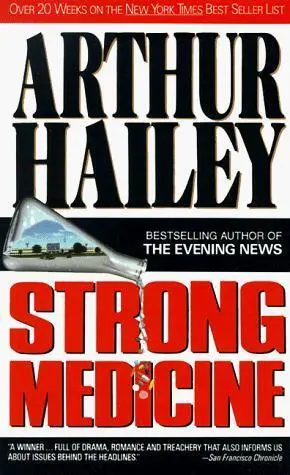
Arthur Hailey - Strong Medicine
Здесь есть возможность читать онлайн «Arthur Hailey - Strong Medicine» весь текст электронной книги совершенно бесплатно (целиком полную версию без сокращений). В некоторых случаях можно слушать аудио, скачать через торрент в формате fb2 и присутствует краткое содержание. Жанр: Современная проза, на английском языке. Описание произведения, (предисловие) а так же отзывы посетителей доступны на портале библиотеки ЛибКат.
- Название:Strong Medicine
- Автор:
- Жанр:
- Год:неизвестен
- ISBN:нет данных
- Рейтинг книги:5 / 5. Голосов: 1
-
Избранное:Добавить в избранное
- Отзывы:
-
Ваша оценка:
Strong Medicine: краткое содержание, описание и аннотация
Предлагаем к чтению аннотацию, описание, краткое содержание или предисловие (зависит от того, что написал сам автор книги «Strong Medicine»). Если вы не нашли необходимую информацию о книге — напишите в комментариях, мы постараемся отыскать её.
Strong Medicine — читать онлайн бесплатно полную книгу (весь текст) целиком
Ниже представлен текст книги, разбитый по страницам. Система сохранения места последней прочитанной страницы, позволяет с удобством читать онлайн бесплатно книгу «Strong Medicine», без необходимости каждый раз заново искать на чём Вы остановились. Поставьте закладку, и сможете в любой момент перейти на страницу, на которой закончили чтение.
Интервал:
Закладка:
It was tough talk and the beginning of what would be a fiercely argued, pro-and-con debate extending over many years.
At Felding-Roth, one keenly anticipated project was now on "hold.,, The deal made by Sam for the American rights to a new French drug, Montayne, still had not reached a point where tests for safety and efficacy, as required by law, could begin in the United States. Thus there was a long way to go even before a new drug application could be made to FDA. Montayne was a drug to combat morning sickness in pregnant women; it held great promise, especially for working women whom it would free from a burden that made life difficult and sometimes threatened their employment. The drug's discoverers Laboratoires Gironde-Chimic, a reputable house-were convinced they had something of highest quality and safety, as shown by unusually extensive tests on animals and volunteer humans. The tests, the Paris-based firm informed Felding-Roth, had so far produced excellent results and no adverse side effects. Still, as the head of Gironde-Chimic explained in a personal letter to Sam: Because of past occurrences, and the nature fragile of this drug, we have need of being extremely prudent. Therefore we have decided to make a few more series of tests on different types of animals, and also more humans. This will take a little more of time.
In the climate of the times, Sam agreed, the additional precautions seemed wise. Meanwhile, Felding-Roth continued to wait for a green light from the French before beginning their own work on Montayne.
THREE
1975-1977
While Dr. Vincent Lord had some problems which were imaginary, he also had others that were real. One was the FDA. The Food and Drug Administration, with headquarters just outside Washington, D.C., represented a labyrinthine obstacle course which any new pharmaceutical drug and its sponsors had to run before the drug was approved for general use. Some drugs were never approved; they failed to complete the course. And since sponsors of drugs were almost always the companies which discovered, manufactured, and eventually sold them to the public, the big drug firms and FDA were, more often than not, locked in a combative state. That state ranged, according to the issue of the moment, from intellectual-scientific skirmishing to all-out war. As far as Vince Lord was concerned, it was war. Part of his jot) at Felding-Roth was to deal, or supervise dealings, with the FDA. He loathed it. He also disliked, and in some cases despised, the people who worked there. Adding to his problem was that, to achieve anything at all at FDA, he had either to subdue those feelings or keep them to himself. He found both things difficult, at times impossible. Of course, Dr. Lord was prejudiced. So were others, from other drug firms, who dealt with FDA. Sometimes that prejudice was justified. Sometimes not. This was because laws and custom required the FDA to be several things at once. It was a guardian of the public's health, its duty to protect the innocent from excessive avarice, incompetence, indifference, or carelessness, all of which sins were at times committed by pharmaceutical companies whose bottom line was profit. The reverse of that was FDA's function as a ministering angel: the covenant to make available, with utmost speed, those new and splendid drugs from the same pharmaceutical companies-which lengthened life or shortened pain. Another agency role was to be a whipping boy for critics--drug firms, consumer groups, journalists, authors, lawyers, lobbyists, other special interests-who accused FDA of being either too rigid or too lenient, depending on what camp the critics lived in. As well, the FDA was used regularly as a political platform by self-serving and self-righteous congressmen and senators who sought an easy way to get their names in print and on TV. Coupled with all this, the FDA was a bureaucratic mess-overcrowded, in critical areas understaffed, its medical and scientific experts overworked and underpaid. Yet the amazing thing was, amid all these roles, hindrances, and critics, the FDA did its job-on the whole-remarkably well. But without question there were glitches, and the so-called drug lag was one of them. Just how bad the drug lag was depended, like so much else surrounding the FDA, on your point of view. But that it existed, even the FDA itself conceded. Vincent Lord suffered through an example of the drug lag during the attempt by Felding-Roth to gain approval for United States marketing of Staidpace, a heart and blood-pressure medicine already in use in Britain, France, West Germany and several other countries. The FDA required that before Staidpace could go on American drugstore shelves and be prescribed by doctors, there must be additional, thorough, American testing of the product's safety and efficacy. And it was a good requirement. Nobody argued against it, including Vincent Lord and others at Felding-Roth. What they did protest-after all the required testing had been done successfully, and results submitted to the FDA-was two extra years of petty, indecisive quibbling by the government agency. In 1972 Felding-Rotb delivered its Staidpace NDA-new drug application-to FDA headquarters in a truck. The NDA consisted of 125,000 printed pages, contained in 307 volumes, enough to fill a small room. All this material was required by law and included information covering two years of U.S. testing on animals and humans. Although the information supplied was as complete as anyone could make it, there was an unspoken awareness on both sides that no one at FDA could possibly read it all. Similar amounts of material were received, with great frequency, from other manufacturers seeking approval of other drugs. From the FDA's medical-scientific staff, a reviewer was selected to oversee and adjudicate the Staidpace submission. He was Gideon R. Mace, M.D., who had been with FDA a year. Dr. Mace would be assisted by scientific specialists in the agency -that is, whenever they could spare time from work on other drugs. Another part of the procedure was that, as FDA's examination proceeded, scientists from Felding-Roth would be called in, perhaps to explain some of the submitted material or to add even more. This was normal. What proved to be less normal were the work habits and attitude of Dr. Mace. His pace was snail-like-slow even for the FDA. He was also petty, unreasonably querulous, and mean. This was how the name of Gideon Mace came to be added to the list of people at FDA whom Vincent Lord despised. Lord had personally overseen the Staidpace application and believed it to be as complete and thorough as any ever submitted by the company. Therefore, as months went by with no decision made, Lord's frustration grew. Then when Mace was finally heard from it was about trifling points, and later-as one of Lord's assistants put it-"he seemed to query every damn comma, sometimes having nothing to do with science.”
Equally maddening was that several times when Mace imperiously demanded extra data, it developed that what was being sought was already in the original submission. Mace simply hadn't looked for it or even asked whether it was there, When the facts were pointed out, he took still more weeks to acknowledge them-and then did so ungraciously. After a good deal of this, Vincent Lord took over from his staff and began doing what he disliked most-going to the FDA himself. The agency headquarters was in an inconvenient location-on Fishers Lane in Maryland, some fifteen miles north of Washington, an hour's tedious drive from the White House or Capitol Hill. It was housed in a plain brick building, shaped like an "E" and built cheaply in the 1960s without benefit of architectural imagination. The offices, where seven thousand people worked, were mostly tiny and crowded. Many were windowless. Others had so many occupants and were filled with so much furniture, it was hard to move around. What little space remained was filled with paper. Paper was everywhere. Piles of it, reams of it, stacks of it, tons of it.
Читать дальшеИнтервал:
Закладка:
Похожие книги на «Strong Medicine»
Представляем Вашему вниманию похожие книги на «Strong Medicine» списком для выбора. Мы отобрали схожую по названию и смыслу литературу в надежде предоставить читателям больше вариантов отыскать новые, интересные, ещё непрочитанные произведения.












Обсуждение, отзывы о книге «Strong Medicine» и просто собственные мнения читателей. Оставьте ваши комментарии, напишите, что Вы думаете о произведении, его смысле или главных героях. Укажите что конкретно понравилось, а что нет, и почему Вы так считаете.