Arthur Hailey - Strong Medicine
Здесь есть возможность читать онлайн «Arthur Hailey - Strong Medicine» весь текст электронной книги совершенно бесплатно (целиком полную версию без сокращений). В некоторых случаях можно слушать аудио, скачать через торрент в формате fb2 и присутствует краткое содержание. Жанр: Современная проза, на английском языке. Описание произведения, (предисловие) а так же отзывы посетителей доступны на портале библиотеки ЛибКат.
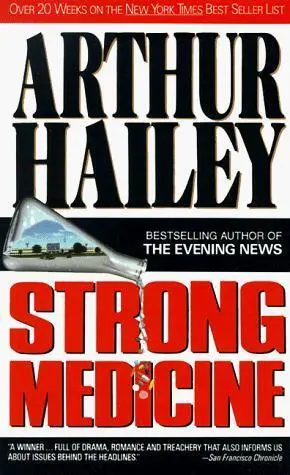
- Название:Strong Medicine
- Автор:
- Жанр:
- Год:неизвестен
- ISBN:нет данных
- Рейтинг книги:5 / 5. Голосов: 1
-
Избранное:Добавить в избранное
- Отзывы:
-
Ваша оценка:
Strong Medicine: краткое содержание, описание и аннотация
Предлагаем к чтению аннотацию, описание, краткое содержание или предисловие (зависит от того, что написал сам автор книги «Strong Medicine»). Если вы не нашли необходимую информацию о книге — напишите в комментариях, мы постараемся отыскать её.
Strong Medicine — читать онлайн бесплатно полную книгу (весь текст) целиком
Ниже представлен текст книги, разбитый по страницам. Система сохранения места последней прочитанной страницы, позволяет с удобством читать онлайн бесплатно книгу «Strong Medicine», без необходимости каждый раз заново искать на чём Вы остановились. Поставьте закладку, и сможете в любой момент перейти на страницу, на которой закончили чтение.
Интервал:
Закладка:
"I know what you mean," Martin said.”When my mother was talking, before she forgot how to, she spoke much the same way. In Pygmalion, Bernard Shaw called it an 'incarnate insult to the English language.'" "I remember that from My Fair Lady, " Celia reminisced.”But you managed to avoid it. How?" "It's one more thing I owe my mother. Before I explain, though, there's something you have to understand about this country. In Britain, the way people speak has always been a class barrier, a social distinction. And despite some who'll tell you otherwise, it still is.”
"In the academic world too? Among scientists.”
"Even there. Perhaps especially there.”
Martin busied himself with the punt pole while considering his next words. "My mother understood that barrier. Which was why, when I was very small, she bought a radio and made me sit for hours in front of it, listening to the BBC announcers. She told me, 'That's the way you'll speak, so start copying those people. It's too late for your Dad and me, but not for you,' "Listening to Martin's pleasant and cultured, though unaffected, voice, Celia said, "It worked.”
"I suppose so. But it was one of many other things she did, including finding out what interested me at school, then discovering what scholarships there were, and making sure I went after them. That was when we had those fights at home my father talked about.”
"He believed your mother was overreaching?" "He thought I should be a stonemason, like him. My father believed in that English rhyme that Dickens wrote.”
Martin smiled as he quoted: let us love our occupations, Bless the squire and his relations, Live upon our daily rations, And always know our proper station.
"But you don't hold a grudge against your father for that?" Martin shook his head.”He simply didn't understand. For that matter, nor did 1. Only my mother understood what could be accomplished through ambition-and through me. Perhaps you realize now why I care so much about her.”
"Of course," Celia said.”And now that I know, I feel the same way.”
They lapsed into a contented silence as the punt progressed upriver between green banks and leafy trees on either side. After a while, Celia said, "Your father said you pay for most of what both your parents need.”
"I do what I can," Martin acknowledged.”One thing I do is send in an agency nurse two mornings a week. It gives my father a break. I'd like to use the nurse more often, but...”
He shrugged, left the sentence unfinished, and expertly brought the punt alongside a grassy bank under the shade of a willow tree.”How's this for a picnic site?" "Idyllic," Celia said.”Straight from Camelot.”
Martin had packed a hamper with some prawns, a Melton Mowbray pork pie, a fresh green salad, strawberries and thick, yellow Devonshire cream. There was wine-a respectable Chablis-and a thermos of coffee. They ate and drank with gusto. At the end of the meal, over coffee, Celia said, "This is my last weekend before going home. It couldn't have been nicer.”
"Was your trip here a success?" About to reply with a platitude, she remembered Andrew's advice on the telephone and answered, "No.”
"Why not?" Martin sounded surprised. "Sam Hawthorne and I found the ideal director for the Felding-Roth research institute, but he didn't want the job. Now, everyone else seems second-rate.”
After a silence, Martin said, "I presume you're talking about me.,, "You know I am.”
He sighed.”I hope you're going to forgive me for that delinquency, Celia.”
"There's nothing to forgive. It's your life, your decision," she assured him.”It's simply that, thinking about it just now, there were two things...”
She stopped. "Go on. What two things?" "Well, a little while ago you admitted you'd like to be first in finding answers about Alzheimer's and mental aging, but others might get there ahead of you.”
Martin leaned back in the punt, facing Celia; he had folded his blazer behind him and was using it as a pillow.”Others are doing similar research to mine. I know of someone in Germany, another in France, a third in New Zealand. They're all good people and we're pursuing the same objectives, exploring the same trail. It's impossible to know who, if anyone, is ahead.”
"So it's a race that you're in," Celia said.”A race against time.”
Unconsciously, her voice had sharpened. "Yes. But that's the way science is.”
"Do any of those others you mentioned have better facilities or more staff than you?" He considered.”Probably 'yes' to both in Germany. I don't know about the other two.”
"How much laboratory space do you have now?" "Altogether"-Martin calculated mentally-"about a thousand square feet.”
"Then wouldn't it help you get closer, faster, to what you're searching for if you had five times that space, plus equipment to go into it--everything you needed, and all for your project-plus a staff of maybe twenty people working for you, instead of two or three? Wouldn't that move things along, and not only find the answers, but get you to them first?" Suddenly Celia was aware that the mood between them had changed. This was no longer a social occasion; whatever innocence there had been had fled. Subtly, it was now a challenge of intellect and wills. Well, she thought, this was why she had come to Britain, and to Cambridge today. Martin was staring at her in amazement.”Are you serious about all that? Five thousand square feet and twenty people!" "Dammit! Of course I'm serious.”
She added impatiently, "Do you think, in the pharmaceutical business, we play games?"
"No," he said, still staring, "I didn't think that. You said there were two things. What's the other?" Celia hesitated. Should she go on? She sensed that what she had just said had made a deep impression on Martin. Would she now destroy that, wiping out any advantage gained? Then, once more, she remembered Andrew. "I'll put this crudely and bluntly, in the usual crass American way," Celia said, "and I'm saying that because I know dedicated researchers like you aren't motivated by money and can't be bought. But if you worked for Felding-Roth, became director of our institute and brought your project with you, you'd most likely be paid twelve thousand pounds a year, plus bonuses, which can be substantial. I've reason to believe that's about five times what you're earning now. Furthermore, having met your parents and knowing what you do for them, and having an idea that there's more you'd like to do, I think you could use that extra cash. You could certainly send a nurse in more than twice a week, move your mother to better surroundings...”
"That's enough!" Martin had sat up and was glaring at her; he had become intensely emotional.”Damn you, Celia! I know what money can do. What's more, don't hand me that bilge about people like me not caring for it. I care like hell, and what you've just told me is mind-boggling. You're trying to undermine me, tempt me, take advantage She snapped, "That's ridiculous! Take what advantage?" "Of meeting my parents, for one thing. Seeing how they live and how much I care. So, using that, you're offering me a golden apple, playing Eve to my Adam.”
He glanced around them.”In Paradise, too.”
"It isn't a poisoned apple," Celia said quietly, "and there's no serpent in this boat. Look, I'm sorry if-" Martin cut her off savagely.”You're not sorry at all! You're a businesswoman who's good at her job-bloody good; I can testify, to-that! But a businesswoman going all out, no holds barred, to get what she wants. You're quite ruthless, aren't you?" Now Celia was surprised.”Am I” He answered emphatically, "Yes.”
"All right," Celia said; she would give back as good as she got, she decided.”Supposing I am. And supposing all of what you said is true. Isn't it what you want too? The answers to Alzheimer's!
Читать дальшеИнтервал:
Закладка:
Похожие книги на «Strong Medicine»
Представляем Вашему вниманию похожие книги на «Strong Medicine» списком для выбора. Мы отобрали схожую по названию и смыслу литературу в надежде предоставить читателям больше вариантов отыскать новые, интересные, ещё непрочитанные произведения.







Обсуждение, отзывы о книге «Strong Medicine» и просто собственные мнения читателей. Оставьте ваши комментарии, напишите, что Вы думаете о произведении, его смысле или главных героях. Укажите что конкретно понравилось, а что нет, и почему Вы так считаете.