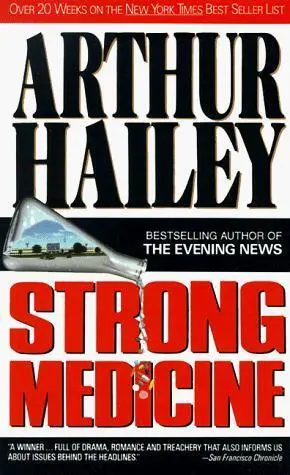
Arthur Hailey - Strong Medicine
Здесь есть возможность читать онлайн «Arthur Hailey - Strong Medicine» весь текст электронной книги совершенно бесплатно (целиком полную версию без сокращений). В некоторых случаях можно слушать аудио, скачать через торрент в формате fb2 и присутствует краткое содержание. Жанр: Современная проза, на английском языке. Описание произведения, (предисловие) а так же отзывы посетителей доступны на портале библиотеки ЛибКат.
- Название:Strong Medicine
- Автор:
- Жанр:
- Год:неизвестен
- ISBN:нет данных
- Рейтинг книги:5 / 5. Голосов: 1
-
Избранное:Добавить в избранное
- Отзывы:
-
Ваша оценка:
Strong Medicine: краткое содержание, описание и аннотация
Предлагаем к чтению аннотацию, описание, краткое содержание или предисловие (зависит от того, что написал сам автор книги «Strong Medicine»). Если вы не нашли необходимую информацию о книге — напишите в комментариях, мы постараемся отыскать её.
Strong Medicine — читать онлайн бесплатно полную книгу (весь текст) целиком
Ниже представлен текст книги, разбитый по страницам. Система сохранения места последней прочитанной страницы, позволяет с удобством читать онлайн бесплатно книгу «Strong Medicine», без необходимости каждый раз заново искать на чём Вы остановились. Поставьте закладку, и сможете в любой момент перейти на страницу, на которой закончили чтение.
Интервал:
Закладка:
Peat-Smith had brought back two stools. He offered the Windsor chair to Celia, one of the stools to Sam, and perched on the second himself. "It's only fair to tell you," he said, "that what I'm attempting here involves not just problems of science, but enormously difficult techniques. What has to be found is a means of transferring information from a brain cell nucleus to the machinery of the cell that makes proteins and peptides...”
Warming to his exposition, he drifted into scientific jargon. take a gross mixture of mRNA from young and old rats and put it into a cell-free system... RNA templates are allowed to produce proteins... a long strand of mRNA may code for many proteins... afterwards, proteins are separated by electrophoresis... a possible technique could use a reverse transcriptase enzyme... then if the RNA and DNA's don't combine, it will mean the old rat has lost that genetic capability, so we'll begin learning which peptides are changing... eventually, I'll be seeking a single peptide 11
The talk continued for more than an hour, interspersed by shrewd, detailed questioning from Sam that impressed Celia. Although Sam had no scientific training, during his years with Felding-Roth he had absorbed much on-the-scene science and the effect of it showed. Throughout, Peat-Smith's enthusiasm transmitted itself to them both. And while he spoke--clearly, concisely, and from what was plainly a disciplined, orderly mind-their respect grew. Near the end of the discussion the scientist pointed to the rats in cages.”These are only a few. We have several hundred others in our animal room.”
He touched a cage and a large rat, which had been sleeping, stirred.”This old man is two and a half years old; that's equivalent to seventy in a human. This is his last day. Tomorrow we'll sacrifice him, then compare his brain chemistry with that of a rat born a few days ago. But to find answers we need it will take a lot of rats, a lot of chemical analysis, and a lot more time.”
Sam nodded his understanding.”We're aware of the time factor from our own experience. Now to summarize, Doctor-how would you express your long-term goal?" Peat-Smith considered before answering. Then he said carefully,
"To discover, through continuing genetic research, a brain peptide which enhances memory in younger people but, as those same people grow older, is not produced in the human body anymore. Then, having found and isolated such a peptide, we'll learn to produce it by genetic techniques. After that, people of all ages can be given it to minimize memory loss, forgetfulness-and perhaps eliminate mental aging altogether.”
The quiet summation was so impressive, so profoundly confident, yet in no way boastful, that neither visitor seemed inclined to break the silence that followed. Celia, despite the dismal surroundings, had a sense of sharing in a moment to be remembered, and of history being made. It was Sam who spoke first.”Dr. Peat-Smith, you now have your grant. It is approved, as of this moment, in the amount you asked.”
Peat-Smith appeared puzzled.”You mean... it's that simple... just like that?" It was Sam's turn to smile.”As president of Felding-Roth Pharmaceuticals I have a certain authority. Once in a while it gives me pleasure to exercise it.”
He added, "The only condition is the usual one, implicit in these arrangements. We'd like to keep in touch with your progress and have first crack at any drug you may produce.”
Peat-Smith nodded.”Of course. That's understood.”
He still seemed dazed. Sam extended his hand, which the young scientist took.”Congratulations and good luck!"
It was a half hour later and teatime in the Biochemistry Building. At Martin's invitation-the three of them had, by now, progressed to first names-they had gone upstairs to where tea and biscuits were being served from tea trolleys in the foyer. Balancing their cups and saucers, the trio moved on to a faculty "tearoom" which, as Martin explained, was a social focal point for scientists who worked there and their guests. The tearoom, as austere and inelegant as the remainder of the building, had long tables with wooden chairs and was crowded and noisy. The scientists were of all shapes, sexes, sizes and ages, but fragments of conversation that could be overheard were decidedly unscientific. One discussion was about official parking places, an elderly faculty member arguing heatedly that favoritism to someone junior was depriving him of his tenurial rights. Alongside, a bearded, white-coated enthusiast reported a "sensational" sale by a Cambridge wine merchant; an available Meursault was recommended. Another group was dissecting a new movie playing in town-The Godfather, starring Marlon Brando and Al Pacino. After some maneuvering and exchanging places with others, Martin Peat-Smith managed to find a comer for his group.
"Is it always like this?" Celia asked. Martin seemed amused.”Usually. And almost everyone comes here. It's the only time some of us get to see each other.”
"It does appear to me," Sam said, "that your setup in this building doesn't allow much privacy.”
Martin shrugged.”That can be a nuisance at times. But you get used to it.”
"But should you have to get used to it?" When there was no answer, Sam went on, lowering his voice to avoid being heard by others nearby, "I was wondering, Martin, if you'd be interested in pursuing the same work you're doing now, but under superior conditions, and with more facilities and help.”
A half smile played over the scientist's face as he asked,
"Superior conditions where?" "What I'm suggesting," Sam said, "as no doubt you've guessed, is that you leave Cambridge University and come to work with us at Felding-Roth. There would be many advantages for you, and it would be in Britain where we're planning-" "Excuse me!" As Martin cut in, he appeared concerned.”May I ask you something?" "Of course.”
"Is the offer of a grant from your company conditional on this?" Sam answered, "Absolutely not. You already have the grant, to which there are no strings attached, other than the one we agreed. On that I give you my word.”
"Thank you. For a moment I was worried.”
The full and boyish smile returned.”I don't wish to be rude, but I think it will save us both time if I tell you something.”
It was Celia who said, "Go ahead.”
"I'm an academic scientist and I intend to remain one," Martin declared. "I won't go into all the reasons, but one is freedom. By that, I mean freedom to do the kind of research I want, without commercial pressures.”
"You'd have freedom with us Sam began. But he stopped as Martin shook his head.
"There'd be commercial factors to consider. Tell me honestly wouldn't there?" Sam admitted, "Well, from time to time, some. We're in business, after all.”
"Exactly. But here there are no commercial considerations. Just pure science, a search for knowledge. For myself, I want to keep it that way. Will you have more tea?" "Thank you, no," Celia said. Sam shook his head. They rose to go. Outside, on Tennis Court Road and standing by the rented Jaguar, Martin told Sam, "Thank you for everything, including the job offer. And you too, Celia. But I'll stay at Cambridge which, apart from this building"-he glanced behind him and grimaced-"is a beautiful place.”
"It's been a pleasure," Sam said.”And about working for us, though I regret your decision, I understand it.”
He got into the car. From the seat beside him, with the window down, Celia told Martin, "Cambridge is a beautiful place. I've never been here until today. I wish I had time to see more.”
"Hey, hold it!" Martin said.”How long are you staying in Britain?" She considered.”Oh, probably another two weeks.”
"Then why not come back for a day? It's easy to get here. I'd be happy to show you around.”
Читать дальшеИнтервал:
Закладка:
Похожие книги на «Strong Medicine»
Представляем Вашему вниманию похожие книги на «Strong Medicine» списком для выбора. Мы отобрали схожую по названию и смыслу литературу в надежде предоставить читателям больше вариантов отыскать новые, интересные, ещё непрочитанные произведения.







Обсуждение, отзывы о книге «Strong Medicine» и просто собственные мнения читателей. Оставьте ваши комментарии, напишите, что Вы думаете о произведении, его смысле или главных героях. Укажите что конкретно понравилось, а что нет, и почему Вы так считаете.