Arthur Hailey - Strong Medicine
Здесь есть возможность читать онлайн «Arthur Hailey - Strong Medicine» весь текст электронной книги совершенно бесплатно (целиком полную версию без сокращений). В некоторых случаях можно слушать аудио, скачать через торрент в формате fb2 и присутствует краткое содержание. Жанр: Современная проза, на английском языке. Описание произведения, (предисловие) а так же отзывы посетителей доступны на портале библиотеки ЛибКат.
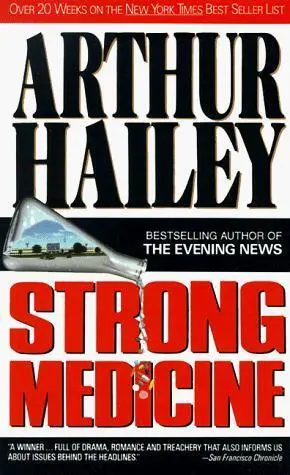
- Название:Strong Medicine
- Автор:
- Жанр:
- Год:неизвестен
- ISBN:нет данных
- Рейтинг книги:5 / 5. Голосов: 1
-
Избранное:Добавить в избранное
- Отзывы:
-
Ваша оценка:
Strong Medicine: краткое содержание, описание и аннотация
Предлагаем к чтению аннотацию, описание, краткое содержание или предисловие (зависит от того, что написал сам автор книги «Strong Medicine»). Если вы не нашли необходимую информацию о книге — напишите в комментариях, мы постараемся отыскать её.
Strong Medicine — читать онлайн бесплатно полную книгу (весь текст) целиком
Ниже представлен текст книги, разбитый по страницам. Система сохранения места последней прочитанной страницы, позволяет с удобством читать онлайн бесплатно книгу «Strong Medicine», без необходимости каждый раз заново искать на чём Вы остановились. Поставьте закладку, и сможете в любой момент перейти на страницу, на которой закончили чтение.
Интервал:
Закладка:
Peat-Smith paused, then told them, "What goes on in the brain can be seen after autopsy. Alzheimer's hits nerve cells in the cortex -where senses and memory are housed. It twists and severs nerve fibers and filaments. It litters the brain with tiny bits of a substance called plaque.”
"I've read something about your research," Sam said, "but I'd like you to tell us yourself what direction you're taking.”
"A genetic direction. And because there are no animal models for Alzheirner's--so far as we know, no animal gets the diseasemy studies with animals are on the chemistry of the mental aging process. As you're aware, I'm a nucleic acid chemist.”
"My chemistry is a little rusty," Celia said, "but as I understand nucleic acids, they're the 'building blocks' of DNA which make up our genes.”
"Correct, and not so rusty.”
Peat-Smith smiled.”And it's likely that big future medical advances will come when we understand the chemistry of DNA better, showing us how genes work and why they sometimes go wrong. That's what I'm researching now, using young and old rats, trying to find differences, varying with age, between the animals' mRNA-messenger ribonucleic acid-which is a template made from their DNA.”
Sam interjected, "But Alzheimer's disease and the normal aging process are two separate things, right?" "It appears so, but there may be overlapping areas.”
As PeatSmith paused, Celia could sense him organizing his thoughts, as a teacher would, into simpler, less scientific words than he was accustomed to using. "An Alzheimer's victim may have had, at birth, an aberration in his DNA, which contains his coded genetic information. However, someone else, born with more normal DNA, can change that DNA by damaging its environment, the human body. Through smoking, for example, or a harmful diet. For a while, our built-in DNA repair mechanism will take care of that, but as we get older the genetic repair system may slow down or fail entirely. Part of what I'm searching for is a reason for that slowing...”
At the end of the explanation, Celia said, "You're a natural teacher. You enjoy teaching, don't you?" Peat-Smith appeared surprised.”Doing some teaching is expected at a university. But, yes, I enjoy it.”
Another facet of this man's interesting personality, Celia thought. She said, "I'm beginning to understand the questions. How far are you from answers?" "Perhaps light-years away. On the other hand we might be close.”
Peat-Smith flashed his genuine smile.”That's a risk that grant givers take.”
A maAre d' brought menus and they paused to decide about lunch. When they had chosen, Peat-Smith said, "I hope you'll visit my laboratory. I can explain better there what I'm trying to do.”
"We were counting on that," Sam said.”Right after lunch.”
While they were eating, Celia asked, "W hat is your status at Cambridge, Dr. Peat-Smith?" "I have an appointment as a lecturer; that's more or less equivalent to assistant professor in America. What it means is that I get lab space in the Biochemistry Building, a technician to help me, and freedom to do research of my choice.”
He stopped, then added, "Freedom, that is, if I can get financial backing.”
"About the grant we're speaking of," Sam said.”I believe the amount suggested was sixty thousand dollars.”
"Yes. It would be over three years, and is the least I can get by on -to buy equipment and animals, employ three full-time technicians, and conduct experiments. There's nothing in there for me personally.”
Peat-Smith grimaced.”All the same, it's a lot of money, isn't it?" Sam nodded gravely.”Yes, it is.”
But it wasn't. As both Sam and Celia knew, sixty thousand dollars was a trifling sum compared with the annual expenditures on research by Felding-Roth Pharmaceuticals or any major drug firm. The question, as always, was: Did Dr. Peat-Smith's project have sufficient commercial promise to make an investment worthwhile? "I get the impression," Celia told Peat-Smith, "that you're quite dedicated on the subject of Alzheimer's. Was there some special reason that got you started?" The young scientist hesitated. Then, meeting Celia's eyes directly, he said, "My mother is sixty-one, Mrs. Jordan. I'm her only child; not surprisingly, we've always been close. She's had Alzheimer's disease for four years and become progressively worse. My father, as best he can, takes care of her, and I go to see her almost every day. Unfortunately, she has no idea who I am.”
Cambridge University's Biochemistry Building was a three-storied red-brick neo-Renaissance structure, plain and unimpressive. It was on Tennis Court Road, a modest lane where no tennis court existed. Martin Peat-Smith, who had come to lunch on a bicycle-a standard form of transportation in Cambridge, it appeared-pedaled energetically ahead while Sam and Celia followed in the Jaguar. At the building's front door, where they rejoined him, PeatSmith cautioned, "I think I should warn you, so you're not surprised, that our facilities here are not the best. We're always crowded, short of space"-again the swift smile-"and usually short of money. Sometimes it shocks people from outside to see where and how we work.”
Despite the warning, a few minutes later Celia was shocked. When Peat-Smith left them alone briefly, she whispered to Sam,
"This place is awful-like a dungeon! How can anyone do good work here?" On entering, they had descended a stairway to a basement. The hallways were gloomy. A series of small rooms leading off them appeared messy, disordered, and cluttered with old equipment. Now they were in a laboratory, not much bigger than the kitchen of a small house, which Peat-Smith had announced was one of two that he worked in, though he shared both with another lecturer who was pursuing a separate project. While they were talking, the other man and his assistant had come and gone several times, making a private conversation difficult. The lab was furnished with worn wooden benches, set close together to make the most of available space. Above the benches were old-fashioned gas and electrical outlets, the latter festooned untidily, and probably unsafely, with adapters and many plugs. On the walls were roughly made shelves, all filled to capacity with books, papers and apparently discarded equipment, amid it, Celia noticed, some outmoded retorts of a type she remembered from her own chemistry work nineteen years earlier. A portion of bench was a makeshift desk. In front was a hard Windsor chair. Several dirty drinking mugs could be seen. On one bench were several wire cages, inside them, twenty or so rats-two to a cage, and in varying states of activity. The floor of the laboratory had not been cleaned in some time. Nor had the windows, which were narrow, high up on a wall, and providing a view of the wheels and undersides of cars parked outside. The effect was depressing. "No matter how it all looks," Sam told Celia, "never forget that a lot of scientific history has been made here. Nobel Prize winners have worked in these rooms and walked these balls.”
"That's right," Martin Peat-Smith said cheerfully; he had returned in time to hear the last remark.”Fred Sanger was one of them; he discovered the amino acid structure of the insulin molecule in a lab right above us.”
He saw Celia looking at the old equipment.”In academic labs we never throw anything away, Mrs. Jordan, because we never know when we'll need it again. Out of necessity, we improvise and build much of our own equipment.”
"That's true of American academia too," Sam said. "Just the same," Peat-Smith acknowledged, "all this must be quite a contrast to the kind of labs you're both used to.”
Remembering the spacious, immaculate, and richly equipped laboratories at Felding-Roth in New Jersey, Celia answered, "Frankly, yes.”
Читать дальшеИнтервал:
Закладка:
Похожие книги на «Strong Medicine»
Представляем Вашему вниманию похожие книги на «Strong Medicine» списком для выбора. Мы отобрали схожую по названию и смыслу литературу в надежде предоставить читателям больше вариантов отыскать новые, интересные, ещё непрочитанные произведения.









Обсуждение, отзывы о книге «Strong Medicine» и просто собственные мнения читателей. Оставьте ваши комментарии, напишите, что Вы думаете о произведении, его смысле или главных героях. Укажите что конкретно понравилось, а что нет, и почему Вы так считаете.