Arthur Hailey - Strong Medicine
Здесь есть возможность читать онлайн «Arthur Hailey - Strong Medicine» весь текст электронной книги совершенно бесплатно (целиком полную версию без сокращений). В некоторых случаях можно слушать аудио, скачать через торрент в формате fb2 и присутствует краткое содержание. Жанр: Современная проза, на английском языке. Описание произведения, (предисловие) а так же отзывы посетителей доступны на портале библиотеки ЛибКат.
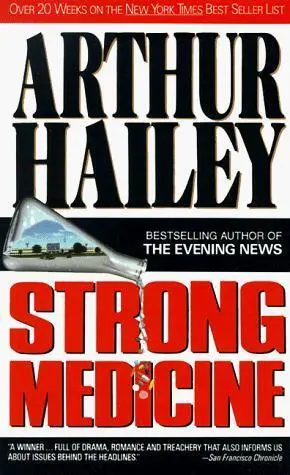
- Название:Strong Medicine
- Автор:
- Жанр:
- Год:неизвестен
- ISBN:нет данных
- Рейтинг книги:5 / 5. Голосов: 1
-
Избранное:Добавить в избранное
- Отзывы:
-
Ваша оценка:
Strong Medicine: краткое содержание, описание и аннотация
Предлагаем к чтению аннотацию, описание, краткое содержание или предисловие (зависит от того, что написал сам автор книги «Strong Medicine»). Если вы не нашли необходимую информацию о книге — напишите в комментариях, мы постараемся отыскать её.
Strong Medicine — читать онлайн бесплатно полную книгу (весь текст) целиком
Ниже представлен текст книги, разбитый по страницам. Система сохранения места последней прочитанной страницы, позволяет с удобством читать онлайн бесплатно книгу «Strong Medicine», без необходимости каждый раз заново искать на чём Вы остановились. Поставьте закладку, и сможете в любой момент перейти на страницу, на которой закончили чтение.
Интервал:
Закладка:
These were elements harmful to healthy tissue, and the cause of adverse side effects and sometimes death. Elimination, or "quenching," of free radicals would mean that beneficial drugs, other drugs, which previously could not be used on humans because of dangerous side effects, could be taken by anyone with impunity. And restricted drugs, hitherto used only at great risk, could be absorbed as casually as aspirin. No longer need physicians, when prescribing for their patients, worry about toxicity of drugs. No longer need cancer patients suffer agonies from the near-deadly drugs which sometimes kept them &live, but equally often tortured, then killed them from some other cause than cancer. The beneficial effects of those and all other drugs would remain, but the killing effects would be nullified by the quenching of free radicals. What Vincent Lord hoped to produce was a drug to add to other drugs, to make them totally safe. And it was all possible. The answer existed. It was there. Hidden, elusive, but waiting to be found. And Vincent Lord, after ten years' searching, believed he was close to that elusive answer. He could smell it, sense it, almost taste the nectar of success. But how much longer? Oh, how much longer would he have to wait? Abruptly he sat upright in his chair and, with an effort of will, expunged his downcast mood. Opening a drawer of his desk, he selected a key. fie would go now--once more-he decided, to the private laboratory, a few steps down the hall, where his research work was done.
Vincent Lord's Friend and ally on the Felding-Roth board of directors was Clinton Etheridge, a successful and prominent New York lawyer who had pretensions to scientific knowledge. The pretensions were based on the fact that, for two years as a young man, Etheridge had been a medical student before deciding to switch to law. As an acquaintance cynically described the changeover, "Clint diagnosed where the big money was and prescribed a route to it directly.”
Etheridge was now fifty-three. The fact that his brief, incomplete medical studies had taken place more than a quarter century earlier never deterred him from making confident pronouncements on scientific matters, delivered in his best courtroom manner with an implication that they should be preserved on stone. It suited Vincent Lord's purposes to flatter Etheridge by appearing to treat him as a scientific equal. In this way the research director's own views were often placed before the Felding-Roth board of directors with the bonus, for Vince Lord, of a lawyer's skilled persuasiveness. Not surprisingly, at a board meeting called to consider Sam Hawthorne's proposal for a British research institute, Clinton Etheridge led off for the opposition. The meeting was at Felding-Roth's Boonton headquarters. Fourteen of the total complement of sixteen directors-all men-were assembled around the boardroom's traditional walnut table. Etheridge, who was tall, slightly stooped and cultivated a Lincolnesque image, began genially.”Were you hoping, Sam, that if this pro-British thing goes through, they'll be so pleased with you over there, you'll be invited to tea at Buckingham Palace?" Sam joined in the general laughter, then shot back, "What I'm really after, Clint, is a long weekend at Windsor Castle.”
"Well," the lawyer said, "I suppose it's an attainable objective, but in my opinion the only one.”
He became serious.”What you've proposed seems to me to overlook the tremendous scientific capability and achievements of our own country-your country too.,, Sam had thought about this meeting in advance and had no intention of letting the argument get away from him.”I haven't overlooked American achievements in science," he objected.”How could I? They're all around us. I simply want to supplement them.”
Someone else injected, "Then let's use our money to supplement them here.”
"The British themselves," Etheridge persisted, "have fostered a myth about science on their little island somehow being superior. But if that's true, why does Britain have its so-called 'brain drain'with so many of their best people hotfooting it over here, to join in U.S. research?" "They mostly do it," Sam answered, "because our facilities are better, and more money is available for staff and equipment. But your question, Clint, supports my argument. This country welcomes British scientists because of their high quality.”
"In your opinion, Sam," Etheridge asked, "what area of scientific research, relating to this industry, is at present most important?" "Without question, genetic engineering.”
"Exactly.”
The lawyer nodded, satisfied with the answer.”And isn't it true-and I speak with some scientific knowledge, as you know-that the United States has led the world, and continues to, in this genetic field?" Sam was tempted to smile, but didn't. For once, the pseudoscientist had allowed himself to be mis-briefed. "Actually, Clint," Sam said, "it isn't true. As long ago as 1651, in Britain, William Harvey studied the development of the chick in the egg, and so laid the foundations of genetic studies. Also in England, the study of biochemical genetics was begun in 1908. In between there were other discoveries, with a good deal of work by an American geneticist, Dr. Hermann Muller, in the 1920s and onward. But a crowning achievement, sometimes referred to as 'an explosion in genetic science,' was also in England-at Cambridge in 1953, when Doctors Watson and Crick discovered the structure of the DNA molecule for which they won a Nobel Prize.”
Now Sam smiled.”Dr. Watson, incidentally, was American-born, which shows that basic science is international.”
Several of the directors chuckled and Etheridge had the grace to look rueful. He acknowledged, "As we lawyers say, there are questions you wish you hadn't asked.”
Then, undeterred, he added, "Nothing that's been said changes my view that American science is second to none; further, that our own research quality will suffer if we spread ourselves too thin by setting up shop in another country.”
There were murmurs of agreement until another director, Owen Norton, rapped his knuckles sharply on the table to command attention. He received it at once. Norton, a prestigious, authoritarian figure in his mid-seventies, was chairman and major stockholder of a communications empire that included a TV network. It was generally agreed that Felding-Roth was fortunate to have him on its board. Now, having gained attention, he spoke forcefully in a loud, rasping voice. "May I remind all of you that we are discussing-or should be the serious and important problems which beset this company. We chose Sam Hawthorne as president, believing he would give leadership, ideas and guidance. So he has come up with a proposal embodying all three, and what is happening here? We are being urged by Clint and others to dismiss it out of hand. Well, I for one, will not.”
Owen Norton glanced at Etheridge, with whom he had clashed at board meetings before, and his voice became sarcastic.”I also believe, Clint, you should save your juvenile, flag-waving polemics for a jury which is less well informed than the members of this board.”
There was a momentary silence during which Sam Hawthorne reflected on how much it might surprise outsiders to discover that corporate board meetings were seldom conducted on the high intellectual level which many might expect. While weighty and sometimes wise decisions could be arrived at, there was often a surprising amount of low-level argument and petty bickering. "What the hell does it matter, anyway," Norton continued, "whose science is superior-Britain's or ours? That isn't the point.”
A director asked, "Then what is?" Norton pounded the table with a fist.”Diversification! In any business, including mine, it's sometimes an advantage to have a second 'think tank,' completely separate from and independent of any existing one. And maybe the best way to get that separation is to put an ocean between the two.”
Читать дальшеИнтервал:
Закладка:
Похожие книги на «Strong Medicine»
Представляем Вашему вниманию похожие книги на «Strong Medicine» списком для выбора. Мы отобрали схожую по названию и смыслу литературу в надежде предоставить читателям больше вариантов отыскать новые, интересные, ещё непрочитанные произведения.






Обсуждение, отзывы о книге «Strong Medicine» и просто собственные мнения читателей. Оставьте ваши комментарии, напишите, что Вы думаете о произведении, его смысле или главных героях. Укажите что конкретно понравилось, а что нет, и почему Вы так считаете.