Arthur Hailey - Strong Medicine
Здесь есть возможность читать онлайн «Arthur Hailey - Strong Medicine» весь текст электронной книги совершенно бесплатно (целиком полную версию без сокращений). В некоторых случаях можно слушать аудио, скачать через торрент в формате fb2 и присутствует краткое содержание. Жанр: Современная проза, на английском языке. Описание произведения, (предисловие) а так же отзывы посетителей доступны на портале библиотеки ЛибКат.
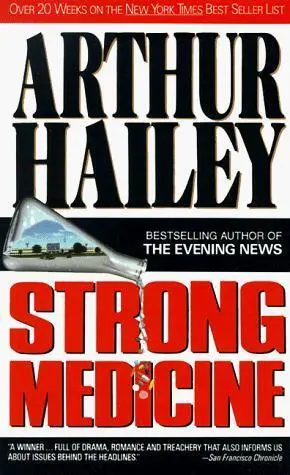
- Название:Strong Medicine
- Автор:
- Жанр:
- Год:неизвестен
- ISBN:нет данных
- Рейтинг книги:5 / 5. Голосов: 1
-
Избранное:Добавить в избранное
- Отзывы:
-
Ваша оценка:
Strong Medicine: краткое содержание, описание и аннотация
Предлагаем к чтению аннотацию, описание, краткое содержание или предисловие (зависит от того, что написал сам автор книги «Strong Medicine»). Если вы не нашли необходимую информацию о книге — напишите в комментариях, мы постараемся отыскать её.
Strong Medicine — читать онлайн бесплатно полную книгу (весь текст) целиком
Ниже представлен текст книги, разбитый по страницам. Система сохранения места последней прочитанной страницы, позволяет с удобством читать онлайн бесплатно книгу «Strong Medicine», без необходимости каждый раз заново искать на чём Вы остановились. Поставьте закладку, и сможете в любой момент перейти на страницу, на которой закончили чтение.
Интервал:
Закладка:
"And why not?" Celia shot back.”Men have used their masculinity for centuries, often to women's disadvantage, so it's our turn now. Anyway, man or woman, we're all entitled to make the most of what we have.”
In the end, Celia's memo was taken seriously and began a process in Felding-Roth which, during the years that followed, was copied enthusiastically by other drug houses. And during all this time, beyond the pharmaceutical business, outside events marched on. The tragedy of Vietnam was taking shape and worsening, with young Americans-the cream of a generation-being slain by tiny people in black pajamas, and no one really knowing why. A rock-music cult called "Woodstock Nation" flared briefly, then burned out. In Czechoslovakia the Soviet Union brutally extinguished freedom. Dr. Martin Luther King, Jr., and Robert Kennedy were savagely assassinated. Nixon became President, Golda Meir prime minister of Israel. Jackie Kennedy married Aristotle Onassis. Eisenhower died. Kissinger went to China, Armstrong to the moon, Edward Kennedy to Chappaquiddick. Then, in February 1972, Sam Hawthorne, at age fifty-one, became president and chief executive officer of Felding-Roth. His accession to power was sudden, and occurred at a difficult, critical period in the company's history.
Sam Hawthorne, in the jargon of the times, was a Renaissance man. He had a multiplicity of interests, indoors and out, intellectual and athletic. He was at heart a scholar who, despite heavy involvement in business, managed to keep alive a lifelong, well-informed love of literature, art and music. In foreign cities, no matter how great the pressures of work Sam would somehow find time to visit bookstores, galleries and concerts. In painting he favored the Impressionists, inclining to Monet and Pissarro. In sculpture his great love was Rodin. Lilian Hawthorne once told a friend that in Paris, in the garden of the Rodin Museum, she had seen her husband stand silent for fifteen minutes contemplating "The Burghers of Calais," much of the time with tears in his eyes. In music, Sam's passion was Mozart. A proficient pianist himself, though not a brilliant one, he liked to have a piano in his hotel suite while on trips and play something from Mozart, perhaps the Sonata No. I I in A-the grave and clear Andante, the quickening Menuetto, and finally the joyous Turkish Rondo, sending his spirits soaring after a tiring day. The fact that he had a piano in what was usually a luxury suite was because he paid for such things himself. He could afford to. Sam was independently wealthy and owned a substantial amount of Felding-Roth stock, having inherited it from his mother who died when he was young.
His mother had been a Roth, and Sam was the last member of either the Felding or Roth clan to be involved in company management. Not that his family connections had made much, if any, difference to his career; they hadn't, particularly as he neared the top. What Sam had achieved was through ability and integrity, and the fact was widely recognized. At home, Sam and Lilian Hawthorne's marriage was solid and both adored Juliet, now fifteen and apparently unspoiled despite the adoration. In athletics Sam had been a long-distance runner in college and still enjoyed an tarly morning run several times a week. He was an enthusiastic and fairly successful tennis player, though the enthusiasm was stronger than his style. Sam's greatest asset on the court was a vicious volley at the net, making him a popular doubles partner. But dominating all outside interests, sporting or cerebral, was the fact that Sam Hawthorne was an Anglophile. For as long as he could remember he had loved visiting England, and felt an admiration and affinity for most things English-traditions, language, education, humor, style, the monarchy, London, the countryside, classic cars. In line with the last preference, he owned and drove to work each day a superb silver-gray Rolls-Bentley. Something else that held Sam's high opinion was British-not just English-science, and it was this conviction that prompted an original, daring proposal during the opening months of his FeldingRoth presidency. In a confidential, written submission to the board of directors he set out some stark, unpleasant facts. "In drug research and production--our raison detre--our company is in a barren, dispiriting period which has extended far beyond the 'flat spell' experienced by this industry generally. Our last major breakthrough was with Lotromycin, nearly fifteen years ago. Since then, while competitors have introduced major, successful new drugs, we have had only minor ones. Nor do we have anything startling in sight. "All this has had a depressing effect on our company's reputation and morale. Equally depressing has been the effect on finances. It is the reason we reduced our dividend last year, an action which caused the value of our stock to plummet, and it is still out of favor with investors.
"We have begun internal belt tightening, but this is not enough. In two to three years, if we fail to produce a strong, positive program for the future we will face a financial crisis of the gravest kind.”
What Sam did not say was that his predecessor as president and CEO, who had been dismissed after a confrontation with the board, had followed a top-level policy of "drift" which, in large part, had reduced Felding-Roth Pharmaceuticals to its present sorry state. Instead, and having set the stage, Sam moved on to his proposal. "I strongly and urgently recommend," he wrote, "that we create a Felding-Roth Research Institute in Britain. The institute would be headed by a topflight British scientist. It would be independent of our research activities in the United States.”
After more details he added, "I profoundly believe the new suggested research arm would strengthen our most critical resource area and hasten discovery of the important new drugs our company so desperately needs.”
Why Britain? Anticipating the question, Sam proceeded to answer it. "Traditionally, through centuries, Britain has been a world leader in basic scientific research. Within this century alone, consider some of the great discoveries which were British in origin and which changed our way of life dramatically-penicillin, television, modem radar, the airplane jet engine, to name just four. "Of course," Sam pointed out, "it was American companies which developed those inventions and reaped commercial benefits -this because of the unique ability of Americans to develop and market, an ability the British so often lack. But the original discoveries, in those and other instances, were British. "If you asked me for a reason," he continued, "I would say there are fundamental, inherent differences between British and American higher education. Each system has its strengths. But in Britain the differences produce an academic and scientific curiosity unmatched elsewhere. It is that same curiosity we can, and should, harness to our advantage.”
Sam dealt at length with costs, then concluded, "It can be argued that embarking on a major costly project at this critical time in our company's existence is reckless and ill-advised. And, yes, a new research institute will be a heavy financial burden. But I believe it would be even more reckless, even more ill-advised, to continue to drift and not take strong, positive, daring action for the future action which is needed now!"
Opposition to Sam Hawthorne's plan surfaced with astounding speed and strength. The proposal was, as someone put it, "scarcely out of the Xerox machine" and beginning to circulate among company directors and a few senior officers when Sam's telephone began ringing, the callers forceful with objections.”Sure the Brits have had their scientific glories," one director argued, "but nowadays American achievements far exceed them, so your whole contention, Sam, is laughable.”
Others focused on-as one board member expressed it heatedly- "the absurd and backward-looking notion of locating a research center in an effete, run-down, has-been country.”
Читать дальшеИнтервал:
Закладка:
Похожие книги на «Strong Medicine»
Представляем Вашему вниманию похожие книги на «Strong Medicine» списком для выбора. Мы отобрали схожую по названию и смыслу литературу в надежде предоставить читателям больше вариантов отыскать новые, интересные, ещё непрочитанные произведения.










Обсуждение, отзывы о книге «Strong Medicine» и просто собственные мнения читателей. Оставьте ваши комментарии, напишите, что Вы думаете о произведении, его смысле или главных героях. Укажите что конкретно понравилось, а что нет, и почему Вы так считаете.