Arthur Hailey - Strong Medicine
Здесь есть возможность читать онлайн «Arthur Hailey - Strong Medicine» весь текст электронной книги совершенно бесплатно (целиком полную версию без сокращений). В некоторых случаях можно слушать аудио, скачать через торрент в формате fb2 и присутствует краткое содержание. Жанр: Современная проза, на английском языке. Описание произведения, (предисловие) а так же отзывы посетителей доступны на портале библиотеки ЛибКат.
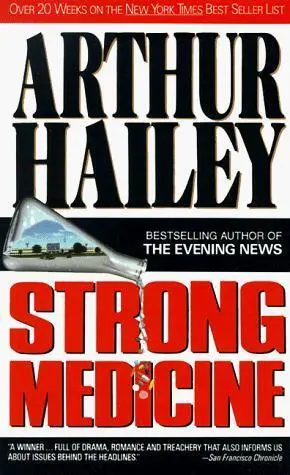
- Название:Strong Medicine
- Автор:
- Жанр:
- Год:неизвестен
- ISBN:нет данных
- Рейтинг книги:5 / 5. Голосов: 1
-
Избранное:Добавить в избранное
- Отзывы:
-
Ваша оценка:
Strong Medicine: краткое содержание, описание и аннотация
Предлагаем к чтению аннотацию, описание, краткое содержание или предисловие (зависит от того, что написал сам автор книги «Strong Medicine»). Если вы не нашли необходимую информацию о книге — напишите в комментариях, мы постараемся отыскать её.
Strong Medicine — читать онлайн бесплатно полную книгу (весь текст) целиком
Ниже представлен текст книги, разбитый по страницам. Система сохранения места последней прочитанной страницы, позволяет с удобством читать онлайн бесплатно книгу «Strong Medicine», без необходимости каждый раз заново искать на чём Вы остановились. Поставьте закладку, и сможете в любой момент перейти на страницу, на которой закончили чтение.
Интервал:
Закладка:
"Yet it didn't stop them, did it? Bastardsl They just went on delivering. Giving Noah anything he wanted. Helping him destroy himself. That's the rotten, filthy business your wife is in, Andrew, and I loathe it!" "There's something in what you've said, Hilda," he acknowledged.”Maybe a lot. And while it isn't the whole picture, I'd like you to know I understand your feelings.”
"Do you?" Hilda Townsend's voice mixed contempt and bitterness.”Then explain them to Celia sometime. Maybe she'll consider changing to another line of work.”
Then, as if a pent-up force had at last broken free, she put her head in her hands and began to cry. The mid-to-late-1960s was a time when women's lib became a phrase on many lips and a fixture in the news. In 1963 Betty Friedan had published The Feminine Mystique, a declaration of war on "the second-class citizenship of women.”
Her book became the vade mecum of the women's movement and the Friedan voice was now heard frequently. Germaine Greer and Kate Millett joined the movement, adding literary and artistic style. Gloria Steinem effectively combined women's advocacy with journalism and feminist politics. Women's lib had its mockers. Abbie Hoffman, a counterculturc celebrity of the period, declared, "The only alliance I would make with the women's lib movement is in bed.”
And historians, reminding the world that few things are ever new, pointed out that in 1792 in England, one Mary Wollstonecraft courageously published A Vindication of the Rights of Woman, arguing, "Tyrants and sensualists... endeavor to keep women in the dark, because the former only want slaves, and the latter a plaything.”
But many in the 1960s took the movement seriously, and thoughtful men explored their consciences. Celia's attitude to women's lib was approving and sympathetic. She bought copies of The Feminine Mystique and gave them to several male executives at Felding-Roth. One was Vincent Lord, who returned the book with a scribbled note, "I have no use for this rubbish.”
Sam Hawthorne, influenced by his wife Lilian, an ardent libber herself, was more sympathetic. He told Celia, "You're proof that this company has no sex discrimination.”
She shook her head in disagreement.”I had to claw my way to where I am, Sam-with your help, but also fighting male prejudice, and you know it.”
"But you don't have to do that anymore.”
"That's because I've proved myself as a producer, and I'm useful. Which makes me a freak, an exception. Also, you know how little support there is whenever I argue for more women on the detail force.”
He laughed.”Okay, I concede, but attitudes are changing. Apart from that, you're still the best example a man could have for treating women as equals.”
Despite her private advocacy, Celia took no active part in women's lib. She decided--selfishly, as she admitted to herself-that, first, she didn't need it personally; second, she didn't have the time. Celia's working time continued to be occupied with O-T-C products at Bray & Commonwealth. Despite Sam's promise of a change to other duties, no new assignment seemed in sight for Celia, and his urging to "be patient for a few months" proved an underestimate. Meanwhile, at home, Celia shared with Andrew the anguish following Noah Townsend's breakdown and committal to a mental institution. As time went on, the prediction of Dr. Gould that Noah would never be discharged seemed increasingly and sadly to be true. Andrew had told Celia of Hilda Townsend's tirade about drug companies and excessive free samples, and was surprised to find her sympathetic.”Hilda's right," Celia said.”The amount of free drugs handed out is crazy and I guess we all know it. But competition made the scene the way it is. Now, no one company could cut back without being at a disadvantage.”
"Surely," Andrew remonstrated, "drug companies could get together and make some agreement to cut back.”
"No," Celia said.”Even if they wanted to, that would be collusion and against the law.”
"Then how about a case like Noah's? Where drug company detail people must have known, or at least had a good idea, that Noah was heavily on drugs. Should they have kept feeding his habit the way they did?" "Noah was an addict, but he was still a doctor," Celia pointed out.”And you know perfectly well, Andrew, doctors can get all the drugs they want, one way or another. If Noah hadn't got his from detail people he'd simply have written prescriptions, which maybe he did as well as getting samples.”
She added with some heat, "Besides, when the medical profession does nothing about doctors who become addicts, why should pharmaceutical companies be expected to be different?" "A fair question," Andrew conceded, "for which I don't have an answer.”
Then, in August of 1967, Celia's reassignment happened. Preceding it, one significant event occurred near the end of 1966. Sam Hawthorne was promoted to executive vice president, making it clear that unless something accidental intervened, Sam would someday soon be at the head of Felding-Roth. Thus, Celia's judgment ten years earlier when choosing a mentor in the company seemed close to being proved correct. It was Sam who eventually sent for her and told her with a smile, "Okay, your O-T-C servitude is over.”
Sam was now in a palatial office with a comfortable conference area, and instead of one secretary outside his door, his new job rated two. At a previous meeting he confided to Celia, "Damned if I know how I keep them busy. I think they dictate letters to each other.”
Now Sam announced, "I'm offering you the post of Latin-American Director for Pharmaceutical Products. If you accept you'll operate from here, though you'll be away a bit, with quite a lot of travel.”
He regarded her interrogatively.”How would Andrew feel about that? And you about the children?" Without hesitation Celia answered, "We'll work it out.”
Sam nodded approvingly.”I expected that was what you'd say.”
The news delighted and excited her. Celia was well aware that international business in pharmaceuticals was becoming increasingly important. The opportunity was excellent, even better than she had hoped for. As if reading her mind, Sam said, "International is where the future is for sales. So far we've barely probed beneath the surface, in Latin America especially.”
He waved a hand in dismissal.”Go home now. Share the news with Andrew. Tomorrow we'll get down to details.”
Thus began five years which proved a Rubicon in Celia's career. It also, far from making the Jordans' family life more difficult, immeasurably enriched it. As Celia was to write later in a letter to her sister Janet, "All of us benefited in ways we never expected. Andrew and I because we had more real togetherness when Andrew traveled with me than we ever did at home, where both of us were busy with our separate working lives. And the children gained because when they traveled too, it enlarged their education and made their thinking international.”
From the beginning, when Celia brought home the news about her new appointment, Andrew was happy for her and supportive. He was relieved that her time with O-T-C was over, and if he had doubts about family separations which her new work would entail, he kept them to himself. His attitude, like Celia's, was: We'll make it work. Then, thinking about it more, Andrew decided he would use the opportunity to take some time away from the pressures of medicine and travel with Celia when he could. Andrew, now just a year away from being forty, was determined to profit from the lesson of Noah Townsend whose breakdown, he believed, began with overwork and too much stress. Andrew had watched other doctors, too, become obsessed with their profession to the exclusion of all else, to the detriment of themselves and their families. In the medical practice he had joined as a newly qualified internist eleven years earlier-the year before he and Celia met and were married-Andrew was now senior partner. The second doctor, Oscar Aarons, a stocky, brisk and bustling Canadian with a lively sense of humor, had proved to be an asset in whom Andrew had great confidence, and he enjoyed their burgeoning friendship. A third internist, Benton Fox, a twenty-eight-year-old with excellent credentials, had been with them for just a month and was already working well. When Andrew told Celia of his intention to travel with her sometimes she was ovedoyed; as it worked out, he went along on South American journeyings several times a year. Occasionally, depending on school arrangements, one or both of the children traveled too. All of it was made easier by some fortunate arrangements at home. Winnie August their young English housekeeper-cum-cook, having long ago abandoned her plan to move on to Australia, and being virtually a member of the Jordan family after seven years, was married in the spring of '67. Incredibly, her husband's last name was March. As Winnie put it, "If it 'ad to be another month, I should be glad it ain't December.”
Читать дальшеИнтервал:
Закладка:
Похожие книги на «Strong Medicine»
Представляем Вашему вниманию похожие книги на «Strong Medicine» списком для выбора. Мы отобрали схожую по названию и смыслу литературу в надежде предоставить читателям больше вариантов отыскать новые, интересные, ещё непрочитанные произведения.












Обсуждение, отзывы о книге «Strong Medicine» и просто собственные мнения читателей. Оставьте ваши комментарии, напишите, что Вы думаете о произведении, его смысле или главных героях. Укажите что конкретно понравилось, а что нет, и почему Вы так считаете.