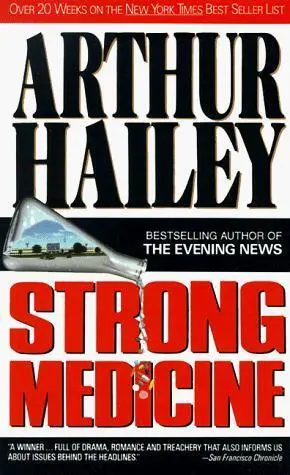
Arthur Hailey - Strong Medicine
Здесь есть возможность читать онлайн «Arthur Hailey - Strong Medicine» весь текст электронной книги совершенно бесплатно (целиком полную версию без сокращений). В некоторых случаях можно слушать аудио, скачать через торрент в формате fb2 и присутствует краткое содержание. Жанр: Современная проза, на английском языке. Описание произведения, (предисловие) а так же отзывы посетителей доступны на портале библиотеки ЛибКат.
- Название:Strong Medicine
- Автор:
- Жанр:
- Год:неизвестен
- ISBN:нет данных
- Рейтинг книги:5 / 5. Голосов: 1
-
Избранное:Добавить в избранное
- Отзывы:
-
Ваша оценка:
Strong Medicine: краткое содержание, описание и аннотация
Предлагаем к чтению аннотацию, описание, краткое содержание или предисловие (зависит от того, что написал сам автор книги «Strong Medicine»). Если вы не нашли необходимую информацию о книге — напишите в комментариях, мы постараемся отыскать её.
Strong Medicine — читать онлайн бесплатно полную книгу (весь текст) целиком
Ниже представлен текст книги, разбитый по страницам. Система сохранения места последней прочитанной страницы, позволяет с удобством читать онлайн бесплатно книгу «Strong Medicine», без необходимости каждый раз заново искать на чём Вы остановились. Поставьте закладку, и сможете в любой момент перейти на страницу, на которой закончили чтение.
Интервал:
Закладка:
"Yes, you can," Celia said.”Unfortunately, most of us don't.”
Bruce's fascination with history continued during a second tour of Cambridge. conducted, this time for the children, by Martin Peat-Smith. Celia met regularly with Martin during her working trips to Britain, though their total time together was not great because each was busy in differing ways. Martin, now that his decision to join Felding-Roth was made, showed himself very much in charge, and aware of his requirements of equipment and staff. He recruited another nucleic acid chemist, a young Pakistani, Dr. Rao.Sastri, who would be second-in-command on the scientific side. There were specialist technicians, including a cell culture expert and another skilled in electrophoretic separation of proteins and nucleic acids. A woman animal care supervisor would safeguard the hundreds of rats and rabbits to be used in experiments. During visits to Harlow, Martin discussed the location of laboratories, staff, and equipment in the building where conversion work was already under way. However, such visits were brief, and until the institute was ready Martin would continue research in his Cambridge lab. Apart from the necessary excursions to Harlow, Martin insisted that his time not be taken up by administrative matters which others could handle-a strategy already endorsed by Sam Hawthorne and implemented by Celia. Celia hired an administrator whose name was Nigel Bentley. A smallish, confident, sparrowlike man in his mid-fifties, Bentley had recently retired from the Royal Air Force where, with the rank of squadron leader, he was in charge of the administrative side of a large RAF hospital. The ex-officer's qualifications for the new post were excellent; he also understood what was expected of him. In Celia's presence, Bentley told Martin, "The less I bother you, sir-in fact, the less you see of me-the better I'll be doing my job.”
Celia liked the statement, also the "sir," which was a gracious way of making clear that Bentley understood what the relationship between himself and the much younger scientist was expected to be. In between trips to Britain, and while Celia was back in the United States, a personal milestone-at least, as she saw it--occurred in her life. That was in September 1972 when Lisa, at age fourteen, excitedly left home to enter boarding school. The school was Emma Willard in upstate New York, and the whole family accompanied Lisa on her odyssey. At home during dinner the night before, Celia asked Andrew nostalgically, "Where did all those years go?" But it was Lisa--ever practical-who answered, "They happened while you were getting all those promotions at work, Mommy. And I've figured out that I'll just be graduating from college when you get to sit in Mr. Hawthorne's chair.”
They all laughed at that, and the good time extended through the next day when they, with other parents, families and new girls, were initiated into the beauty, enlivening spirit, and traditions of Emma Willard School. Two weeks later Celia returned once more to Britain. Sam Hawthorne, deeply involved with other requirements of the company presidency, was now leaving almost all details of the British scene to her. Eventually. in February 1973, the Felding-Roth Research Institute (U.K.) Limited was officially opened. At the same time, Dr. Martin Peat-Smith's research project into Alzheimer's disease and the mental aging process was transferred from Cambridge to Harlow. It had been decided, as a matter of company policy, that no other research wouid be embarked on in Britain for the time being. The reasoning, as Sam confided it to the board of directors at a meeting in New Jersey, was that "the project we now have is timely, damned exciting, and with big commercial possibilities; therefore we should concentrate on it.”
No public fanfare was made about the Harlow opening.”The time for fanfare," declared Sam, who had flown over for the occasion, "is when we have something positive to show, and that isn't yet.”
When would there be something positive? "Allow me two years," Mar-tin told Sam and Celia during a relaxed private moment.”There ought to be some progress to report by then.”
After the institute's opening, Celia's visits to Britain became fewer and shorter. For a while she went, as Sam's representative, to help smooth cut initial working problems. But, mostly, Nigel Bentley seemed to be justifying the confidence placed in him by his appointment as administrator. From Martin, as months went by, there was no specific news except, via Bentley, that research was continuing. At Felding-Roth's New Jersey headquarters, Celia continued as special assistant to the president, working on other projects Sam gave her. It was during this period that, on the national scene, the putrescent boil of Watergate burst. Celia and Andrew, like millions of others worldwide, watched the parade of events nightly on television and were caught up in the unfolding drama's fascination. Celia reminisced about how, a year earlier when driving to Harlow with Sam, she had dismissed the first published report of a Watergate burglary as insignificant. Near the end of April, while tension mounted, two haughty presidential aides--Haldeman and Ehrlichman-were thrown to the wolves by President Nixon in an attempt to save himself Then, in October, adding to Nixon's and the nation's misery, Vice President Agnew was ejected from office for other corruption, unconnected with Watergate. Finally, ten months later, Nixon himself reluctantly became the first American President to resign. As Andrew remarked, "Whatever else history may say, at least he'll be in The Guinness Book of Records.” Nixon's successor promptly granted his predecessor a pardon-inadvance against criminal prosecution and, when asked if it was all tit-for-tat pol&cs, proclaimed, "There was no deal.”
Watching and hearing the statement on TV, Celia asked Andrew, "Do you believe that?" "No.,' She said emphatically, "Nor do L" Around the same time-less significant on the larger scene, but important to the Jordan family-Bruce, too, left home to enter prep school-the Hill School, at Pottstown, Pennsylvania. Through the entire period and into 1975 the fortunes of FeldingRoth, while not spectacular, maintained an even keel. They were helped by two products developed in the company's own laboratories-an anti-inflammatory for rheumatoid arthritis and a betablocker called Staidpace, a medicine to slow heartbeat and reduce blood pressure. The arthritis drug was only moderately successful but Staidpace proved an excellent, lifesaving product which became widely used. Staidpace would have contributed even more to Felding-Roth revenues had its United States approval not been delayed by the Food and Drug Administration for what seemed an unconscionable time-in the company's view, two years longer than necessary. At FDA's Washington headquarters there seemed, in the frustrated words of Felding-Roth's research director, Vincent Lord, "an infectious unwillingness to make a decision about anything.”
The opinion was echoed by other drug firms. Reportedly, one senior FDA official exhibited proudly on his desk a plaque with the famed promise of France's Marshal P6tain in World War 1, "They shall not pass.” It appeared to sum up neatly the attitude of FDA's staff to any new drug application. It was about this time that the phrase "drug lag"--describing the non-availability in the United States of beneficial drugs in use else- where-began to be used and gain attention. Yet, always, a routine reply to any plea for faster action on new drug approvals was: "Remember Thalidomide!" Sam Hawthorne tackled this attitude head-on in a speech to an industry convention.”Strong safety standards," he declared, "are necessary in the public interest, and not long ago, too few of them existed. But pendulums swing too far, and bureaucratic indecision has now become a national disservice. As to critics of our industry who point back to Thalidomide, I point forward to this: The number of Thalidomide-deformed babies is now exceeded by the number of those who have suffered or died because effective drugs, held back by American regulatory delays, are failing to reach them in their time of need.”
Читать дальшеИнтервал:
Закладка:
Похожие книги на «Strong Medicine»
Представляем Вашему вниманию похожие книги на «Strong Medicine» списком для выбора. Мы отобрали схожую по названию и смыслу литературу в надежде предоставить читателям больше вариантов отыскать новые, интересные, ещё непрочитанные произведения.










Обсуждение, отзывы о книге «Strong Medicine» и просто собственные мнения читателей. Оставьте ваши комментарии, напишите, что Вы думаете о произведении, его смысле или главных героях. Укажите что конкретно понравилось, а что нет, и почему Вы так считаете.