Arthur Hailey - Strong Medicine
Здесь есть возможность читать онлайн «Arthur Hailey - Strong Medicine» весь текст электронной книги совершенно бесплатно (целиком полную версию без сокращений). В некоторых случаях можно слушать аудио, скачать через торрент в формате fb2 и присутствует краткое содержание. Жанр: Современная проза, на английском языке. Описание произведения, (предисловие) а так же отзывы посетителей доступны на портале библиотеки ЛибКат.
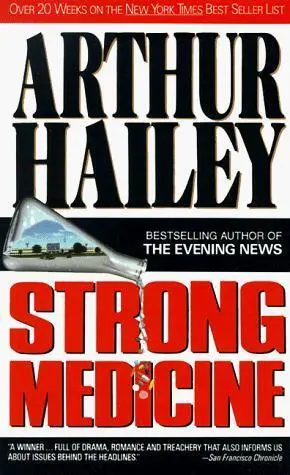
- Название:Strong Medicine
- Автор:
- Жанр:
- Год:неизвестен
- ISBN:нет данных
- Рейтинг книги:5 / 5. Голосов: 1
-
Избранное:Добавить в избранное
- Отзывы:
-
Ваша оценка:
Strong Medicine: краткое содержание, описание и аннотация
Предлагаем к чтению аннотацию, описание, краткое содержание или предисловие (зависит от того, что написал сам автор книги «Strong Medicine»). Если вы не нашли необходимую информацию о книге — напишите в комментариях, мы постараемся отыскать её.
Strong Medicine — читать онлайн бесплатно полную книгу (весь текст) целиком
Ниже представлен текст книги, разбитый по страницам. Система сохранения места последней прочитанной страницы, позволяет с удобством читать онлайн бесплатно книгу «Strong Medicine», без необходимости каждый раз заново искать на чём Вы остановились. Поставьте закладку, и сможете в любой момент перейти на страницу, на которой закончили чтение.
Интервал:
Закладка:
Also at dinner that night was Juliet Hawthorne, now nineteen and home briefly from college. She had become a beautiful, poised young woman who seemed to have suffered not at all from the attention lavished on an only child. Escorting her was a, pleasant, interesting young man whom Juliet introduced as "Dwight Goodsmith, my boyfriend. He's studying to be a lawyer.”
Celia and Andrew were impressed with both young people, Celia reflecting how short a time ago it seemed that Juliet and Lisa, as small children in pajamas, had chased each other through this same room where they were dining. After Lilian's toast to Celia, Sam said with a smile, "What Celia doesn't know yet, because I only approved a memo about it late today, is the real promotion. She now has her own parking slot on the catwalk level.”
"My God, Daddy!" Juliet said, and to her friend: "That's like being selected for the Hall of Fame.”
The so-called catwalk level was the top floor of a garage and parking structure alongside the Felding-Roth headquarters building. The level was reserved for the company's most senior officers who could park their cars, then use a convenient glassed-in ramp to reach the opposite story of the main building where a private elevator whisked them to the eleventh floor and "executive country.”
Sam was one of those who used the catwalk level and parked his silver-gray Rolls-Bentley there each day, preferring it to a chauffeured limousine to which, as president, he was entitled.
Others in the company with lesser status used lower parking levels, then had to take an elevator downward, cross to the other building in the open, and go up again. There was more good-natured banter about Celia's "double elevation" before the evening ended. In their car going home, Andrew, who was driving, said, "It turned out to be a wise decision you made, years ago, to hitch your career to Sam's.- "Yes," Celia said, then added, "lately I've been concerned about him.”
"Why?" 'He's more driven than he used to be, and he agonizes when something doesn't go right, though I suppose both things go with big responsibility. But there are also times when he's secretive, as if there are things he's worrying about but doesn't want to share.”
"You've enough responsibility of your own," Andrew reminded her, "without taking on Sam's psyche too.”
"I suppose so. You get wiser every day, Dr. Jordan.”
Celia squeezed her husband's arm gratefully. "Quit making sexual advances to the driver," Andrew told her.”You're distracting him.”
A few minutes later, he asked, "Speaking of hitching careers to stars, what's happened to that young man who hitched his to yours?" "Bill Ingram?" Celia laughed; she always remembered the first time Ingram had come to her favorable attention-at the QuadrilleBrown advertising meeting in New York.”Bill has been working in International as Latin-American Director-the job I had. Now we're thinking of bringing him to pharmaceutical sales with a promotion.”
"Nice," Andrew said.”Looks as if he made a good star-choice too.”
Amid Celia's happiness about her promotion, a note of grief intruded. Teddy Upshaw died, while working at his desk, from a heart attack. Teddy had remained as O-T-C sales manager, having found his niche, which he filled successfully and happily. At his death he was less than a year from retirement. It grieved Celia that she would never again hear Teddy's lively voice, watch his energetic stride, or see his bouncing-ball head while he talked enthusiastically. Celia, with Andrew, and others from the company, attended Teddy's funeral and accompanied the cortege to the graveside. It was a miserable, blustery March day, with showers of freezing rain, and the mourners huddled in their coats while sheltering under wind-besieged umbrellas. Some, including Celia and Andrew. went to the Upshaws' home afterward, and it was there that Teddy's widow, Zoe, took Celia aside. "Teddy admired you so much, Mrs. Jordan," Zoe said.”He was proud to work for you, and he used to say that as long as you were at Felding-Roth, the company would always have a conscience.”
Celia, moved by the words, remembered the first day she had become aware of Teddy-fifteen years earlier, immediately after her speech to the Waldorf sales convention, when she had been ordered from the meeting hall in apparent disgrace. His was one of the few sympathetic faces she had seen on the way out. "I loved Teddy, too," she told the other woman. Afterward Andrew asked, "What was it Mrs. Upshaw said to you?" Celia told him, adding "I haven't always lived up to Teddy's ideal. I remember that fight, the argument, you and I had in Ecuador when you pointed out some places where I'd ignored my conscience, and you were right.”
"We were both right," Andrew corrected her, "because you brought up some things that I'd done, or hadn't done, too. But none of us is perfect, and I agree with Teddy. You are FeldingRoth's conscience, I'm proud of you for it, and I hope you'll stay that way.”
The following month brought better news, for the world at large and, in a narrower sense, for Felding-Roth. The war in Vietnam was over. It was a crushing defeat for America, a nation not accustomed to defeats. Yet, the tragic slaughter had ceased and the task ahead-formidable but less bloody-was the healing of national wounds, more divisive and bitter than any since the Civil War. "In our lifetimes the bitterness won't end," Andrew predicted one evening, after he and Celia had watched on television the final, humiliating exodus of Americans from Saigon.”And historians, two centuries from now, will still be arguing the rights and wrongs about our being in Vietnam.”
"I know it's selfish," Celia said, "but all I can think of is, thank heaven it finished before Brucie was old enough to go!" A week or two later, the hierarchy of Felding-Roth was cheered by news from France that the drug Montayne had been approved for manufacture and sale in that country. It meant that under the licensing agreement between Felding-Roth Pharmaceuticals and Laboratoires Gironde-Chimie, American testing of Montayne would now begin. As to the drug's purpose, Celia had suffered some unease on first learning that it was intended for pregnant women, to be taken early in their pregnancy when nausea and morning sickness were most prevalent conditions which Montayne would banish. Celia, like others, had strong memories of Thalidomide and its awful aftermath. She also remembered how glad in retrospect she had been that during both of her own pregnancies Andrew had insisted she take no drugs at all. She had confided her concern to Sam, who was understanding and sympathetic.”When I first heard about Montayne," he admitted, "my reaction was the same as yours. But since then I've learned more about it, convincing me it's a splendidly effective, yet totally safe drug.”
Since Thalidomide, Sam pointed out, fifteen years had passed during which time there had been enormous progress in pharmaceutical research, including scientific testing of new drugs. As well, government regulations in 1975 were stricter by far than in the 1950s. "Many things change," Sam insisted.”For example, there was a time when the idea of using anesthetics during childbirth was fiercely opposed by some who believed it would be dangerous and destructive. In the same way there can, and must, be safe drugs for use during pregnancy. Montayne is simply one whose time has come.”
He urged Celia to keep an open mind until she had examined all the data. She promised that she would. The importance of Montayne to Felding-Roth was underlined soon afterward when the vice president and comptroller, Seth Feingold, confided to Celia, "Sam has promised the board that Montayne will give us a big boost moneywise, which we sure as hell need. This year our balance sheet looks like we're candidates for a welfare handout.”
Читать дальшеИнтервал:
Закладка:
Похожие книги на «Strong Medicine»
Представляем Вашему вниманию похожие книги на «Strong Medicine» списком для выбора. Мы отобрали схожую по названию и смыслу литературу в надежде предоставить читателям больше вариантов отыскать новые, интересные, ещё непрочитанные произведения.









Обсуждение, отзывы о книге «Strong Medicine» и просто собственные мнения читателей. Оставьте ваши комментарии, напишите, что Вы думаете о произведении, его смысле или главных героях. Укажите что конкретно понравилось, а что нет, и почему Вы так считаете.