Arthur Hailey - Evening News
Здесь есть возможность читать онлайн «Arthur Hailey - Evening News» весь текст электронной книги совершенно бесплатно (целиком полную версию без сокращений). В некоторых случаях можно слушать аудио, скачать через торрент в формате fb2 и присутствует краткое содержание. Жанр: Современная проза, на английском языке. Описание произведения, (предисловие) а так же отзывы посетителей доступны на портале библиотеки ЛибКат.
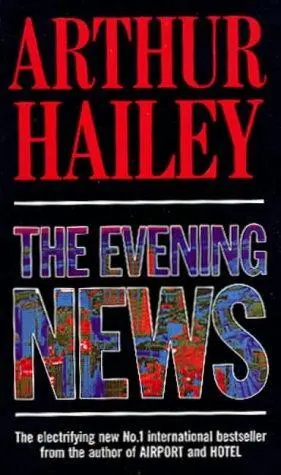
- Название:Evening News
- Автор:
- Жанр:
- Год:неизвестен
- ISBN:нет данных
- Рейтинг книги:3.5 / 5. Голосов: 2
-
Избранное:Добавить в избранное
- Отзывы:
-
Ваша оценка:
Evening News: краткое содержание, описание и аннотация
Предлагаем к чтению аннотацию, описание, краткое содержание или предисловие (зависит от того, что написал сам автор книги «Evening News»). Если вы не нашли необходимую информацию о книге — напишите в комментариях, мы постараемся отыскать её.
Evening News — читать онлайн бесплатно полную книгу (весь текст) целиком
Ниже представлен текст книги, разбитый по страницам. Система сохранения места последней прочитанной страницы, позволяет с удобством читать онлайн бесплатно книгу «Evening News», без необходимости каждый раз заново искать на чём Вы остановились. Поставьте закладку, и сможете в любой момент перейти на страницу, на которой закончили чтение.
Интервал:
Закладка:
Allowing for the fact that some heads of companies were too old to be eligible, there were three strong candidates. Margot Lloyd-Mason was one.
Margot was conscious of this as she reported early in the proceedings on the state of CBA.
Speaking precisely, she disclosed that since Globanic Industries' acquisition of CBA television and radio network and affiliated stations, strict financial controls had been introduced, budgets pared and redundant personnel dismissed. As a result, third-quarter profits would be up twenty-two percent compared with the pre-Globanic year before.
”That's a fair beginning,” Theodore Elliott commented, "though we'll expect even better in future.” There were confirming nods from others in the room.
Margot had dressed carefully today, not wanting to appear too feminine, yet at the same time not wishing to lose the advantage of her sex. At first she considered wearing a tailored suit, as she often did in her office at Stonehenge, but decided it was inappropriate in the semi tropics. In the end she chose beige linen slacks and a cotton sweater in a soft peach shade. The outfit emphasized her well-proportioned body, a judgment confirmed by lingering glances from some of the men.
Continuing her report, Margot mentioned the recent kidnapping of the Crawford Sloane family.
The chairman of International Forest Products, a hard driving Oregonian named DeWitt, injected, "That's too bad and we all hope they catch those people. Just the same, your network's getting a lot of attention from it.”
"So much attention,” Margot informed him, "that our National Evening News ratings have soared from 9.2 to 12.1 within the past five days, which means an additional six million viewers and puts us strongly in front as number one. It's also raised the rating of our daily game show, carried by our five owned and operated stations immediately after the news. And the same is true of our prime-time shows, especially the Ben Largo Show on Friday which went from 22.5 to 25.9. The sponsors all around are delighted; as a result we're pushing hard with next season's advertising.”
Someone asked, "Does that spread of good ratings mean most people don't change channels?” The question reminded Margot that even among this exalted group there was an inherent fascination with the minutiae of broadcasting.
”Networks know from experience that if viewers tune in to the evening news the odds are they will stay with that network for the next ninety minutes, sometimes more. At the same time, others join the audience.”
"So it's an ill wind . . . as the old saying goes,” the forest products chief said, smiling. Margot smiled back.”Since we're here in private I'll agree, though please don't quote me.”
"No one quotes anybody,” Theo Elliott said.”Privacy and truth are why we hold these sessions.”
"Speaking of your advertisers, Margot.” The voice belonged to Leon Ironwood of West World Aviation, a tanned, athletic Californian and another of the three contenders to be Elliott's successor. The company Ironwood headed was a successful defense contractor making fighter airplanes.”What's the latest on that ongoing problem of video recording machines? How many households have them anyway?”
"About fifty percent,” Margot acknowledged, "and you're right about the problem. Most of those who record network programs later zip through commercials without watching, thereby diminishing our advertising effectiveness.”
Ironwood nodded.”Especially since VCR owners represent an affluent population group. It's how I watch TV.”
Someone else added, "And don't forget mute buttons. I use mine whenever there's a commercial.”
"The truth is,” Margot said, "the whole VCR and mute problems are like permanent storm clouds over us, which is why networks have dragged their feet in researching their effects. There could have been a measuring technique long ago, except we don't want to know the bad news, and in that we have an ally—advertising agencies who fear that knowledge would turn off big advertisers, depriving the agencies of enormous business.”
"I'm sure,” Elliott prompted, "that your fiscal planning has taken that into account.”
"It has, Theo. Looking ahead and accepting that network advertising money will diminish, we're seeking additional revenue sources, and it's why CBA and others have quietly bought up TV cable operators and will acquire more. The networks have the capital and one day soon cable TV may wake up to find itself almost entirely owned by broadcast networks. At the same time, we're exploring joint-venture agreements with the phone companies.”
"Joint venture?” Ironwood asked
"I'll explain. First, accept the fact that terrestrial broadcasting—over-the-air television—is near the end of its useful life. Within ten to fifteen years about the only place you'll find an old-fashioned TV antenna is the Smithsonian; also by then, TV stations will have abandoned their conventional transmitters as uneconomic.”
"With cable and satellite dishes taking over?”
"Partly, but not entirely.” Margot smiled. She was dealing with a familiar subject as well as demonstrating, she hoped, her own farsightedness.
”The next thing to realize,” she continued, "is that there is no important future in this business for cable operators alone. To survive, they must pool resources—and so shall we—with the telephone people whose lines already go into every hom e.”
Several nodded approvingly as Margot declared, "The technology for a combination phone and TV line, using fiber-optic cable, is available now. It's simply a matter of getting the system working, which includes a network like ours developing specialized cable programming. The potential revenues are enormous.”
"Aren't there government restrictions,” Ironwood asked, "on phone companies entering the broadcast business?”
"Restrictions which the Congress will change. We're working on that; in fact legislation has been drafted.”
"And you're convinced Congress will go along?”
Theo Elliott laughed.”If she is, it's with good reason. I assume most of us here have read the book The Best Congress Money Can Buy. If not, it's must reading for people like ourselves . . . What's the author's name?”
"Philip Stern,” Margot said.
”Right. Well, just the way Stem described, Globanic Industries contributes handsomely to every Political Action Committee affecting our concerns, which means congressional votes are bought and ready when we need them. When Margot wants those regulations changed, she can let me know. I'll pass the word.”
"There's talk of abolishing the PAC system,” DeWitt said.
”And that's all it is—talk,” Elliott responded.”Besides, even if the name is changed, you can be sure those in Congress will find some other way to do exactly what they're doing now.”
The forthright, off-the-record talk continued. However, the subject of the Sloane family kidnapping was not brought up again.
Late in the morning it was the turn of K. Phocis ("Fossie") Xenos, chairman of Globanic Financial Services, to address his fellow CEO's.
Three years earlier Tri-Trade Financial Services, as it was then, was a consumer credit enterprise making loans to middleclass Americans from a chain of storefront offices; it also sold life and casualty insurance. Globanic then bought out TriTrade, Theo Elliott seeing it as a ready-made base—much simpler than starting a new company—for attracting international investors seeking entrepreneurial risk and glamour. He put Fossie Xenos in charge—a young second-generation Greek-American with an MBA degree from Wharton, who had come to Elliott's attention through some artful investment-bank maneuvers.
Almost the first thing Xenos did was dispose of the consumer credit business, which produced only modest profits, and close the storefront offices; soon after, he terminated the insurance activity, describing it as "small-time humdrum for mental midgets.” He was more interested in something fresh and exciting on the monetary scene—leveraged buyouts, known as LBO's, financed by junk bonds.
Читать дальшеИнтервал:
Закладка:
Похожие книги на «Evening News»
Представляем Вашему вниманию похожие книги на «Evening News» списком для выбора. Мы отобрали схожую по названию и смыслу литературу в надежде предоставить читателям больше вариантов отыскать новые, интересные, ещё непрочитанные произведения.










Обсуждение, отзывы о книге «Evening News» и просто собственные мнения читателей. Оставьте ваши комментарии, напишите, что Вы думаете о произведении, его смысле или главных героях. Укажите что конкретно понравилось, а что нет, и почему Вы так считаете.