Arthur Hailey - Evening News
Здесь есть возможность читать онлайн «Arthur Hailey - Evening News» весь текст электронной книги совершенно бесплатно (целиком полную версию без сокращений). В некоторых случаях можно слушать аудио, скачать через торрент в формате fb2 и присутствует краткое содержание. Жанр: Современная проза, на английском языке. Описание произведения, (предисловие) а так же отзывы посетителей доступны на портале библиотеки ЛибКат.
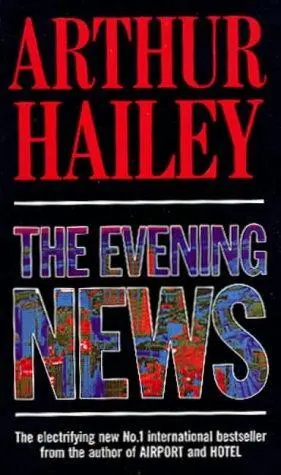
- Название:Evening News
- Автор:
- Жанр:
- Год:неизвестен
- ISBN:нет данных
- Рейтинг книги:3.5 / 5. Голосов: 2
-
Избранное:Добавить в избранное
- Отзывы:
-
Ваша оценка:
Evening News: краткое содержание, описание и аннотация
Предлагаем к чтению аннотацию, описание, краткое содержание или предисловие (зависит от того, что написал сам автор книги «Evening News»). Если вы не нашли необходимую информацию о книге — напишите в комментариях, мы постараемся отыскать её.
Evening News — читать онлайн бесплатно полную книгу (весь текст) целиком
Ниже представлен текст книги, разбитый по страницам. Система сохранения места последней прочитанной страницы, позволяет с удобством читать онлайн бесплатно книгу «Evening News», без необходимости каждый раз заново искать на чём Вы остановились. Поставьте закладку, и сможете в любой момент перейти на страницу, на которой закончили чтение.
Интервал:
Закладка:
But gradually, discarding earlier assumptions and with specific memories returning, the likelihood grew stronger. Wasn't it possible, she reasoned, that she, Nicky and Angus had been unconscious far longer than she had considered possible, even when she thought they might be in a southern U.S. state? Obviously, yes.
Yet if this was Peru, how had they been brought here? It could not have been easy to smuggle three unconscious people . . .
A sudden flash of memory! An image sharp and clear, yet totally forgotten until now.
During that brief interval when she struggled and managed to wound Cutface . . . in those desperate moments she had seen two empty funeral caskets, one smaller than the other. That terrifying sight had convinced her she and Nicky were about to be killed.
But now, with a shudder, Jessica realized they must have been brought here in those caskets—like dead people! The thought was so horrific that she wouldn't, couldn't think of it. Instead, she forced her mind back to the present, grim and painful as it was.
Jessica, Nicky and Angus, with their hands tied behind them, were still walking, stumbling over the narrow trail hemmed in by densely growing trees and undergrowth. Some armed men were ahead, others behind. At any sign of slowing, those behind shouted, " Andale! Apurense! “ prodding with their rifles to urge the captives on.
And it was hot. Incredibly hot. Sweat poured from them all.
Jessica worried desperately about the other two. She herself was suffering an intense headache, nausea, and a myriad of buzzing insects she was unable to brush away. How long could this go on? Nicky had said they were going to a river. Surely they must get there soon!
Yes, Jessica decided, Nicky's informant must have been right. This was Peru and, realizing how far from home they had come and how remote were the chances of their being rescued here, she felt like weeping.
The ground beneath her feet had become soggy, making it increasingly difficult to walk. Suddenly, behind her, Jessica heard a sharp cry, a commotion and a thud. Turning, she saw that Angus had fallen. His face was in mud.
Gamely, the old man struggled to get up, but failed because of his tied hands. Behind him the men with guns laughed. One of them lunged forward with his rifle, ready to thrust the barrel in Angus's back.
Jessica screamed at the man, "No, no, no!”
The words briefly startled him and before he could recover, Jessica ran to Angus and dropped to her knees beside him. She managed to keep her body upright, even with her hands tied, though was helpless to assist Angus to his feet. The man with the gun moved angrily toward her, but stopped at the sound of Miguel's sharp voice. From the front of the column, Miguel now appeared, with Socorro and Baudelio behind him.
Before anyone else could speak, Jessica raised her voice, strong with emotion.”Yes, we are your prisoners. We don't know why, but we know we can't escape, and so do you. Why, then, tie our hands? All we want is to help ourselves, to keep from falling. Look what happens when we can’t Please, please, show some mercy! I beg you, free our hands!”
For the first time, Miguel hesitated, especially as Socorro told him softly, "If one of them breaks a leg or arm, or even has a cut, it could be infected. In Nueva Esperanza we'll have no means of dealing with infection.”
Beside her, Baudelio said, "She's right.”
Miguel, with an impatient gesture, snapped an order in Spanish. One of the men with guns stepped forward—the same man who had helped Nicky in the truck. From a sheath fastened to his belt he produced a knife and reached behind Jessica. She felt the rope binding her wrists loosen, then fall away. Nicky was next. Angus was propped up while his bonds were severed too, then Jessica and Nicky helped him stand.
Amid shouted commands, they again moved forward.
In the past few minutes, despite her emotion, Jessica had learned several things. First, their destination was Nueva Esperanza, though the name meant nothing to her. Second, the man who had befriended Nicky was Vicente—she'd heard his name used when he cut the bonds. Third, the woman who interceded with Miguel, the same one who struck Jessica in the hut, possessed some medical knowledge. So did Cutface. Possibly one or the other was a doctor, perhaps both,
She squirreled the nuggets of information away, instinct telling her that whatever she could learn might prove useful later.
Moments later, as the column rounded a bend in the trail, a wide river appeared ahead.
* * *
Miguel remembered reading in his early nihilist days that a successful terrorist must divest himself of conventional human emotions and achieve his ends by instilling terror in those who opposed his wishes and his will. Even the emotion of hatred, while useful in providing terrorists with psychic passion, could be a liability in excess, obscuring judgment.
In his terrorist career, Miguel had followed those dicta faithfully, adding one more: Action and danger were a terrorist's stimulants. For himself, he needed them the way an addict needed drugs.
Which was the reason for his disenchantment with what lay immediately ahead.
For four months, commencing with his flight to London and his acquisition of the illegal passport he used to enter the United States, he had been driven by the zest of ever-present danger, the life-and-death necessity for careful planning, more recently the heady flavor of success and, overall, a constant vigilance to assure survival.
But now, in these jungle backwaters of Peru, the dangers were less great. While there was always a possibility of government forces appearing suddenly, spraying automatic weapons fire and asking questions after, most other pressures were reduced or absent. Yet Miguel had contracted to remain here—or at least in Nueva Esperanza, the small village they would reach today—for an unspecified length of time because when this deal was made with the Medellin cartel, Sendero Luminoso had wanted it that way. For what reason? Miguel didn't know.
Nor did he know precisely why the prisoners had been taken and what would happen now they had been brought here. He did know they were to be strictly guarded, which was probably the reason for his staying on since he had a reputation for reliability. As to anything more, that was presumably in the hands of Abimael Guzman, the raving lunatic—as Miguel thought of him nowadays—who had founded Sendero Luminoso and considered himself the immaculate Maoist—Jesus. Of course, that was assuming Guzman was still alive. Rumors that he was or wasn't came with the persistence—and unreliability —of jungle rain.
Miguel hated the jungle—or Selva, as Peruvians called it. Hated the all—pervading dampness, decay and mold . . . the sense of confinement, as if the swiftly growing, impenetrable undergrowth was forever closing in . . . the never-ceasing dissonance of insects until you longed for a few minutes of silence and relief . . . the loathsome legion of soundless, slithering snakes. And the jungle was huge: almost twice the size of California and representing three fifths of Peru, though only five percent of the country's inhabitants lived there.
Peruvians were fond of declaring there were three Perus: the bustling coastal region with a thousand miles of cities, commerce, beaches; the South Andean mountains, their magnificent peaks rivaling the Himalayas and the area perpetuating Inca history and tradition; and finally this jungle, the Amazonian Selva Indian, wild and tribal. Well, Miguel could take and even enjoy the first and second. Nothing, though, would change his aversion to the third. The jungle was asquerosa.
His thoughts returned to Sendero Luminoso—the "Shining Path”to revolution, the name taken from the writings of Peru's late Marxist philosopher, Jose Carlos Maridtegui. In 1980, Abimael Guzmin followed that lead, soon afterward anointing himself "the fourth sword of world revolution,” his predecessors, as he saw it, being Marx, Lenin and Mao Tse-tung. All other revolutionaries were spurned by Guzman as pallid charlatans, the rejects including Lenin's Soviet successors and Cuba's Castro.
Читать дальшеИнтервал:
Закладка:
Похожие книги на «Evening News»
Представляем Вашему вниманию похожие книги на «Evening News» списком для выбора. Мы отобрали схожую по названию и смыслу литературу в надежде предоставить читателям больше вариантов отыскать новые, интересные, ещё непрочитанные произведения.











Обсуждение, отзывы о книге «Evening News» и просто собственные мнения читателей. Оставьте ваши комментарии, напишите, что Вы думаете о произведении, его смысле или главных героях. Укажите что конкретно понравилось, а что нет, и почему Вы так считаете.