Arthur Hailey - Evening News
Здесь есть возможность читать онлайн «Arthur Hailey - Evening News» весь текст электронной книги совершенно бесплатно (целиком полную версию без сокращений). В некоторых случаях можно слушать аудио, скачать через торрент в формате fb2 и присутствует краткое содержание. Жанр: Современная проза, на английском языке. Описание произведения, (предисловие) а так же отзывы посетителей доступны на портале библиотеки ЛибКат.
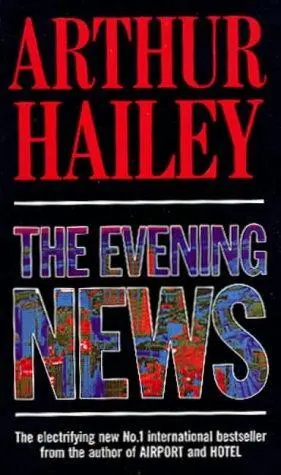
- Название:Evening News
- Автор:
- Жанр:
- Год:неизвестен
- ISBN:нет данных
- Рейтинг книги:3.5 / 5. Голосов: 2
-
Избранное:Добавить в избранное
- Отзывы:
-
Ваша оценка:
Evening News: краткое содержание, описание и аннотация
Предлагаем к чтению аннотацию, описание, краткое содержание или предисловие (зависит от того, что написал сам автор книги «Evening News»). Если вы не нашли необходимую информацию о книге — напишите в комментариях, мы постараемся отыскать её.
Evening News — читать онлайн бесплатно полную книгу (весь текст) целиком
Ниже представлен текст книги, разбитый по страницам. Система сохранения места последней прочитанной страницы, позволяет с удобством читать онлайн бесплатно книгу «Evening News», без необходимости каждый раз заново искать на чём Вы остановились. Поставьте закладку, и сможете в любой момент перейти на страницу, на которой закончили чтение.
Интервал:
Закладка:
"When you get to that stage,” a petite redhead asked, "will there be camera crews?”
"You mean might you be on camera?”
She smiled.”Something like that.”
"That won't be my decision, but I'd say it's likely.”
When the questions ended, Cooper concluded with some thoughts he had discussed with no one else, but had considered carefully the night before.
”As well as looking for the kind of advertised buildings I've described, I want you to use the chance, with those three months of newspapers in front of you, to look at every page and be alert for anything unusual.
”Don't ask me what that might be because I have no clue myself
But remember this: Those kidnappers we're trying to track down have been lurking in this area we reckon for at least a month, probably two. In that time, no matter how careful they've tried to be, possibly they've done some small thing which left a trace behind. The other possibility is that that small thing may somehow have found its way into print.”
"Sounds pretty chancy,” someone said.
Teddy Cooper nodded agreement.”You could say it's a chance in ten thousand that something happened which got reported, and another long-shot chance that one of you will find it if it did. So okay, the odds are against us. But don't forget that someone always wins the lottery when the odds are a million to one.
”All I can tell you is think, think, think! Look hard, and look intelligently. Use your imagination. You were hired because we think you're smart, so prove us right. Yep, search for our first target—the ads for premises—but watch out for that other long shot as you go.”
At the end of his remarks, to Cooper's considerable surprise, the young people facing him rose to their feet and applauded.
* * *
Earlier that morning, as soon as businesses were open, Harry Partridge had telephoned his contact, the lawyer with organized crime clients. The response was less than cordial.”Oh, it's you. Well, I told you Friday I'd do some discreet checking and I've already done that twice with no result. What I don't need is you climbing on my back.”
"I'm sorry if I Partridge began, but the other wasn't listening.
”What you newshounds never realize is that in something like this, it's my goddamn head that's on the block. The people I deal with, my clients, trust me and I intend to keep it that way. I also know that one thing they don't give a shit about is other people's problems, including yours and Crawford Sloane's, however bad you think they are.”
"I understand that,” Partridge protested.”But this is a kidnapping and . . .”
"Shut up and listen! I told you when we talked, I was sure none of the people I represent did the kidnapping or were even involved. I'm still sure. I also conceded that I owe you and would try to find out what I could. But I have to walk like I'm in a minefield and, second, convince anyone I talk to that it's to their advantage to help if they know anything or have heard rumors.”
"Look, I said I'm sorry if... "
The lawyer pressed on.”So it isn't something to be done with a bulldozer or an express train. Understand?”
Inwardly sighing, Partridge said, "I understand.”
The lawyer's voice moderated.”Give me a few more days. And don't call me; I'll call you.”
Hanging up, Partridge reflected that while contacts could be useful, you didn't necessarily have to like them.
* * *
Before his arrival at CBA News that morning Partridge had reached a decision on whether or not to reveal on the National Evening News that a known Colombian terrorist, Ulises Rodriguez, had been linked conclusively to the Sloane family kidnap.
His decision was to withhold the information for the time being.
Following the session with Cooper's recruits, Partridge sought out special task force members to inform them. In the group conference room he found Karl Owens and Iris Everly and explained his reasoning.
”Look at it this way: Right now Rodriguez represents the only lead we have and he doesn't know we have it. But if we broadcast what we know, chances are strong that Rodriguez himself will hear of it and we'll have tipped our hand.”
Owens asked doubtfully, "Does that matter?”
"I think it does. Everything points to Rodriguez having been under cover, and the effect would be to drive him further under. I don't have to tell you how much that would lessen our chances of discovering where he is—and, of course, the Sloanes.”
"I can see all that,” Iris acknowledged, "but do you really think, Harry, that a red-hot piece of news like this, already known to at least a dozen people, is going to stay conveniently under wraps until we're ready? Don't forget every network, every newspaper, every wire service has their best people working on this story. I give it twenty-four hours at most before everybody knows.”
Rita Abrams and Norman Jaeger had joined them and were listening.
”You may be proved right,” Partridge told Iris, "but I think it's a risk we have to take.” He added, "I hate to sound corny but I think we should remember once in a while that this news thing we do is not some holy grail. When reporting endangers life and liberty, news has to take second place.”
"I don't want to seem stuffy either,” Jaeger put in.”But in that, I'm with Harry.”
"There's one other thing,” Owens said, "and that's the FBI. By withholding this from them, we could be in trouble.”
"I've thought about that,” Partridge acknowledged, "and decided to take our chances. If that bothers any of you, I'll remind you I'm the one responsible. The thing is, if we tell the FBI, we know from experience they're as likely as not to discuss it with other news people, then we'll have blown our exclusive that way.”
"Coming back to the main issue,” Rita said, "there are precedents for what we'd be doing. I remember one at ABC.”
Iris prompted, "So tell us.”
"You recall the TWA hijack—Beirut, 1985?”
The others nodded, reminded that during the mid-1980s Rita had worked for ABC News; also that the hijacking was a terrorist outrage, holding world attention for two weeks during which a U.S. Navy diver, a passenger aboard TWA Flight 847, was savagely murdered.
”Almost from the beginning of that hijack,” Rita said, "we knew at ABC that there were three American servicemen aboard that plane, in civilian clothes, and we believed we had the information exclusively. The question was: Should we use it on the air? Well, we never did, believing that if we did, the hijackers would learn of it and those servicemen would be as good as dead. In the end the terrorists found out themselves but we always hoped, because of doing the decent thing, we helped two of those three survive.”
"Okay,” Iris said, "I suppose I go along. Though if no one's used the story by tomorrow, I suggest we take another look.”
"I'll buy that,” Owens agreed, and the discussion ended.
However, because of its importance Partridge decided to share his decision with Les Chippingham and Chuck Insen.
The news president, who received Partridge in his paneled office, merely shrugged when told, and commented, "You're the one making task force decisions, Harry; if we didn't trust your judgment you wouldn't be there. Thanks for telling me, though."
The National Evening News executive producer was in his presiding seat at the Horseshoe. As he listened, Insen's eyes brightened. At the end he nodded.”Interesting, Harry; nice piece of research. When you give it to us, we'll run it top of the show. But not until you say so.”
Which left Partridge free to resume telephoning and he settled down in his temporary private office.
Once more he had his blue book of names and phone numbers, but unlike last week when his calls were directed mainly at U.S. sources today Partridge tried to reach contacts in Colombia and the countries immediately adjoining—Venezuela, Brazil, Ecuador, Panama and Peru—plus Nicaragua. In all those places, from where he had frequently reported for CBA News, there were people he knew who had helped him, and for some of whom he had done return favors.
Читать дальшеИнтервал:
Закладка:
Похожие книги на «Evening News»
Представляем Вашему вниманию похожие книги на «Evening News» списком для выбора. Мы отобрали схожую по названию и смыслу литературу в надежде предоставить читателям больше вариантов отыскать новые, интересные, ещё непрочитанные произведения.

Обсуждение, отзывы о книге «Evening News» и просто собственные мнения читателей. Оставьте ваши комментарии, напишите, что Вы думаете о произведении, его смысле или главных героях. Укажите что конкретно понравилось, а что нет, и почему Вы так считаете.