Reif Larsen - I Am Radar
Здесь есть возможность читать онлайн «Reif Larsen - I Am Radar» весь текст электронной книги совершенно бесплатно (целиком полную версию без сокращений). В некоторых случаях можно слушать аудио, скачать через торрент в формате fb2 и присутствует краткое содержание. Год выпуска: 2015, Издательство: Penguin Press, Жанр: Современная проза, на английском языке. Описание произведения, (предисловие) а так же отзывы посетителей доступны на портале библиотеки ЛибКат.
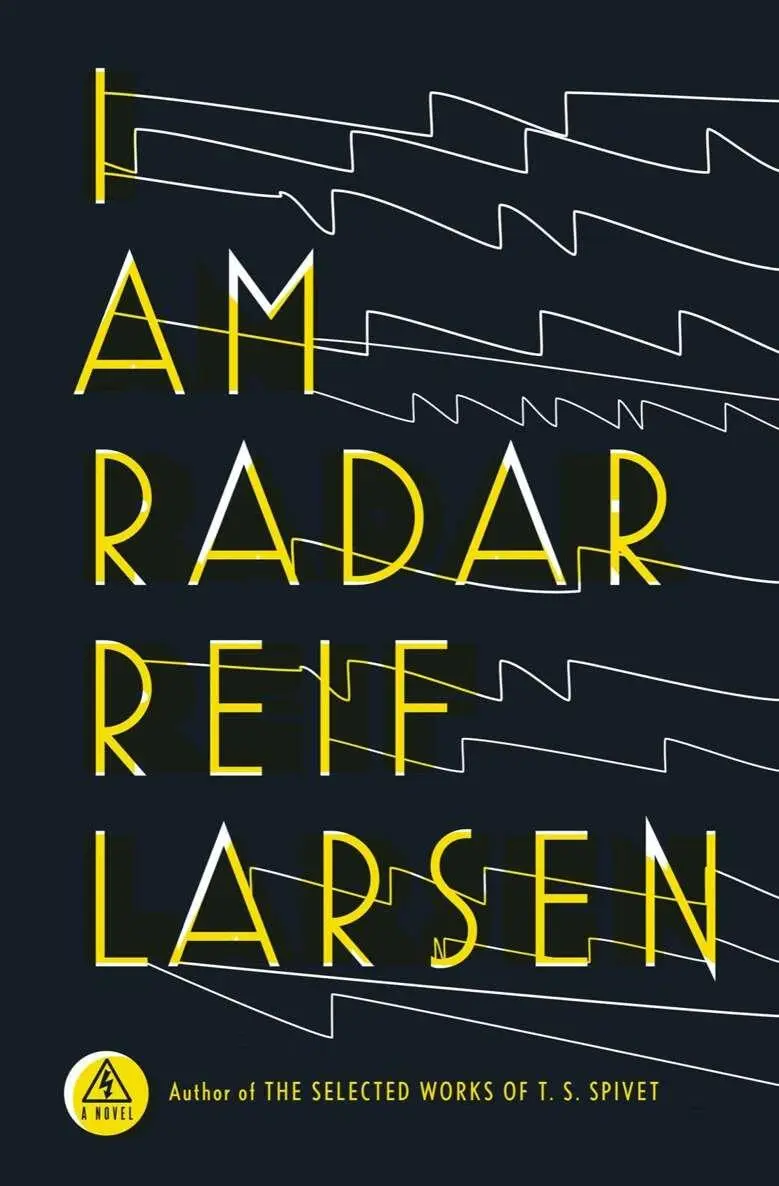
- Название:I Am Radar
- Автор:
- Издательство:Penguin Press
- Жанр:
- Год:2015
- ISBN:нет данных
- Рейтинг книги:3 / 5. Голосов: 1
-
Избранное:Добавить в избранное
- Отзывы:
-
Ваша оценка:
I Am Radar: краткое содержание, описание и аннотация
Предлагаем к чтению аннотацию, описание, краткое содержание или предисловие (зависит от того, что написал сам автор книги «I Am Radar»). Если вы не нашли необходимую информацию о книге — напишите в комментариях, мы постараемся отыскать её.
I Am Radar Deep in arctic Norway, a cadre of Norwegian schoolteachers is imprisoned during the Second World War. Founding a radical secret society that will hover on the margins of recorded history for decades to come, these schoolteachers steal radioactive material from a hidden Nazi nuclear reactor and use it to stage a surreal art performance on a frozen coastline. This strange society appears again in the aftermath of Cambodia’s murderous Khmer Rouge regime, when another secret performance takes place but goes horrifically wrong. Echoes of this disaster can be heard during the Yugoslavian wars, when an avant-garde puppeteer finds himself trapped inside Belgrade while his brother serves in the genocidal militia that attacks Srebrenica. Decades later, in the war-torn Congo, a disfigured literature professor assembles the largest library in the world even as the country around him collapses. All of these stories are linked by Radar — now a gifted radio operator living in the New Jersey Meadowlands — who struggles with love, a set of hapless parents,and a terrible medical affliction that he has only just begun to comprehend.
I Am Radar — читать онлайн бесплатно полную книгу (весь текст) целиком
Ниже представлен текст книги, разбитый по страницам. Система сохранения места последней прочитанной страницы, позволяет с удобством читать онлайн бесплатно книгу «I Am Radar», без необходимости каждый раз заново искать на чём Вы остановились. Поставьте закладку, и сможете в любой момент перейти на страницу, на которой закончили чтение.
Интервал:
Закладка:
Impressed by Jean-Baptiste, who lingered after the lecture and asked several probing questions about measuring stellar luminosity, Lemaître invited him to attend an atomic physics conference in Copenhagen the following week.
Jean-Baptiste took the sleeper up to Denmark, and over the course of four utterly chilly, utterly magical days, he rubbed shoulders with some of the greatest minds of a generation — men like Niels Bohr, Werner Heisenberg, and Wolfgang Pauli, who were ferociously negotiating the framework of quantum mechanics over stale pints of lager at the Hviids Vinstue, a poorly lit pub that smelled like the bilge of a ship.9
The crew of physicists did not seem to mind that Jean-Baptiste was not a scientist, that he was instead a middling botanist and deficient philosopher who hailed from an Oriental plantation. Such credentials appeared, rather, to gain him credence in their eyes; his place outside of their discipline encouraged them to use him as a confessional booth for their unformed theories. After the day’s formal sessions, he would find himself in intimate interlocution with the men as they strolled through the streets of the city, lit brightly by a constellation of white lanterns, their conversations dancing across a range of quantum theories that would set his head spinning. At the Hviids Vinstue, he was often used as a prop when someone was trying to illustrate a particular point. Sometimes he was an electron, sometimes a quark, sometimes a vast celestial body. They would orbit him in circles, knocking over chairs, spilling beer, laughing at their own audacity, all the while arguing about charge, position, spin. His involvement in these impromptu demonstrations — even simply as a flexible bit of mass — gave him goose bumps. Pauli teasingly referred to him as “Your Highness.” Heisenberg ignored him. Bohr — Bohr was the best of the lot. Bohr knew, in that way that few great men do, exactly how much of the universe could never be understood at all. The limits of the known world did not bother Bohr — instead, he viewed our peaceful coexistence with the unknown as a testament to the capacities of the human mind.
“If you admit you are uncertain,” he said once, “then you are that much closer to certainty.”
Tofte-Jebsen recounts how, on the final evening, the conference members had paid a visit to the university’s cyclotron, a sleeping giant of a machine that struck Jean-Baptiste as “the altar of the new secular religion” (107). Afterwards, he found himself back at the pub, deep in an argument with Bohr about the nature of free will. The others, exhausted by the week’s negotiations, had already headed home, but Bohr persisted, and Jean-Baptiste got the feeling that it was strictly for his benefit, though he was unsure why such a genius would want to spend any time with a colonial dilettante like himself.
That evening, a pipe had burst in the flat above, and the pub was unusually humid. Every now and then, little drops of condensation would fall upon their heads and into their beer mugs.
“Are you comfortable with complementarity?” Bohr asked him.
“I’m not sure. .” Jean-Baptiste’s English was excellent, but around Bohr he always felt a bit like a child again.
“Most people aren’t. They don’t want to hear about something being both true and not true at the same time. They don’t want to believe that Schrödinger’s cat can be both dead and alive until the moment they open the box. Most people don’t want to push their minds to accept both possibilities at once. But for me, such concurrence is beautiful — necessary, even. The universe is not based on truth but on possibility .”
Jean-Baptiste took a slow drink from his mug. “But surely there are things that are just true? What about the forces that govern us? Laws? Causality?”
“Causality is a siren. She enchants and she tames,” said Bohr. “Look at Einstein. He’s come undone. He’s trying to explode our framework, and he’s convinced he will, all because he cannot release himself from the temptations of locality. He cannot free himself from If this, then that . Don’t tell me it’s a failure of imagination. Don’t tell me it’s because of the numbers. I’ll tell you what it is: we are confined to consequence. We can survive the now only because we claim to know what comes next. We are terrified of the truth: that by saying If this, we have already destroyed then that .”
Jean-Baptiste shook his head. “Your entire framework is based on the unobserved theory—”
“Observation is precisely the problem. Observation, as we understand it, is the nemesis of understanding,” said Bohr. “We’re obsessed with this act of witnessing — yet witnessing is an action that irrevocably affects the subject. As it turns out, we can only witness the witnessing .”
Jean-Baptiste left that evening — damp and bewildered, his core shaken by the steadiness, the utter generosity, of Bohr’s belief in the uncertain. On the train back to Paris, he sat in a state of agitated confusion, nursing a brandy as the lowlands slid past. Yet he had never felt more alive. It was as if he had suddenly jumped orbits and could now feel the heat of the sun against his skin.
• • •
“I DIDN’T OPEN IT,” his wife said as soon as he came through the door. She pointed to a telegram from Saigon that was propped up on the dining room table.
He sat down, laced open the envelope, read the fifteen words, and then read them again.
It was midafternoon, but the sun had already begun to sink. Jean-Baptiste left the house and walked through the cold and empty streets, following a familiar path through the Cimetière du Père Lachaise. The dew had frosted in the grass. In a hickory tree, a lone raven pecked at its feet, its brethren having left long ago for balmier skies. At some point, Jean-Baptiste placed his hand on the surface of one of the gravestones. To his surprise, he found the stone warm to the touch.
“What will you do?” Leila asked when he returned. Her voice revealing the slightest tremor.
“There’s nothing to be done,” he said. “I must go and take my place.”
His father, André de Broglie, was dead.
3
Leila did not try to dissuade him. She packed her possessions into a pair of steamer trunks, and together they made the long, grueling trip to La Seule Vérité. A journey is never measured by its distance alone, but rather by its chapters: they took the overnight train to Marseille; then a steamer to Saigon, stopping in Alexandria, switching boats first in Bombay and again in Singapore; then a riverboat up the Mekong, pausing in Phnom Penh for supplies before heading on to the plantation that was to be their new home.
Eugenia welcomed her son’s return, if only for the company he provided. She had never harbored the same grand illusions about the de Broglie lineage as her husband did. For her, the rubber plantation, even during its heyday, had been something to tolerate rather than celebrate. Deafness was a shroud that had taught her to study life’s details while always ensuring she could never fully touch them, and this distance had afforded her a shrewd kind of wisdom. As Tofte-Jebsen writes, “She haunted a stage not of her own design” (110). Eugenia had known for a long time that her only son’s heart was not in the business, but she could not bring herself to release him from his burden. Selfishly, she wanted him close, to suffer as she had suffered.
If Jean-Baptiste ever resented the millstone of his familial duty, he did not express it. He buried his father on the hilltop, next to his grandfather, in a quasi-Christian ceremony that also incorporated local animistic funeral rites performed with incense and flowers freshly cut by André’s distraught workers. They had clearly loved him. When Jean-Baptiste walked past them they would bow, tears in their eyes. At first he tried to go out of his way to be friendly with them, telling jokes, querying them on their work, even joining them for the early-morning tap, but after being met with only confused silence, he eventually stopped trying. Knowing he could never fill the gulf left behind by his late father, Jean-Baptiste delegated responsibility for the day-to-day rubber operations to a young, wily Algerian man named Raouf, whom he brought in from Phnom Penh, meanwhile busying himself with a series of complicated projects that became less and less relevant to the family business.
Читать дальшеИнтервал:
Закладка:
Похожие книги на «I Am Radar»
Представляем Вашему вниманию похожие книги на «I Am Radar» списком для выбора. Мы отобрали схожую по названию и смыслу литературу в надежде предоставить читателям больше вариантов отыскать новые, интересные, ещё непрочитанные произведения.









Обсуждение, отзывы о книге «I Am Radar» и просто собственные мнения читателей. Оставьте ваши комментарии, напишите, что Вы думаете о произведении, его смысле или главных героях. Укажите что конкретно понравилось, а что нет, и почему Вы так считаете.