Reif Larsen - I Am Radar
Здесь есть возможность читать онлайн «Reif Larsen - I Am Radar» весь текст электронной книги совершенно бесплатно (целиком полную версию без сокращений). В некоторых случаях можно слушать аудио, скачать через торрент в формате fb2 и присутствует краткое содержание. Год выпуска: 2015, Издательство: Penguin Press, Жанр: Современная проза, на английском языке. Описание произведения, (предисловие) а так же отзывы посетителей доступны на портале библиотеки ЛибКат.
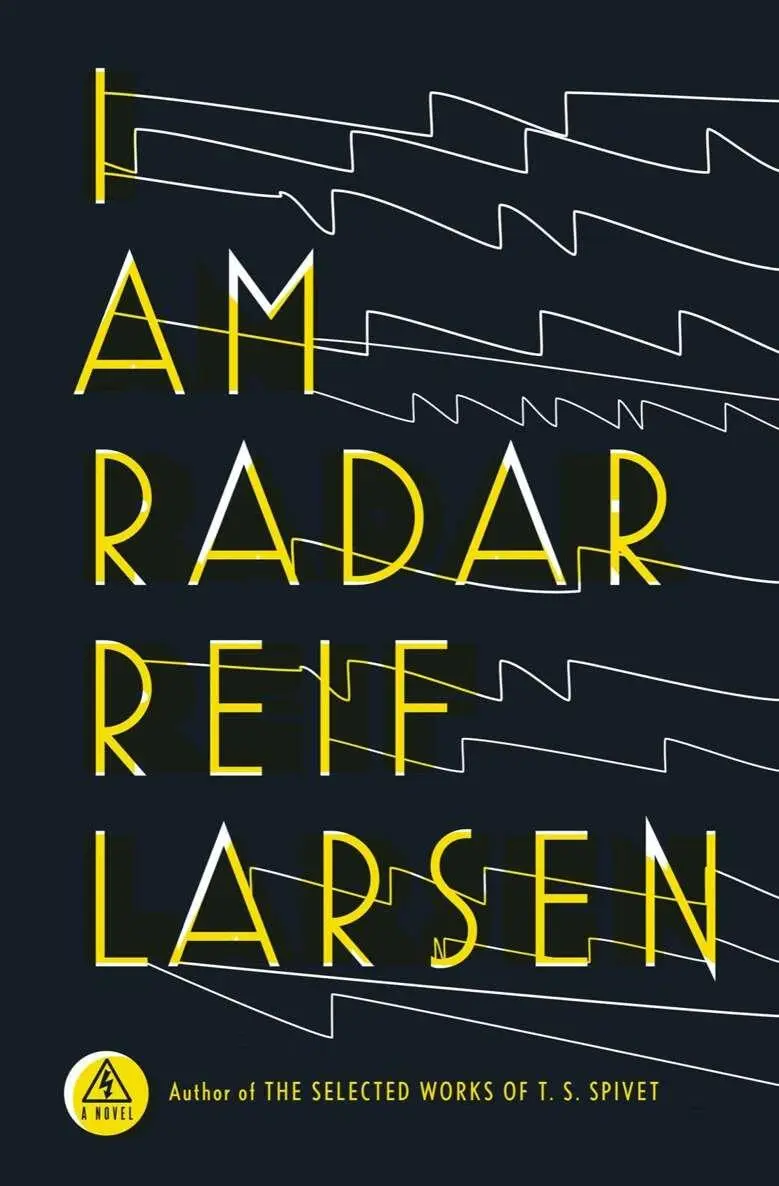
- Название:I Am Radar
- Автор:
- Издательство:Penguin Press
- Жанр:
- Год:2015
- ISBN:нет данных
- Рейтинг книги:3 / 5. Голосов: 1
-
Избранное:Добавить в избранное
- Отзывы:
-
Ваша оценка:
I Am Radar: краткое содержание, описание и аннотация
Предлагаем к чтению аннотацию, описание, краткое содержание или предисловие (зависит от того, что написал сам автор книги «I Am Radar»). Если вы не нашли необходимую информацию о книге — напишите в комментариях, мы постараемся отыскать её.
I Am Radar Deep in arctic Norway, a cadre of Norwegian schoolteachers is imprisoned during the Second World War. Founding a radical secret society that will hover on the margins of recorded history for decades to come, these schoolteachers steal radioactive material from a hidden Nazi nuclear reactor and use it to stage a surreal art performance on a frozen coastline. This strange society appears again in the aftermath of Cambodia’s murderous Khmer Rouge regime, when another secret performance takes place but goes horrifically wrong. Echoes of this disaster can be heard during the Yugoslavian wars, when an avant-garde puppeteer finds himself trapped inside Belgrade while his brother serves in the genocidal militia that attacks Srebrenica. Decades later, in the war-torn Congo, a disfigured literature professor assembles the largest library in the world even as the country around him collapses. All of these stories are linked by Radar — now a gifted radio operator living in the New Jersey Meadowlands — who struggles with love, a set of hapless parents,and a terrible medical affliction that he has only just begun to comprehend.
I Am Radar — читать онлайн бесплатно полную книгу (весь текст) целиком
Ниже представлен текст книги, разбитый по страницам. Система сохранения места последней прочитанной страницы, позволяет с удобством читать онлайн бесплатно книгу «I Am Radar», без необходимости каждый раз заново искать на чём Вы остановились. Поставьте закладку, и сможете в любой момент перейти на страницу, на которой закончили чтение.
Интервал:
Закладка:
CE QUE TU AS ÉTÉ DÉCIDE DE CE QUE TU ES.
CE QUE TU FAIS MAINTENANT DÉCIDE DE CE QUE TU SERAS.
Tofte-Jebsen translates this as: “What you are is what you have been. What you’ll be is what you do now” (89).
Jean-Baptiste, full of jaundice, came forth into this cauldron of patrimony and newfound wealth in the monsoon season of 1907, nearly killing his young mother in the process. He was a sickly child, whose first years were marked by a succession of illnesses that kept him bedridden and unable to venture outdoors. A hawkish, unpleasant French tutor (Tofte-Jebsen assigns this tutor no name or gender) was brought in from Phnom Penh to teach Jean-Baptiste in his bedroom, which became a sanctuary not just for restless sleep but for intercontinental and even interstellar travel through the crates of books that arrived on the slow boat from Paris. He developed a devout love of reading, devouring the tales of Robert Louis Stevenson, Rudyard Kipling, Victor Hugo, and Alexandre Dumas by candlelight as lizards flicked across the ceiling. Later, he read Keats and Blake and Coleridge and pined for an English countryside he had never seen. He wished desperately that he had grown up in the open expanse of the heathered moorland instead of the equatorial cage of Indochine.
And all who heard should see them there,
And all should cry, Beware! Beware!
His flashing eyes, his floating hair!
Weave a circle round him thrice,
And close your eyes with holy dread,
For he on honey-dew hath fed,
And drunk the milk of Paradise.
When he was thirteen, having outgrown his tutor’s expertise, and being well enough to weather the dangers of the outside world, he requested admission to the Collège Lanessan, in Saigon. Eugenia remained reluctant; she worried not just for her son’s fragile health but about exposing him to Saigon’s colonial aristocracy. Yet André supported the idea: it was evident that in this new world born from the ashes of the Great War, the successful businessman had to possess not just local wisdom but worldly knowledge— mondanités, as the French say. Perhaps he saw a lack of mondanités as one of his own shortcomings — André much preferred to stay at home, tending the books rather than searching out inspiration in some remote corner of the globe. He knew such complacency soon would not be enough: the owner of a plantation in Indochina now needed to understand the shifting markets in Europe just as well as the flooding cycle of the Mekong. Morse’s telegraph, Marconi’s radio, and now the proliferation of Bell’s telephones — which had just begun appearing in the more stylish salons of Saigon — these were all contributing to a swiftly shrinking globe. André was a child of the last century, but his son was coming of age in a new age.
When Jean-Baptiste was fourteen, he made his first journey to Europe. He and Eugenia — who also had never ventured out of the colonies — traveled by steamship to visit Monsieur Pascal Vernon, a distant uncle in Paris. On the occasions when her son was either unable or unwilling to act as her interpreter, Eugenia communicated by using a little writing pad that hung around her neck. Although slightly involved, such a method of communication seemed to curry her favor wherever they went. Tofte-Jebsen claimed that the pad from that trip remained intact many years later, providing a kind of oratory receipt of their travels: “Allons nous asseoir près de la fenêtre?”. . “Cette crème brûlée est passée”. . “Pardon, mais que cet homme est bête.” 6
Jean-Baptiste’s intoxication with La Ville Lumière was evident in his short (but precise) journal entries. After managing to skip the lines at Notre Dame due to his mother’s “déficience,” he called the famous cathedral “splendide” and “comme un cauchemar plaisant.” He wondered about the similarities of the gargoyles to “les démons d’Angkor.” They also managed to jump the queue at La Tour Eiffel, which he labeled “majestueuse, mais incomplète.” Yet his real attention was drawn back again and again to the nature that cushioned the more famous aspects of the urban landscape. He filled an entire sketchbook with renderings of the city’s trees in autumn — the chestnuts of Montmartre, the long rows of London planes lining the Champs-Élysées, the distinguished canopy of a weeping willow guarding a curve of the Seine like a great Chinese firework frozen in mid-explosion. He came to realize, even before he could articulate the thought, that a place was defined by the manner in which it came up for air.
Tofte-Jebsen lingers (96) on an account of a strange episode that occurred the day before they were to head back home. For the first time since her enforced oral schooling, Eugenia encountered another deaf person, at the Marché aux Fleurs et aux Oiseaux at the Île de la Cité. The woman was a Parisian, out on a Sunday to buy daffodils for her apartment. At first excited for such a meeting, Eugenia animatedly began to sign a barrage of questions and comments, only to be met by confusion. Soon the pad was brought out and it was determined that the woman could decipher only one in three of Eugenia’s signs. The reasons were manifold: L’Épée’s dictionary, from which she had taught herself sign, turned out to be very much out of date, long ago cast away for the more modern and practical LSF (la Langue des Signes Française). She herself had greatly manipulated L’Épée’s turgid system to make it more streamlined, largely abandoning his strict adhesion to oral grammar. On top of this, her own realization of each of L’Épée’s signs, taken from two-dimensional, static diagrams, was a singular interpretation. She had taught herself in isolation, with no one to learn from or to converse with. She had thus invented her own dialect, a dialect so particular as to be incomprehensible to all others. Her language was uniquely her own, an island of marooned expression.
This discovery sent Eugenia into a deep depression, which lasted the entire journey back to Indochina. Not only was she an outcast from the society of the hearing; she was an outcast from her own kind. She vowed never again to venture abroad. La Seule Vérité became her only domain.
In contrast to his mother, Jean-Baptiste could not be contained. After that first taste of Paris, he traveled abroad every summer, initially with Uncle Pascal and then on his own, visiting much of Europe, including those English foothills that he had so often dreamed about. His travels then took him farther afield: to North America, where he visited New York City, Niagara Falls, and the Grand Canyon; to Brazil, where he floated the Amazon and saw a vast array of flora, winged fauna, and flesh-eating fish; and to India, where he fell ill in Calcutta, remaining bedridden for three weeks, suffering from feverish flashbacks to his immobile childhood and the stale, molding odor of his tutor’s breath as he (or she) read to him from Plato’s Republic .
André, at first supportive of his son’s boundless interest in the world, soon grew worried that he might one day leave and never return. It was his hope that Jean-Baptiste would absorb a certain degree of mondanités but then eventually grow tired of such adventures and settle down to the more mundane task of managing the planation. André therefore tolerated his son’s sojourns as long as he attended to his schooling and was home every Christmas.
The schooling, of course, was not a problem — Jean-Baptiste was a naturally brilliant student. When he turned seventeen, he was one of two dozen in the colony offered a place at the Sorbonne.
Once back in the heart of Paris, Jean-Baptiste quickly dropped the course in economics that he had qualified for and instead took up philosophy, specializing in metaphysics, while also making the occasional informal foray into medicinal botany during his free time. He would spend his afternoons in the botanical gardens, splayed out on a bench reading Kant and a young German philosopher named Martin Heidegger.
Читать дальшеИнтервал:
Закладка:
Похожие книги на «I Am Radar»
Представляем Вашему вниманию похожие книги на «I Am Radar» списком для выбора. Мы отобрали схожую по названию и смыслу литературу в надежде предоставить читателям больше вариантов отыскать новые, интересные, ещё непрочитанные произведения.










Обсуждение, отзывы о книге «I Am Radar» и просто собственные мнения читателей. Оставьте ваши комментарии, напишите, что Вы думаете о произведении, его смысле или главных героях. Укажите что конкретно понравилось, а что нет, и почему Вы так считаете.