Reif Larsen - I Am Radar
Здесь есть возможность читать онлайн «Reif Larsen - I Am Radar» весь текст электронной книги совершенно бесплатно (целиком полную версию без сокращений). В некоторых случаях можно слушать аудио, скачать через торрент в формате fb2 и присутствует краткое содержание. Год выпуска: 2015, Издательство: Penguin Press, Жанр: Современная проза, на английском языке. Описание произведения, (предисловие) а так же отзывы посетителей доступны на портале библиотеки ЛибКат.
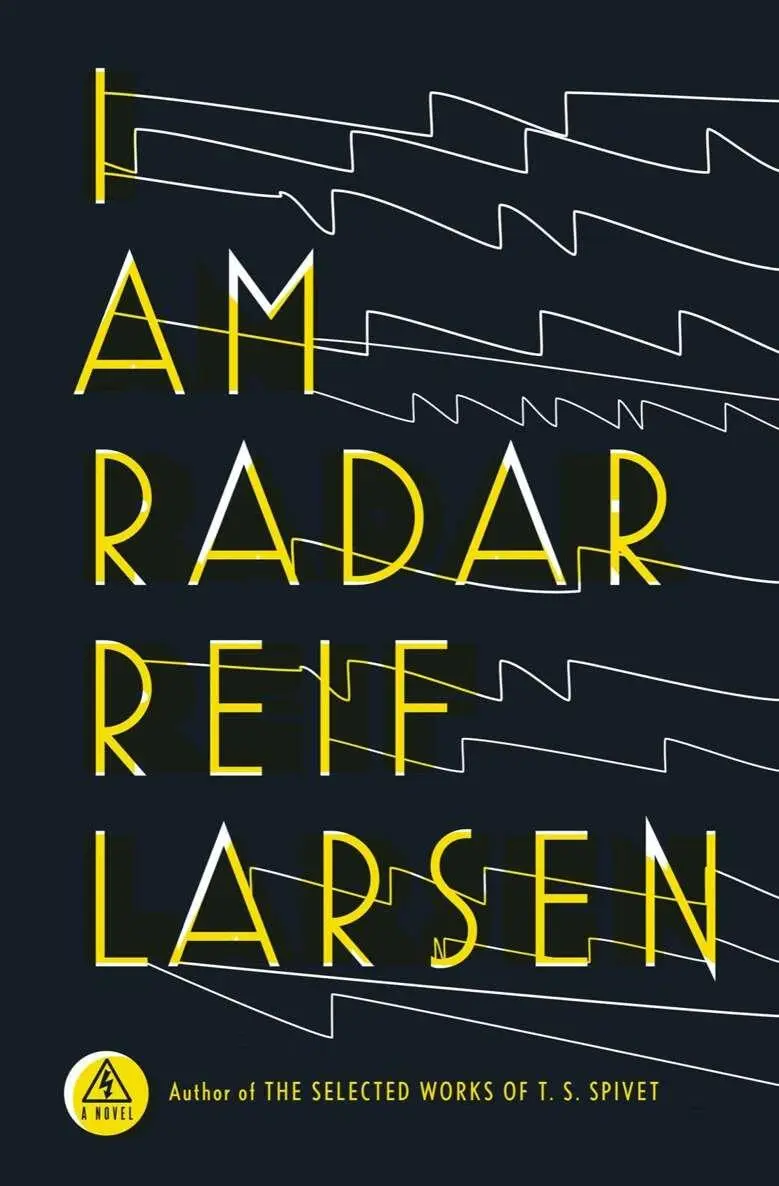
- Название:I Am Radar
- Автор:
- Издательство:Penguin Press
- Жанр:
- Год:2015
- ISBN:нет данных
- Рейтинг книги:3 / 5. Голосов: 1
-
Избранное:Добавить в избранное
- Отзывы:
-
Ваша оценка:
I Am Radar: краткое содержание, описание и аннотация
Предлагаем к чтению аннотацию, описание, краткое содержание или предисловие (зависит от того, что написал сам автор книги «I Am Radar»). Если вы не нашли необходимую информацию о книге — напишите в комментариях, мы постараемся отыскать её.
I Am Radar Deep in arctic Norway, a cadre of Norwegian schoolteachers is imprisoned during the Second World War. Founding a radical secret society that will hover on the margins of recorded history for decades to come, these schoolteachers steal radioactive material from a hidden Nazi nuclear reactor and use it to stage a surreal art performance on a frozen coastline. This strange society appears again in the aftermath of Cambodia’s murderous Khmer Rouge regime, when another secret performance takes place but goes horrifically wrong. Echoes of this disaster can be heard during the Yugoslavian wars, when an avant-garde puppeteer finds himself trapped inside Belgrade while his brother serves in the genocidal militia that attacks Srebrenica. Decades later, in the war-torn Congo, a disfigured literature professor assembles the largest library in the world even as the country around him collapses. All of these stories are linked by Radar — now a gifted radio operator living in the New Jersey Meadowlands — who struggles with love, a set of hapless parents,and a terrible medical affliction that he has only just begun to comprehend.
I Am Radar — читать онлайн бесплатно полную книгу (весь текст) целиком
Ниже представлен текст книги, разбитый по страницам. Система сохранения места последней прочитанной страницы, позволяет с удобством читать онлайн бесплатно книгу «I Am Radar», без необходимости каждый раз заново искать на чём Вы остановились. Поставьте закладку, и сможете в любой момент перейти на страницу, на которой закончили чтение.
Интервал:
Закладка:
The combination to the vault containing all of the ledger books had somehow been lost. Jean-Baptiste considered blowing open the door but instead had it moved by fifteen men to the basement, where it would stand unopened for forty years. He bought another safe, the same model, and put it in the old safe’s place, though he never used it.
“If they have come this far, a safe will not stop them,” he said to no one in particular.
His first item of business was to construct a telegraph line. The line would cut east through the jungle, meeting with National Road No. 7 down to Kratié, before heading twenty-five kilometers south through the rice fields into Vietnam, to the northern station at Saigon. The construction of the line took six months and came at an enormous expense: Jean-Baptiste hired two teams of three hundred laborers to work from either end and spent nearly a quarter of the family’s savings on the project. When it was finally finished, he sat in the telegraph room beneath the stairwell in the main hall and breathed deep. The smell of blood in the wires.
Jean-Baptiste tapped out a message to Monseigneur Lemaître, the astronomer-priest in Brussels, and imagined the electromagnetic flashes hurtling their way through the thick foliage. The quiver of signal. The promise of contact. He was a part of the world now.
Under Lemaître’s distant instruction, Jean-Baptiste built a domed rosewood observatory on the hilltop shared by his grandfather’s and, now, his father’s gravestones. The dome rose up like a moon, a wooden effigy to the invisible planets suspended above. Two months later, the telescope arrived from Paris, lashed like a cannon to a barrel-stave barge that was filled with bleating livestock. The device was installed inside the observatory with much fanfare, an ancient Khmer man bowing a high-pitched tune on a three-stringed fiddle, and awed locals came from miles around to look through its eyepiece at the rings of Saturn. Jean-Baptiste began taking meticulous notes on the rotation of the constellations, the regularity of comets, and a star that Lemaître had informed him was about to disappear, had in fact already disappeared — they were watching a death from the past, echoed across the great expanse. After barely a full moon cycle, however, the novelty of the telescope had worn off and Jean-Baptiste grew bored with his astronomical observations.
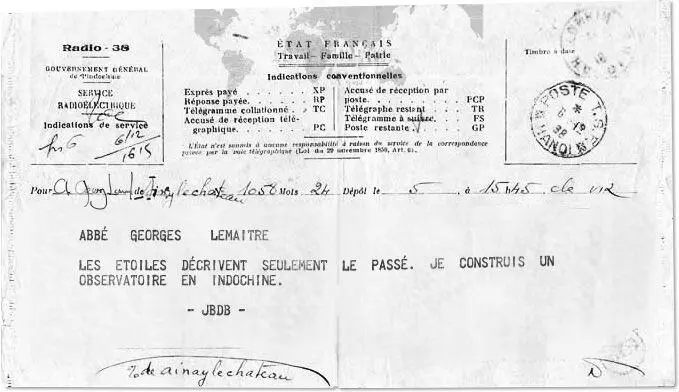
Fig. 4.4. Jean-Baptiste de Broglie to Georges Lemaître, telegram, July 16, 1938
From Tofte-Jebsen, B., Jeg er Raksmey, p. 113
One morning, he was leafing through the pages of a French science journal when he came across a dazzling array of radiographic photos: bony hands with wedding rings, open-mouthed skulls, a bullet lodged inside a buttock. He had stumbled upon his next calling.
“These rays have a very high frequency — four times that of visible light, and so they can penetrate where light cannot,” he wrote to Lemaître. “I mean this with no offense, but to see inside the depths of a human body is even more exciting than glimpsing the heavens. It’s almost enough to make me believe in God again. To think: it’s all right here, right in front of us. We need only make it visible.”
He constructed a giant but erratic Tesla coil in their wine cellar and then connected this to a footlong cathode ray tube that he had ordered from Tokyo. The results were far from immediate as the coil sparked and churned, causing the radio receiver in his study to erupt into static, and the cutlery in the corner of the cellar to take on an ethereal glow. It was not an exact science: he blew through three transformers and constantly overwhelmed their fragile power supply, which had been tenuously wired only a year before from a hydroelectric dam on a tributary of the Mekong. Gradually, though, after much experimentation, he began to home in on the correct amount of voltage needed to operate the X-ray tube with some precision.
His wife became his primary subject. At first, the intensity of the X-rays was either too powerful or too weak, the images coming out white and misty, as if her body were suspended in an English fog. In time, he figured out how to master the machine. The first clear photograph was of her hand, with the darkened orbit of a wedding ring just visible — a re-creation of the photo he had first seen in the journal. Ignoring her protests, he hung this in their bedroom.
“I feel like I’m witnessing my own death,” she said.
“Nonsense,” he said. “You’re witnessing your life.”
Despite her hesitancy at being documented so intimately, he X-rayed every inch of her skeleton again and again. Fully clothed, she lay on the examining table as he unveiled her with his machine. He could hear her breath before the X-ray sprang noisily to life, shuddering, groaning, sending its stream of photons flying into her body. Afterwards, he would develop the images alone in the red-tinged darkness of his closet, the negatives emerging wet with solution, his hand trembling as he handled the proof of his wife’s conquest. He had ventured where no one had ventured before, including himself, for their actual lovemaking was a passionless, fumbling affair, done under cover of night. Jean-Baptiste hung the ghostly X-rays of his wife’s bones in the hallways, the drawing rooms, even the bathrooms — an ethereal gallery of possession.
Meanwhile, Leila suffered. From the beginning, his wife had been a poor match for the tropics — she pined for the familiarities of home, for the comforting spray of the sea during her walks along the bluffs. She could not grow used to the heat, the damp, the insects, the constant smell of cooking rubber, the natives that watched her every move. Her melancholy was stoked by a long correspondence with her mother in which she savored the most banal news from their village. A dog had borne puppies. Her niece had made a paper hat for Bastille Day. The house at the end of the pier had collapsed during a storm. Jean-Baptiste could not appease her homesickness, even as he imported maps of the Seine’s curvatures and the Channel Islands, novels, fine linens, silverware, oil pantings, and custom-made marionettes crafted in the finest workshops of Paris. Their drawing room became an elaborate museum of his placations, but no earthly object could quell her misery. Yet when Jean-Baptiste offered to take Leila to Paris and Normandy for Christmas, she refused, oddly, saying there was too much to be done at the plantation. In the end, she spent the holiday doing nothing except writing her letters back home and reading the same Russian tragedies over and over again.
Leila and Eugenia tolerated each other, but in private each complained of the other’s shortcomings. Eugenia viewed her daughter-in-law as a spoiled priss who lacked both backbone and a sense of humor, while Leila saw her mother-in-law as a terrifying, controlling matriarch who heard more than most hearing people and cared only for her spooky portraits of phantasmagoric flowers. Leila had done her best to learn Eugenia’s obscure language of signs, but it was as if Eugenia willfully chose not to understand Leila when she signed, shaking her head and insisting that her son act as their translator.
Leila’s despair grew with each passing year, for despite their awkward attempts beneath the mosquito nets, no child came therefrom. Jean-Baptiste’s mother was strangely content with the absence of any progeny, despite the uncertainty that such a scenario brought to the question of inheritance.
“You must at least be where you are,” Eugenia signed to her son. “And she is no place at all.” Though the matter was a delicate one, a doctor from Phnom Penh was brought in to examine Leila. He could find nothing wrong.
Читать дальшеИнтервал:
Закладка:
Похожие книги на «I Am Radar»
Представляем Вашему вниманию похожие книги на «I Am Radar» списком для выбора. Мы отобрали схожую по названию и смыслу литературу в надежде предоставить читателям больше вариантов отыскать новые, интересные, ещё непрочитанные произведения.











Обсуждение, отзывы о книге «I Am Radar» и просто собственные мнения читателей. Оставьте ваши комментарии, напишите, что Вы думаете о произведении, его смысле или главных героях. Укажите что конкретно понравилось, а что нет, и почему Вы так считаете.