Reif Larsen - I Am Radar
Здесь есть возможность читать онлайн «Reif Larsen - I Am Radar» весь текст электронной книги совершенно бесплатно (целиком полную версию без сокращений). В некоторых случаях можно слушать аудио, скачать через торрент в формате fb2 и присутствует краткое содержание. Год выпуска: 2015, Издательство: Penguin Press, Жанр: Современная проза, на английском языке. Описание произведения, (предисловие) а так же отзывы посетителей доступны на портале библиотеки ЛибКат.
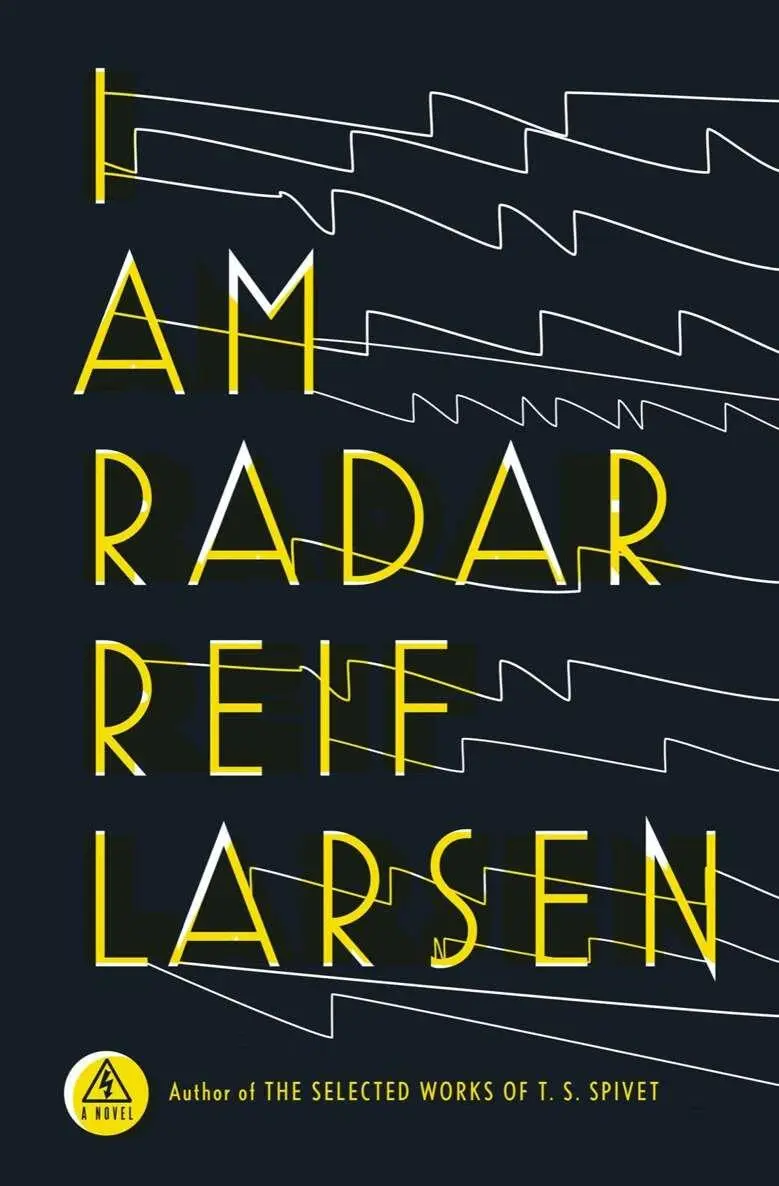
- Название:I Am Radar
- Автор:
- Издательство:Penguin Press
- Жанр:
- Год:2015
- ISBN:нет данных
- Рейтинг книги:3 / 5. Голосов: 1
-
Избранное:Добавить в избранное
- Отзывы:
-
Ваша оценка:
I Am Radar: краткое содержание, описание и аннотация
Предлагаем к чтению аннотацию, описание, краткое содержание или предисловие (зависит от того, что написал сам автор книги «I Am Radar»). Если вы не нашли необходимую информацию о книге — напишите в комментариях, мы постараемся отыскать её.
I Am Radar Deep in arctic Norway, a cadre of Norwegian schoolteachers is imprisoned during the Second World War. Founding a radical secret society that will hover on the margins of recorded history for decades to come, these schoolteachers steal radioactive material from a hidden Nazi nuclear reactor and use it to stage a surreal art performance on a frozen coastline. This strange society appears again in the aftermath of Cambodia’s murderous Khmer Rouge regime, when another secret performance takes place but goes horrifically wrong. Echoes of this disaster can be heard during the Yugoslavian wars, when an avant-garde puppeteer finds himself trapped inside Belgrade while his brother serves in the genocidal militia that attacks Srebrenica. Decades later, in the war-torn Congo, a disfigured literature professor assembles the largest library in the world even as the country around him collapses. All of these stories are linked by Radar — now a gifted radio operator living in the New Jersey Meadowlands — who struggles with love, a set of hapless parents,and a terrible medical affliction that he has only just begun to comprehend.
I Am Radar — читать онлайн бесплатно полную книгу (весь текст) целиком
Ниже представлен текст книги, разбитый по страницам. Система сохранения места последней прочитанной страницы, позволяет с удобством читать онлайн бесплатно книгу «I Am Radar», без необходимости каждый раз заново искать на чём Вы остановились. Поставьте закладку, и сможете в любой момент перейти на страницу, на которой закончили чтение.
Интервал:
Закладка:
Eventually the contractions subsided and Radar’s body settled into an uneasy quiet. His bald head was covered in a pin screen of sweat. On the television, a commercial showed two blond twins laughing in ski coats as they shuffled gum into their mouths. Charlene held her son and stroked his head. She whispered something small and true into his ear. His eyes slowly came back into focus, darting around the room in fear.
“I’m so sorry,” she said. “You’re here. You’re back. Radar, my love, my sweet, we’re together.”
Charlene felt a strong urge to yell, but there was no one there to hear her except her limp son and the synchronized twins on the television.
It was his first grand mal seizure. Despite her promise, it would not be his last.
That autumn, Charlene exchanged several heated letters with Leif. The inherent delay caused by the intercontinental postal system left her plenty of time to fill the spaces in between with a vast ocean of anxiety. At first, Leif was sympathetic when he heard of Radar’s hair loss and epilepsy. He asked her to describe the symptoms in detail and even to send pictures, which she curtly refused to do. When she accused him of betraying their trust and threatened legal action, he distanced himself from any responsibility and then, around Christmas, abruptly ended their communication altogether. Desperate, she even wrote several letters to the address she had for Brusa Tofte-Jebsen in Oslo, but these all came back RETURN TO SENDER. The trail had gone utterly cold.
With nothing left to do, Charlene unraveled. She quit her receptionist job at the salon. She stopped eating. Soon she was no longer leaving the house. Kermin began taking Radar to his shop every day. He did all of the shopping, the housework, the little administrative tasks of life, as his wife lay prone in bed. He persisted. He persisted and said nothing to her of her descent. There was nothing left to say.
• • •
ONE NIGHT CHARLENE AWOKE, shivering. Her body felt as if it were eating itself alive.
“Kerm,” she hissed, terrified.
He stirred, mumbling.
“Kermin!”
“Yes?”
“I can’t do it.” Surprised at her own certainty.
The bedside light clicked on. He blinked, rubbed his eyes in the dimness.
“I can’t do it. I just can’t,” she said. “I’m afraid of what I might do.”
“I think,” he said after a moment, “it is not a question of can’t. ”
“There’s nothing I can—”
“It is a question of must, ” he said. “You have no choice. We make him. We make Radar. We did what we did. What is done is done. But he is there, in that room. There . He must go and live tomorrow and tomorrow. So you must go and live tomorrow and tomorrow and tomorrow after this.”
She stared at her husband. Her eyes welled up. “I ruined him.”
“No,” he said. “There is not just you. There is you and me and him.”
She nodded.
“There is us, ” he said.
“Okay,” she said. “Okay. What do I do? Tell me what to do, Kerm. Tell me.”
“I cannot tell you. Be the person. Love him like always. It is not hard. He is Radar. He is love.”
• • •
THE NEXT MORNING, she got up and cooked pancakes. Mediocre pancakes — misshapen, singed pancakes — but pancakes nonetheless. There were no complaints. She went over and held Radar so tightly that he complained, “Mommy, you’re breaking me!”
That afternoon, she opened up the hole in the bedroom floor. A scent of stillness when the boards came up. A life left behind. She pulled out a folder from the stack and fingered the classified ad for the flavorist job at IFAC.
She sat down and wrote a letter. “I know you’ve probably already filled this position long ago but I wanted to offer myself as a possible candidate as I suffer from an extraordinary sensitivity to certain smells.” She crossed out “suffer from” and wrote “possess.” Underlined it.
To her surprise, she received a phone call barely a week later. They were interested. She went to an interview in the International Flavor and Aroma Corporation headquarters, a giant glass-and-steel monstrosity in an anonymous office park off the turnpike. They had her sniff a series of white strips. She closed her eyes and inhaled. Then she used as many big words as she could think of to tell them what she smelled. Her answers astonished them.
“There are only two people in this building right now who could do that, and one of them is you,” said a man in a lab coat.
They offered her the job on the spot.
“Apparently they call you a nose, ” she said to Kermin that evening.
“A nose ?”
“That’s the job. You’re a professional nose,” she said. “We’re supposed to make perfumes, or to describe perfumes. Or. . I don’t know. I’ve never been very good at making things.”
“Charlene,” he said, coming to her, embracing her. “You are smartest person I know.”
“No, I’m not.”
“You can make whatever you want. You know this, right?”
“Really?”
“Tell me, what are you waiting for?”
“But—”
“It is time to wake up. Wake up and become the nose.”
She became the nose.
It was not an instant transformation. The job offer was conditional: she had to go back to school. Two courses at Rutgers, her old haunt, in organic chemistry and molecular biology, and then a six-week perfumery intensive in Manhattan. She had to learn the names for everything: the pantheon of citric notes, the coarse parade of musks, the natural accordion florals and the synthetic aldehydes, ketones, and terpenes that silently mimicked the sensory world around us. She had to unlace complex bouquets of scents with just her nose and then measure her precision against a gas chromatograph. But she could do what the chromatograph could never do: compose an exact recipe for the smell using fifty words or fewer. Thus, the early draft of a perfume, zingiberene — pentyl butyrate — thioterpineol — ethyl acetate–2-ethyl–3-methoxypyrazine, became:
A tender bed of hawthorn, supporting a high trio of grapefruit, Asian pear, and elderberry, with lingering undercurrents of hazelnut and a single, faint note of ginger. A late-summer fragrance, perfect for outdoor events.
She could do this. She could dip her hand into the night-pit of the imagination. She knew all the right words from her previous, foiled career. Life had filled her quiver with the right arrows, even when the target itself had been too far away to see.
• • •
GIVEN HER EXTENSIVE BACKGROUND in librarianship, it remains surprising that Charlene never performed a standard literature search on “Kirkenesferda.” If she had, she would’ve discovered that by 1979, there were almost two hundred articles, essays, monographs, or book-length projects that referenced the “experimental puppet troupe,” though the vast majority of these were enfolded within a longstanding (and antagonistic) call-and-response between only two authors: Brusa Tofte-Jebsen and Per Røed-Larsen.
After 1979, there was a mysterious, nearly eighteen-year gap in the literature before Per Røed-Larsen published his comprehensive Spesielle Partikler: Kirkenesferda 1944–1995 (Oslo: J. W. Cappelens). Spesielle Partikler is a fifteen-hundred-page monstrosity that details the troupe’s four major bevegelser, or “movements”: the Poselok nuclear fission installation, outside Murmansk, in 1944; the Gåselandet Island Tsar Bomba show on fusion, in 1961, staged during the middle of the largest hydrogen bomb detonation in history; the disastrous Cambodian performance, in 1979; and the abbreviated Sarajevo show on superstring theory, in the ruins of the National Library of Bosnia in 1995.
Читать дальшеИнтервал:
Закладка:
Похожие книги на «I Am Radar»
Представляем Вашему вниманию похожие книги на «I Am Radar» списком для выбора. Мы отобрали схожую по названию и смыслу литературу в надежде предоставить читателям больше вариантов отыскать новые, интересные, ещё непрочитанные произведения.











Обсуждение, отзывы о книге «I Am Radar» и просто собственные мнения читателей. Оставьте ваши комментарии, напишите, что Вы думаете о произведении, его смысле или главных героях. Укажите что конкретно понравилось, а что нет, и почему Вы так считаете.