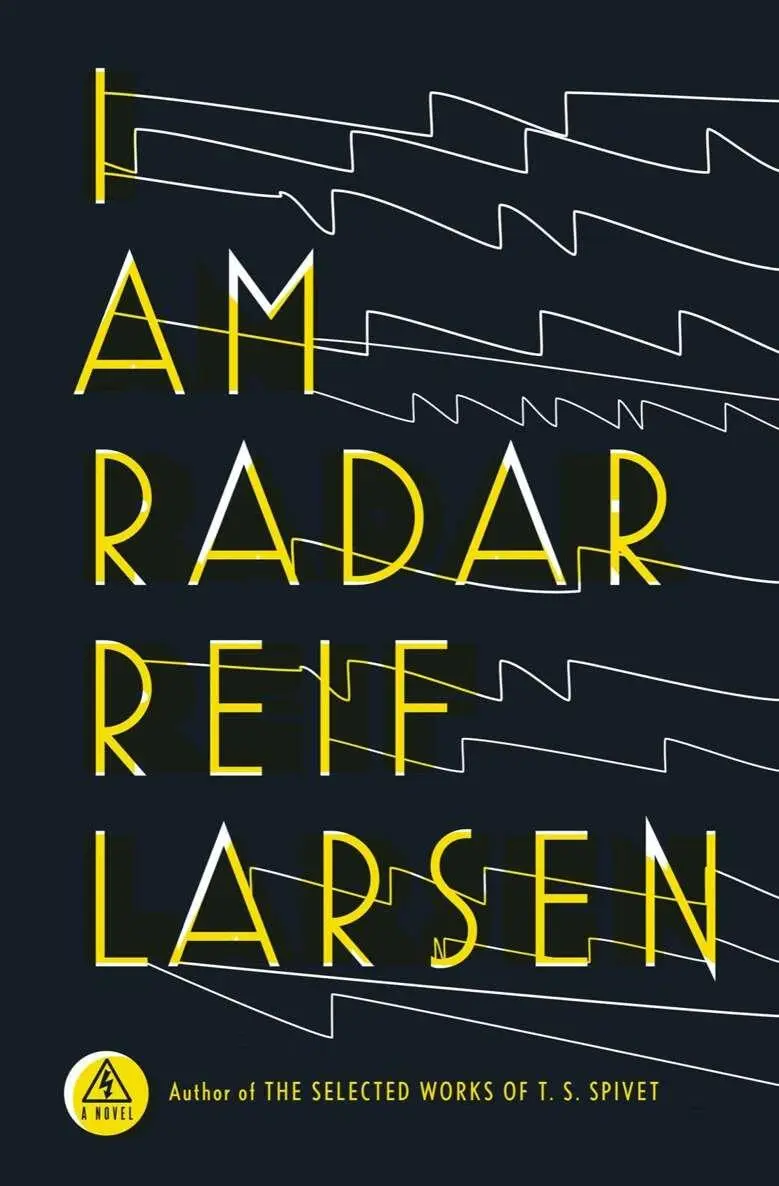
Reif Larsen - I Am Radar
Здесь есть возможность читать онлайн «Reif Larsen - I Am Radar» весь текст электронной книги совершенно бесплатно (целиком полную версию без сокращений). В некоторых случаях можно слушать аудио, скачать через торрент в формате fb2 и присутствует краткое содержание. Год выпуска: 2015, Издательство: Penguin Press, Жанр: Современная проза, на английском языке. Описание произведения, (предисловие) а так же отзывы посетителей доступны на портале библиотеки ЛибКат.
- Название:I Am Radar
- Автор:
- Издательство:Penguin Press
- Жанр:
- Год:2015
- ISBN:нет данных
- Рейтинг книги:3 / 5. Голосов: 1
-
Избранное:Добавить в избранное
- Отзывы:
-
Ваша оценка:
I Am Radar: краткое содержание, описание и аннотация
Предлагаем к чтению аннотацию, описание, краткое содержание или предисловие (зависит от того, что написал сам автор книги «I Am Radar»). Если вы не нашли необходимую информацию о книге — напишите в комментариях, мы постараемся отыскать её.
I Am Radar Deep in arctic Norway, a cadre of Norwegian schoolteachers is imprisoned during the Second World War. Founding a radical secret society that will hover on the margins of recorded history for decades to come, these schoolteachers steal radioactive material from a hidden Nazi nuclear reactor and use it to stage a surreal art performance on a frozen coastline. This strange society appears again in the aftermath of Cambodia’s murderous Khmer Rouge regime, when another secret performance takes place but goes horrifically wrong. Echoes of this disaster can be heard during the Yugoslavian wars, when an avant-garde puppeteer finds himself trapped inside Belgrade while his brother serves in the genocidal militia that attacks Srebrenica. Decades later, in the war-torn Congo, a disfigured literature professor assembles the largest library in the world even as the country around him collapses. All of these stories are linked by Radar — now a gifted radio operator living in the New Jersey Meadowlands — who struggles with love, a set of hapless parents,and a terrible medical affliction that he has only just begun to comprehend.
I Am Radar — читать онлайн бесплатно полную книгу (весь текст) целиком
Ниже представлен текст книги, разбитый по страницам. Система сохранения места последней прочитанной страницы, позволяет с удобством читать онлайн бесплатно книгу «I Am Radar», без необходимости каждый раз заново искать на чём Вы остановились. Поставьте закладку, и сможете в любой момент перейти на страницу, на которой закончили чтение.
Интервал:
Закладка:
As Leif walked back to his car, Charlene ran after him. She touched his shoulder.
“Leif,” she said.
“Yes?”
“I know who you are.”
“Oh? Who is that?”
“I know you wrote those telegrams.”
He looked at her strangely.
“Why tell us not to do this?” she said. “And then tell us to do it?”
He carefully removed her hand from his arm and got into his car. “Safe travels, Charlene. Good luck.”
“I’m not angry,” she said through the open window. “I’m just wondering why someone would do this. Why pretend you are someone else?”
He started up the car but then paused. “My dear, the mask cannot be the player,” he said. “And the player cannot be the mask.”
• • •
AS THEY WAITED in the terminal for their plane to land, Charlene put her head on her husband’s shoulder.
“Thank you,” she said.
“For what?”
“For letting us come here.” She rubbed Radar’s head as he slept in her lap. “I understand now. Things can be normal again.”
“What’s done will be done,” Kermin said as a low whine rose in the distance. “This is done.”
10
Two weeks later, Charlene found a sheath of dried dermis lying coiled around the leg of their armchair. She did not know what it was until she saw that Radar was missing a large patch of skin on his left thigh. The skin beneath was pale and raw. It blushed pink when touched.
Her heart sank.
She called Kermin at the shop, sobbing.
He was unmoved. “Leif’s a man to trust. This is what you wanted. This is what he gave you.”
“But I didn’t want this .”
“Then what? I gave you everything you wanted.”
“Kermin!” she cried. “Oh, Kermin! What have I done?”
Over the course of two months, Radar went through a series of four separate “peels,” in which his skin came away from his body in great translucent chunks, like a snake shedding its skin. She would find little pieces of him all around the house — beneath the furniture, caught in the door of the oven, inside her slippers. Like pellucid pages from an ancient tome. The skin smelled of wax and wet burlap and slightly rotten leather, sometimes with the thinnest lead note of citrus, a lemon or kumquat tone. She went around the house collecting the pieces in a small paper bag, which she kept hidden beneath the bed. And then one day she lifted the bedspread and found that the bag had vanished.
Besides making him tender to the touch, the shedding did not seem particularly painful for Radar, though as the skin sheathed off his face and neck, he began to resemble a walking zombie. Since their return from Norway, Charlene hadn’t brought him back to the day care. She couldn’t even imagine what the other kids would say if they saw him in this condition. The thought made her shudder.
“Why is that like this?” Radar asked one evening. He was standing in front of the mirror. In his hand was a piece of his skin.
Charlene panicked.
“This,” she said, hating every inch of her being, “this happens to everyone. You shed your skin. This is part of growing up.”
“Okay,” he said. “Am I growned up?”
“Not yet, honey. Soon.” She brought him close to hide her tears. “Soon.”
She didn’t dare take him to the doctors, the same doctors whom she knew all too well. She didn’t take him even when she noticed that his smooth black hair had started to fall out in quarter-size chunks, leaving him with an uneven patchwork across his skull. She took to combing and recombing the thin hair that remained. When Charlene took Radar outside, she would rub him with lotion and then enshroud him like a mummy in a series of cashmere scarves. It was a ritual Radar came to greatly enjoy, despite the summer heat.
“I am a gift!” he said when she brought out the scarves, holding up his arms. “Wrap me up!” He grew attached to fabrics and the safety they offered — she often found him hiding behind the sheets of her Rothko library, palms on the cotton, humming a little tune to himself.
Kermin was intent on not acknowledging the horror of their son’s condition. On more than one occasion, she had to rebuke him when he was about to take Radar out in public without his protective covering.
“This is important!” she said, making sure she left a little space for Radar to breathe.
“He doesn’t care,” said Kermin.
“People care. I care,” she said, wrapping.
“I am a gift!” cried Radar.
Each successive shedding left Radar paler than the last, until his skin settled into a slightly yellowish, flushed cream color — a Type I/II on the Fitzgerald Skin Type Classification Scale, somewhere between the rough-hewn maple of Kermin’s unshaven cheek and the cautious milky complexion of Charlene’s Franco-Irish-Germanic roots. Certain dark blotches remained around his nipples and belly button and behind his left ankle, where there was a prominent marking resembling the silhouette of a sinking Viking ship. It was like a rebirth.
But the procedure in Norway also led to several serious complications, none of which Leif had mentioned in his debriefing. Radar’s skin became incredibly sensitive and subject to severe rashes. His hair did not grow back, and after the final shed, he was left almost completely bald, save for a little patch above his left ear.
“Where is my hair?” Radar asked her.
“Some boys don’t have hair,” said Charlene. “Like your grandfather.”
“ He’s not a boy!”
“He was once a boy like you.”
“Okay,” said Radar. She could tell he didn’t believe her twisted logic.
The media never got wind of this miraculous transformation. There was no reference to Radar in any of the major New York or New Jersey metropolitan newspapers, nor did Dr. Fitzgerald, as least as far as his personal literature suggested, ever learn of his former research subject’s “recovery.” Not that they would have noticed. The three of them had retreated into a protective cocoon. Some days it felt like the rest of the world barely existed.
About two months after their Kirkenes trip, Radar was busy deconstructing radio receivers in front of the television, watching an episode of Godzilla. He was wearing his favorite blue knit cap, which he had taken to doing since losing his hair. From the kitchen, Charlene sensed a misplaced stillness in the air. She came into the room and found her son sitting like a statue, his torso rigid and strangely arched backwards, a motherboard lying in the palm of one hand. And then a wave passed through him, and his entire frame began to shiver and shake uncontrollably, sending him tumbling into the pile of radio parts splayed out before him.
At first she thought he might have electrocuted himself accidentally, but when he continued to shake, she ran over and held him as his eyes rolled backwards and his arms popped and trembled in their sockets. A wilted smell of urine filled the air. She put her hand on his face and felt his jaw balling and grinding into itself with an uncanny mechanical persistence. His hat fell to the ground, revealing the lonely lateral tuft. On the television, the picture of Godzilla went soft and then split into a static that pulsed and thrummed with each of Radar’s convulsions. A stench of burnt wires wafted through the room.
“Radar!” she screamed. “Radar!”
She comprehended his death with complete clarity. Such finality halted the most basic functions in her body. She could barely breathe. Life without him was incomprehensible. He was all there was, all there could ever be.
“Come back to me,” she cried. “I promise I will never let this happen again. . Come back to me. Please .”
Читать дальшеИнтервал:
Закладка:
Похожие книги на «I Am Radar»
Представляем Вашему вниманию похожие книги на «I Am Radar» списком для выбора. Мы отобрали схожую по названию и смыслу литературу в надежде предоставить читателям больше вариантов отыскать новые, интересные, ещё непрочитанные произведения.












Обсуждение, отзывы о книге «I Am Radar» и просто собственные мнения читателей. Оставьте ваши комментарии, напишите, что Вы думаете о произведении, его смысле или главных героях. Укажите что конкретно понравилось, а что нет, и почему Вы так считаете.