Mavis Gallant - Paris Stories
Здесь есть возможность читать онлайн «Mavis Gallant - Paris Stories» весь текст электронной книги совершенно бесплатно (целиком полную версию без сокращений). В некоторых случаях можно слушать аудио, скачать через торрент в формате fb2 и присутствует краткое содержание. Год выпуска: 2002, Издательство: NYRB Classics, Жанр: Современная проза, на английском языке. Описание произведения, (предисловие) а так же отзывы посетителей доступны на портале библиотеки ЛибКат.
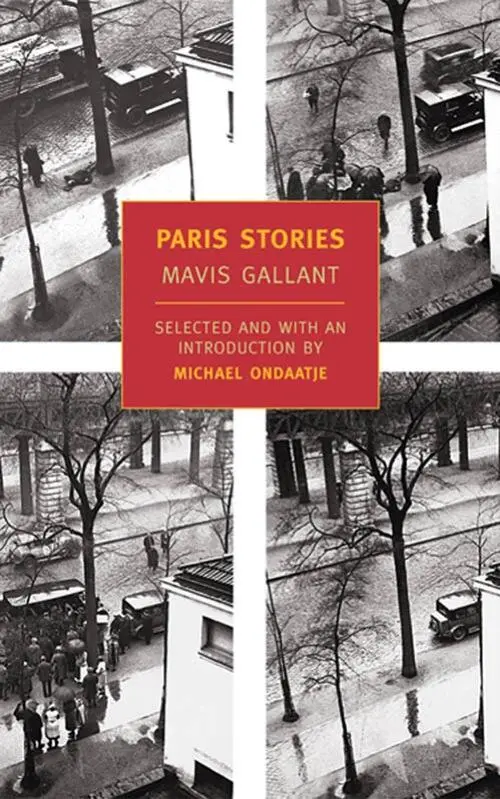
- Название:Paris Stories
- Автор:
- Издательство:NYRB Classics
- Жанр:
- Год:2002
- ISBN:нет данных
- Рейтинг книги:5 / 5. Голосов: 1
-
Избранное:Добавить в избранное
- Отзывы:
-
Ваша оценка:
Paris Stories: краткое содержание, описание и аннотация
Предлагаем к чтению аннотацию, описание, краткое содержание или предисловие (зависит от того, что написал сам автор книги «Paris Stories»). Если вы не нашли необходимую информацию о книге — напишите в комментариях, мы постараемся отыскать её.
Paris Stories — читать онлайн бесплатно полную книгу (весь текст) целиком
Ниже представлен текст книги, разбитый по страницам. Система сохранения места последней прочитанной страницы, позволяет с удобством читать онлайн бесплатно книгу «Paris Stories», без необходимости каждый раз заново искать на чём Вы остановились. Поставьте закладку, и сможете в любой момент перейти на страницу, на которой закончили чтение.
Интервал:
Закладка:
He gazed up and down the bleak road; of course there were no taxis. Inside a bus shelter huddled a few commuters. The thrust of their lives, their genetic destiny obliged them to wait for public transport — unlike Speck, thrown among them by random adventures. A plastic-covered timetable announced a bus to Paris every twenty-three minutes until five, every sixteen minutes from four to eight, and every thirty-one minutes thereafter. His watch had stopped late in the afternoon, probably at the time of the accident. He left the shelter and stood out in the wet, looking at windows of shops, one of which might contain a clock. He stood for a minute or two staring at a china tea set flanked by two notices, HAND PAINTED and CHRISTMAS IS COMING, both of which he found deeply sad. The tea set had been decorated with reproductions of the Pompidou Art Center, which was gradually replacing the Eiffel Tower as a constituent feature of French design. The day's shocks caught up with him: He stared at the milk jug, feeling surprise because it did not tell him the time. The arrival of a bus replaced this perplexity with one more pressing. He did not know what was needed on suburban buses — tickets or tokens or a monthly pass. He wondered whether the drivers accepted banknotes, and gave change, with civility.
“Dr. Speck, Dr. Speck!” Lydia Cruche, her raincoat open and flying, waving a battered black umbrella, bore down on him out of the dark. “You were right,” she said, gasping. “You were there first.” Speck took his place at the end of the bus queue. “I mean it,” she said, clutching his arm. “He can wait.”
Speck's second rule of disappointment came into play: The deceitful one will always come back to you ten seconds too late. “What does it mean?” he said, wiping rain from the end of his nose. “Having it before him means what? Paying for the primary expenses and the catalogue and sweetening the Paris critics and letting him rake in the chips?”
“Wasn't that what you wanted?”
“Your chap from Milan thought he was first,” said Speck. “He may not want to step aside for me — a humble Parisian expert on the entire Cruche context and period. You wouldn't want Cruche to miss a chance at Milan, either.”
“Milan is ten times better for money than Paris,” she said. “If that's what we're talking about. But of course we aren't.”
Speck looked down at her from the step of the bus. “Very well,” he said. “As we were.”
“I'll come to the gallery,” she called. “I'll be there tomorrow. We can work out new terms.”
Speck paid his fare without trouble and moved to the far end of the bus. The dark shopping center with its windows shining for no one was a Magritte vision of fear. Lydia had already forgotten him. Having tampered with his pride, made a professional ass of him, gone off with his idea and returned it dented and chipped, she now stood gazing at the Pompidou Center tea set, perhaps wondering if the ban on graven images could possibly extend to this. Speck had often meant to ask her about the Mickey Mouse napkins. He thought of the hoops she had put him through — God, and politics, and finally the most dangerous one, which was jealousy. There seemed to be no way of rolling down the window, but a sliding panel at the top admitted half his face. Rising from his seat, he drew in a gulp of wet suburban air and threw it out as a shout: “Fascist! Fascist! Fascist!”
Not a soul in the bus turned to see. From the look of them, they had spent the best Sundays of their lives shuffling in demonstrations from Place de la République to Place de la Nation, tossing “Fascist”s around like confetti. Lydia turned slowly and looked at Speck. She raised her umbrella at arm's length, like a trophy. For the first time, Speck saw her smile. What was it the Senator had said? “She had a smile like a fox's.” He could see, gleaming white, her straight little animal teeth.
The bus lurched away from the curb and lumbered toward Paris. Speck leaned back and shut his eyes. Now he understood about that parting shot. It was amazing how it cleared the mind, tearing out weeds and tree stumps, flattening the live stuff along with the dead. “Fascist” advanced like a regiment of tanks. Only the future remained — clean, raked, ready for new growth. New growth of what? Of Cruche, of course — Cruche, whose hour was at hand, whose time was here. Speck began to explore his altered prospects. “New terms,” she had said. So far, there had been none at all. The sorcerer from Milan must have promised something dazzling, swinging it before her eyes as he had swung his Alfa Romeo key. It would be foolish to match the offer. By the time they had all done with bungling, there might not be enough left over to buy a new Turkey carpet for Walter.
I was no match for her, he thought. No match at all. But then, look at the help she had — that visitation from Cruche. “Only once,” she said, but women always said that: “He asked if he could see me just once more. I couldn't very well refuse.” Dead or alive, when it came to confusion and double-dealing, there was no such thing as “only once.” And there had been not only the departed Cruche but the very living Senator Bellefeuille — “Antoine”; who had bought every picture of Lydia for sixteen years, the span of her early beauty. Nothing would ever be the same again between Speck and Lydia, of course. No man could give the same trust and confidence the second time around. All that remained to them was the patch of landscape they held in common — a domain reserved for the winning, collecting, and sharing out of profits, a territory where believer and skeptic, dupe and embezzler, the loving and the faithless could walk hand in hand. Lydia had a talent for money. He could sense it. She had never been given much chance to use it, and she had waited so much longer than Speck.
He opened his eyes and saw rain clouds over Paris glowing with light — the urban aurora. It seemed to Speck that he was entering a better weather zone, leaving behind the gray, indefinite mist in which the souls of discarded lovers are said to wander. He welcomed this new and brassy radiation. He saw himself at the center of a shadeless drawing, hero of a sort of cartoon strip, subduing Lydia, taming Henriette. Fortunately, he was above petty grudges. Lydia and Henriette had been designed by a bachelor God who had let the creation get out of hand. In the cleared land of Speck's future, a yellow notebook fluttered and lay open at a new page. The show would be likely to go to Milan in the autumn now; it might be a good idea to slip a note between the Senator's piece and the biographical chronology. If Cruche had to travel, then let it be with Speck's authority as his passport.
The bus had reached its terminus, the city limit. Speck waited as the rest of the passengers crept inch by inch to the doors. He saw, with immense relief, a rank of taxis half a block long. He alighted and strode toward them, suddenly buoyant. He seemed to have passed a mysterious series of tests, and to have been admitted to some new society, the purpose of which he did not yet understand. He was a saner, stronger, wiser person than the Sandor Speck who had seen his own tight smile on M. Chassepoule's window only two months before. As he started to get into a taxi, a young man darted toward him and thrust a leaflet into his hand. Speck shut the door, gave his address, and glanced at the flier he was still holding. Crudely printed on cheap pink paper was this:
FRENCHMEN!
FOR THE SAKE OF EUROPE, FIGHT
THE GERMANO-AMERICANO-ISRAELO
HEGEMONY!
Germans in Germany!
Americans in America!
Jews in Israel!
For a True Europe, For One Europe,
Death to the Anti-European Hegemony!
Speck stared at this without comprehending it. Was it a Chasse-poule statement or an anti-Chassepoule plea? There was no way of knowing. He turned it over, looking for the name of an association, and immediately forgot what he was seeking. Holding the sheet of paper flat on his briefcase, he began to write, as well as the unsteady swaying of the cab would let him.
Читать дальшеИнтервал:
Закладка:
Похожие книги на «Paris Stories»
Представляем Вашему вниманию похожие книги на «Paris Stories» списком для выбора. Мы отобрали схожую по названию и смыслу литературу в надежде предоставить читателям больше вариантов отыскать новые, интересные, ещё непрочитанные произведения.



Обсуждение, отзывы о книге «Paris Stories» и просто собственные мнения читателей. Оставьте ваши комментарии, напишите, что Вы думаете о произведении, его смысле или главных героях. Укажите что конкретно понравилось, а что нет, и почему Вы так считаете.