Mavis Gallant - Paris Stories
Здесь есть возможность читать онлайн «Mavis Gallant - Paris Stories» весь текст электронной книги совершенно бесплатно (целиком полную версию без сокращений). В некоторых случаях можно слушать аудио, скачать через торрент в формате fb2 и присутствует краткое содержание. Год выпуска: 2002, Издательство: NYRB Classics, Жанр: Современная проза, на английском языке. Описание произведения, (предисловие) а так же отзывы посетителей доступны на портале библиотеки ЛибКат.
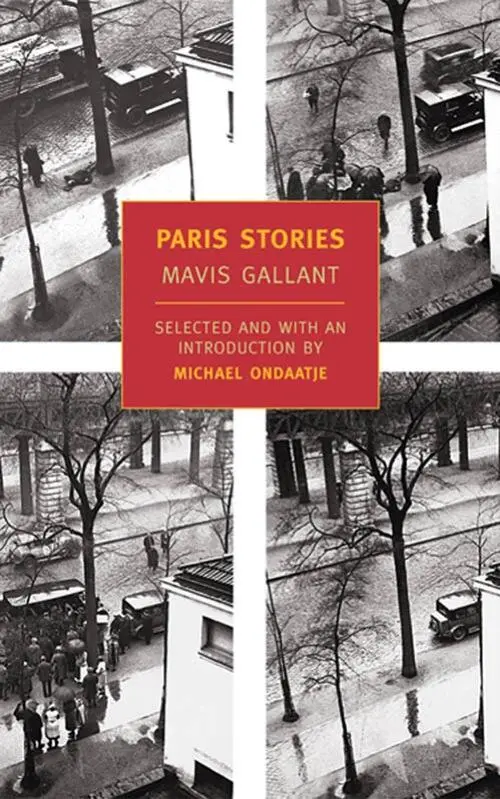
- Название:Paris Stories
- Автор:
- Издательство:NYRB Classics
- Жанр:
- Год:2002
- ISBN:нет данных
- Рейтинг книги:5 / 5. Голосов: 1
-
Избранное:Добавить в избранное
- Отзывы:
-
Ваша оценка:
Paris Stories: краткое содержание, описание и аннотация
Предлагаем к чтению аннотацию, описание, краткое содержание или предисловие (зависит от того, что написал сам автор книги «Paris Stories»). Если вы не нашли необходимую информацию о книге — напишите в комментариях, мы постараемся отыскать её.
Paris Stories — читать онлайн бесплатно полную книгу (весь текст) целиком
Ниже представлен текст книги, разбитый по страницам. Система сохранения места последней прочитанной страницы, позволяет с удобством читать онлайн бесплатно книгу «Paris Stories», без необходимости каждый раз заново искать на чём Вы остановились. Поставьте закладку, и сможете в любой момент перейти на страницу, на которой закончили чтение.
Интервал:
Закладка:
He got up and began turning out lights, leaving just a spot in the window. To have been anti-American during the Second World War in France had a strict political meaning. Any hope of letters from Louis Aragon and Elsa withered and died: Hubert Cruche had been far right. Of course, there was right and right, thought Speck as he triple-locked the front door. Nowadays the Paris intelligentsia drew new lines across the past, separating coarse collaborators from fine-drawn intellectual Fascists. One could no longer lump together young hotheads whose passionate belief in Europe had led them straight to the Charlemagne Division of the Waffen-S.S. and the soft middle class that had stayed behind to make money on the black market. Speck could not quite remember why pure Fascism had been better for civilization than the other kind, but somewhere on the safe side of the barrier there was bound to be a slot for Cruche. From the street, he considered a page of Charles Despiau sketches — a woman's hand, her breast, her thigh. He thought of the Senator's description of that other, early Lydia and of the fragments of perfection Speck could now believe in, for he had seen the Bellefeuille nudes. The familiar evening sadness caught up with him and lodged in his heart. Posterity forgives, he repeated, turning away, crossing the road on his way to his dinner.
Speck's ritual pause brought him up to St. Amand and his demon just as M. Chassepoule leaned into his window to replace a two-volume work he had probably taken out to show a customer. The bookseller drew himself straight, stared confidently into the night, and caught sight of Speck. The two greeted each other through glass. M. Chassepoule seemed safe, at ease, tucked away in a warm setting of lights and friends and royal blue, and yet he made an odd little gesture of helplessness, as if to tell Speck, “Here I am, like you, over-taxed, hounded, running an honest business against dreadful odds.” Speck made a wry face of sympathy, as if to answer that he knew, he knew. His neighbor seemed to belong to an old and desperate breed, its back to the wall, its birthright gnawed away by foreigners, by the heathen, by the blithe continuity of art, by Speck himself. He dropped his gaze, genuinely troubled, examining the wares M. Chassepoule had collected, dusted, sorted, and priced for a new and ardent generation. The work he had just put back in the window was La France Juive, by Édouard Drumont. A handwritten notice described it as a classic study, out of print, hard to find, and in good condition.
Speck thought, A few years ago, no one would have dared put it on display. It has been considered rubbish for fifty years. Edouard Drumont died poor, alone, cast off even by his old friends, completely discredited. Perhaps his work was always being sold, quietly, somewhere, and I didn't know. Had he been Walter and superstitious, he might have crossed his fingers; being Speck and rational, he merely shuddered.
Walter had a friend — Félicité Blum-Weiler-Bloch, the owner of the Afghan hound. When Walter complained to her about the temperature of the gallery, she gave him a scarf, a sweater, an old flannel bedsheet, and a Turkey carpet. Walter decided to make a present of the carpet to Speck.
“Get that thing out of my gallery,” said Speck.
“It's really from Félicité.”
“I don't want her here, either,” said Speck. “Or the dog.”
Walter proposed spreading the carpet on the floor in the basement. “I spend a lot of time there,” he said. “My feet get cold.”
“I want it out,” said Speck.
Later that day Speck discovered Walter down in the framing room, holding a vacuum cleaner. The Turkey carpet was spread on the floor. A stripe of neutral color ran through the pattern of mottled reds and blues. Looking closer, Speck saw it was warp and weft. “Watch,” said Walter. He switched on the vacuum; another strip of color vanished. “The wool lifts right out,” said Walter.
“I told you to get rid of it,” said Speck, trembling.
“Why? I can still use it.”
“I won't have my gallery stuffed with filth.”
“You'll never have to see it. You hardly ever come down here.” He ran the vacuum, drowning Speck's reply. Over the noise Walter yelled, “It will look better when it's all one color.”
Speck raised his voice to the right-wing pitch heard during street fights: “Get it out! Get it out of my gallery!”
Like a telephone breaking into a nightmare, delivering the sleeper, someone was calling, “Dr. Speck.” There on the stairs stood Lydia Cruche, wearing an ankle-length fur coat and a brown velvet turban. “I thought I'd better have a look at the place,” she said. “Just to see how much space you have, how much of Cruche you can hold.”
Still trembling, Speck took her hand, which smelled as if she had been peeling oranges, and pressed it to his lips.
That evening, Speck called the Senator: Would he be interested in writing the catalogue introduction? No one was better fitted, said Speck, over senatorial modesty. The Senator had kept faith with Cruche. During his years of disappointment and eclipse Cruche had been heartened, knowing that guests at the Senator's table could lift their eyes from quail in aspic to feast on Nude in the Afternoon.
Perhaps his lodge brother exaggerated just a trifle, the Senator replied, though it was true that he had hung on to his Cruches even when their value had been wiped out of the market. The only trouble was that his recent prose had been about the capital-gains-tax project, the Common Market sugar-beet subsidy, and the uninformed ecological campaign against plastic containers. He wondered if he could write with the same persuasiveness about art.
“I have taken the liberty of drawing up an outline,” said Speck. “Just a few notes. Knowing how busy you are.”
Hanging up, he glanced at his desk calendar. Less than six weeks had gone by since the night when, by moonlight, Speck had heard the Senator saying “… hats.”
A few days before Christmas Speck drove out to Lydia's with a briefcase filled with documents that were, at last, working papers: the list of exhibits from the Bellefeuille collection, the introduction, and the chronology in which there were gaps for Lydia to fill. He still had to draw up a financial arrangement. So far, she had said nothing about it, and it was not a matter Speck cared to rush.
He found another guest in the house — a man somewhat younger than he, slightly bald and as neat as a mouse.
“Here's the doctor I was telling you about,” said Lydia, introducing Speck.
Signor Vigorelli of Milan was a fellow-Japhethite — so Speck gathered from their conversation, which took up, in English, as though he had never come in. Lydia poured Speck's tea in an offhand manner he found wounding. He felt he was being treated like the hanger-on in a Russian play. He smashed his lemon cupcake, scattering crumbs. The visitor's plate looked cleaner than his. After a minute of this, Speck took the catalogue material out of his briefcase and started to read. Nobody asked what he was reading. The Italian finally looked at his watch (expensive, of a make Speck recognized) and got to his feet, picking up car keys that had been lying next to his plate.
“That little man had an Alfa Romeo tag,” said Speck when Lydia returned after seeing him out.
“I don't know why you people drive here when there is perfectly good bus service,” she said.
“What does he do?”
“He is a devout, religious man.”
For the first time, she sat down on the sofa, close to Speck. He showed her the introduction and the chronology. She made a number of sharp and useful suggestions. Then they went upstairs and looked at the pictures. The studio had been cleaned, the light repaired. Speck suddenly thought, I've done it — I've brought it off.
Читать дальшеИнтервал:
Закладка:
Похожие книги на «Paris Stories»
Представляем Вашему вниманию похожие книги на «Paris Stories» списком для выбора. Мы отобрали схожую по названию и смыслу литературу в надежде предоставить читателям больше вариантов отыскать новые, интересные, ещё непрочитанные произведения.





Обсуждение, отзывы о книге «Paris Stories» и просто собственные мнения читателей. Оставьте ваши комментарии, напишите, что Вы думаете о произведении, его смысле или главных героях. Укажите что конкретно понравилось, а что нет, и почему Вы так считаете.