Mavis Gallant - Paris Stories
Здесь есть возможность читать онлайн «Mavis Gallant - Paris Stories» весь текст электронной книги совершенно бесплатно (целиком полную версию без сокращений). В некоторых случаях можно слушать аудио, скачать через торрент в формате fb2 и присутствует краткое содержание. Год выпуска: 2002, Издательство: NYRB Classics, Жанр: Современная проза, на английском языке. Описание произведения, (предисловие) а так же отзывы посетителей доступны на портале библиотеки ЛибКат.
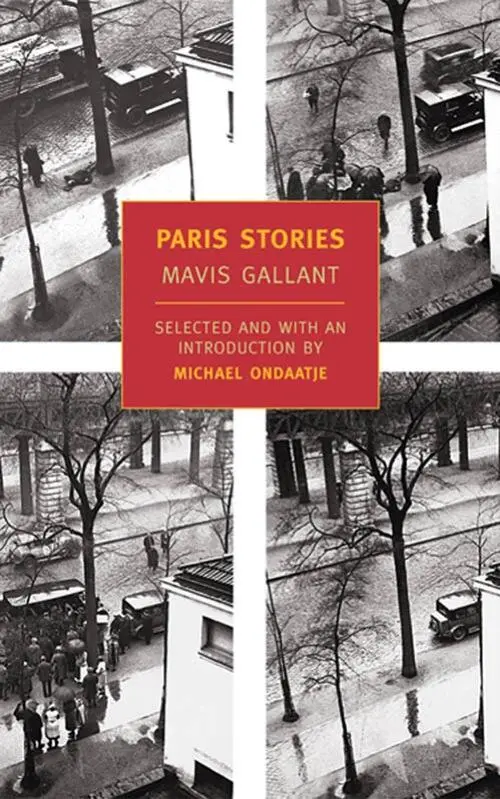
- Название:Paris Stories
- Автор:
- Издательство:NYRB Classics
- Жанр:
- Год:2002
- ISBN:нет данных
- Рейтинг книги:5 / 5. Голосов: 1
-
Избранное:Добавить в избранное
- Отзывы:
-
Ваша оценка:
Paris Stories: краткое содержание, описание и аннотация
Предлагаем к чтению аннотацию, описание, краткое содержание или предисловие (зависит от того, что написал сам автор книги «Paris Stories»). Если вы не нашли необходимую информацию о книге — напишите в комментариях, мы постараемся отыскать её.
Paris Stories — читать онлайн бесплатно полную книгу (весь текст) целиком
Ниже представлен текст книги, разбитый по страницам. Система сохранения места последней прочитанной страницы, позволяет с удобством читать онлайн бесплатно книгу «Paris Stories», без необходимости каждый раз заново искать на чём Вы остановились. Поставьте закладку, и сможете в любой момент перейти на страницу, на которой закончили чтение.
Интервал:
Закладка:
As soon as he got back to the gallery, he had Walter look up Saskatchewan in an atlas. Its austere oblong shape turned his heart to ice. Walter said that it was one of the right-angled territories that so frequently contain oil. Oil seemed to Speck to improve the oblong. He saw a Chirico chessboard sliding off toward a horizon where the lights of derricks twinkled and blinked.
He let a week go by before calling Lydia Cruche.
“I won't be able to show you those roses of yours,” she said. “They died right off.”
He took the hint and arrived with a spray of pale green orchids imported from Brazil. Settled upon the faded sofa, which was apparently destined to be his place, he congratulated his hostess on the discovery of oil in her native plain.
“I haven't seen or heard of the place since Trotsky left the Soviet Union,” she said. “If there is oil, I'd sooner not know about it. Oil is God's curse.” The iron silence that followed this seemed to press on Speck's lungs. “That's a bad cough you've got there, Doctor,” she said. “Men never look after those things. Who looks after you?”
“I look after myself,” said Speck.
“Where's your wife? Where'd she run off to?”
Not even “Are you married?” He saw his hostess as a tough little pagan figure, with a goddess's gift for reading men's lives. He had a quick vision of himself clasping her knees and sobbing out the betrayal of his marriage, though he continued to sit upright, crumbling walnut cake so that he would not have to eat it.
“My wife,” he said, “insofar as I can still be said to have one, has gone to live in a warm climate.”
“She run off alone? Women don't often do that. They haven't got that kind of nerve.”
Stepping carefully, for he did not wish to sound like a stage cuckold or a male fool, Speck described in the lightest possible manner how Henriette had followed her lover, a teacher of literature, to a depressed part of French-speaking Africa where the inhabitants were suffering from a shortage of Racine. Unable to halt once he had started, he tore on toward the edge: Henriette was a hopeless nymphomaniac (she had fallen in love) who lacked any sense of values (the man was broke); she was at the same time a grasping neurotic (having sunk her savings in the gallery, she wanted a return with 14 percent interest).
“You must be thankful you finally got rid of her,” said Lydia Cruche. “You must be wondering why you married her in the first place.”
“I felt sorry for Henriette,” he said, momentarily forgetting any other reason. “She seemed so helpless.” He told about Henriette living in her sixth-floor walk-up, working as slave labor on a shoddy magazine. A peasant from Alsace, she had never eaten anything but pickled cabbage until Speck drove his Bentley into her life. Under his tactful guidance she had tasted her first fresh truffle salad at Le Récamier; had worn her first mink-lined Dior raincoat; had published her first book-length critical essay, “A Woman Looks at Edgar Allan Poe.” And then she had left him — just like that.
“You trained her,” said Lydia Cruche. “Brought her up to your level. And now she's considered good enough to marry a teacher. You should feel proud. You shouldn't mind what happened. You should feel satisfied.”
“I'm not satisfied,” said Speck. “I do mind.” He realized that something had been left out of his account. “I loved her.” Lydia Cruche looked straight at him, for once, as though puzzled. “As you loved Hubert Cruche,” he said.
There was no response except for the removal of crumbs from her lap. The goddess, displeased by his mortal impertinence, symbolically knocked his head off her knee.
“Hube liked my company,” she finally said. “That's true enough. After he died I saw him sitting next to the television, by the radiator, where his mother usually crouched all winter looking like a sheep with an earache. I was just resting here, thinking of nothing in particular, when I looked up and noticed him. He said, 'You carry the seed of your death.' I said, 'If that's the case, I might as well put my head in the oven and be done with it.' ‘Non,’ he said, ‘ce n'est pas la peine.’ Now, his mother was up in her room, making lists of all the things she had to feel sorry about. I went up and said, ‘Madame,’ because you can bet your boots she never got a ‘Maman’ out of me, ‘Hube was in the parlor just now.’ She answered, ‘It was his mother he wanted. Any message was for me.’ I said that if that was so, then all he needed to do was to materialize upstairs and save me the bother of climbing. She gave me some half-baked reason why he preferred not to, and then she did die. Aged a hundred and three. It was in France-Soir.”
The French she had spoken rang to Speck like silver bells. Everything about her had changed — voice, posture, expression. If he still could not see the Lydia Cruche of the Senator's vision, at least he could believe in her.
“Do you talk to your husband often?” he said, trying to make it sound like a usual experience.
“How could I talk to Hube? He's dead and buried. I hope you don't go in for ghosts, Dr. Speck. I would find that very silly. That was just some kind of accident — a visitation. I never saw him again or ever expect to. As for his mother, there wasn't a peep out of her after she died. And here I am, alone in the Cruche house.” It was hard to say if she sounded glad or sorry. “I gather you're on your own, too. God never meant men and women to live by themselves, convenient though it may seem to some of us. That's why he throws men and women together. Coincidence is God's plan.”
So soon, thought Speck. It was only their second meeting. It seemed discourteous to draw attention to the full generation that lay between them; experience had taught him that acknowledging any fragment of this dangerous subject did more harm than good. When widows showed their cards, he tried to look like a man with no time for games. He thought of the young André Malraux, dark and tormented, the windblown lock on the worried brow, the stub of a Gauloise sending up a vagabond spiral of smoke. Unfortunately, Speck had been born forty years too late for the model; he belonged to a much reedier generation of European manhood. He thought of the Pope. White-clad, serene, he gazed out on St. Peter's Square, over the subdued heads of one hundred thousand artists' widows, not one of whom would dare.
“So this was the Cruche family home,” he said, striking out, he hoped, in a safe direction.
“The furniture was his mother's,” said Lydia Cruche. “I got rid of most of it, but there was stuff you couldn't pay them to cart away. Sa petite Maman adorable,” she said softly. Again Speck heard the string of silver bells. “I thought she was going to hang around forever. They were a tough family — peasants from the west of France. She took good care of him. Cooked him sheep's heart, tripe and onions, big beefsteaks they used to eat half raw. He was good-looking, a big fellow, big for a Frenchman. At seventy you'd have taken him for forty. Never had a cold. Never had a headache. Never said he was tired. Drank a liter of Calvados every other day. One morning he just keeled over, and that was that. I'll show you a picture of him sometime.”
“I'd also like to see his pictures,” said Speck, thankful for the chance. “The pictures you said you had upstairs.”
“You know how I met Hube? People often ask me that. I'm surprised you haven't. I came to him for lessons.”
“I didn't know he taught,” said Speck. His most reliable professional trait was his patience.
“He didn't. I admired him so much that I thought I'd try anyway. I was eighteen. I rang the bell. His mother let me in. I never left — he wouldn't let me go. His mother often said if she'd known the future she'd never have answered the door. I must have walked about four miles from a tram stop, carrying a big portfolio of my work to show him. There wasn't even a paved street then — just a patch of nettles out front and some vacant lots.”
Читать дальшеИнтервал:
Закладка:
Похожие книги на «Paris Stories»
Представляем Вашему вниманию похожие книги на «Paris Stories» списком для выбора. Мы отобрали схожую по названию и смыслу литературу в надежде предоставить читателям больше вариантов отыскать новые, интересные, ещё непрочитанные произведения.

Обсуждение, отзывы о книге «Paris Stories» и просто собственные мнения читателей. Оставьте ваши комментарии, напишите, что Вы думаете о произведении, его смысле или главных героях. Укажите что конкретно понравилось, а что нет, и почему Вы так считаете.