Mavis Gallant - Paris Stories
Здесь есть возможность читать онлайн «Mavis Gallant - Paris Stories» весь текст электронной книги совершенно бесплатно (целиком полную версию без сокращений). В некоторых случаях можно слушать аудио, скачать через торрент в формате fb2 и присутствует краткое содержание. Год выпуска: 2002, Издательство: NYRB Classics, Жанр: Современная проза, на английском языке. Описание произведения, (предисловие) а так же отзывы посетителей доступны на портале библиотеки ЛибКат.
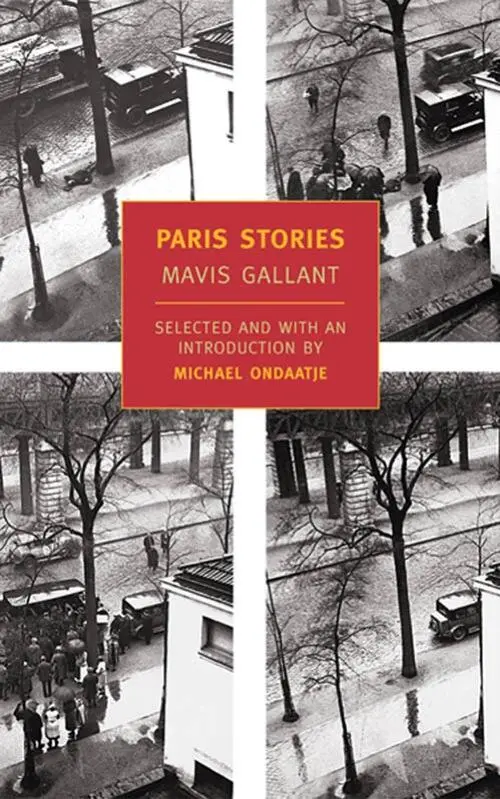
- Название:Paris Stories
- Автор:
- Издательство:NYRB Classics
- Жанр:
- Год:2002
- ISBN:нет данных
- Рейтинг книги:5 / 5. Голосов: 1
-
Избранное:Добавить в избранное
- Отзывы:
-
Ваша оценка:
Paris Stories: краткое содержание, описание и аннотация
Предлагаем к чтению аннотацию, описание, краткое содержание или предисловие (зависит от того, что написал сам автор книги «Paris Stories»). Если вы не нашли необходимую информацию о книге — напишите в комментариях, мы постараемся отыскать её.
Paris Stories — читать онлайн бесплатно полную книгу (весь текст) целиком
Ниже представлен текст книги, разбитый по страницам. Система сохранения места последней прочитанной страницы, позволяет с удобством читать онлайн бесплатно книгу «Paris Stories», без необходимости каждый раз заново искать на чём Вы остановились. Поставьте закладку, и сможете в любой момент перейти на страницу, на которой закончили чтение.
Интервал:
Закладка:
“This gallery will be an oasis of peace and culture,” Walter had predicted as they were hanging the first show, “Little-Known Aspects of Post-Decorator Style.” “An oasis of peace and culture in the international desert.”
Speck breathed germ-laden night air. Boulevard theaters and music halls were deserted, their managers at home writing letters to the mayor of Paris deploring the decline of popular entertainment and suggesting remedies in the form of large cash subsidies. The sluggish river of autumn life congealed and stagnated around millions of television sets as Parisians swallowed aspirin and drank the boiling-hot Scotch believed to be a sovereign defense against Warsaw flu.
A few determined intellectuals slunk, wet, into the Métro on their way to cultural centers where, in vivid translations from the German, actors would address the occasional surly remark to the audience — that loyal, anxious, humorless audience in its costly fake working-class clothes. Another contingent, dressed in Burberry trench coats, had already fought its way into the Geographical Institute, where a lecture with colored slides, “Ram-blings in Secret Greenland,” would begin, after a delay owing to trouble with the projection machine, at about nine-twenty. The advantage of slides over films was that they were not forever jumping about and confusing one, and the voice describing them belonged to a real speaker. When the lights went up, one could see him, talk to him, challenge him over the thing he had said about shamanism on Disko Island. What had drawn the crowd was not Greenland but the word “secret.” In no other capital city does the population wait more trustfully for the mystery to be solved, the conspiracy laid bare, the explanation of every sort of vexation to be supplied: why money slumps, why prices climb, why it rains in August, why children are ungrateful. The answers might easily come from a man with a box of slides.
In each of the city's twenty administrative districts, Communists, distinguished by the cleanliness of their no-iron shirts, the sobriety of their washable neckties, and the modesty of their bearing, moved serenely toward their local cell meetings. I must persuade Walter to take out membership sometime, Speck thought. It might be useful and interesting for the gallery and it would take his mind off salvation.
Walter was at this moment in the Church of St. Gervais, across the Seine, where an ecumenical gathering of prayer, music, and debate on Unity of Faith had been marred the week before by ugly scuffling between middle-aged latecomers and young persons in the lotus position, taking up too much room. Walter had turned to his neighbor, a stranger to him, and asked courteously, “Is it a string ensemble tonight, or just the organ?” Mistaken for a traditionalist demanding the Latin Mass, he had been punched in the face and had to be led to a side chapel to mop up his nosebleed. God knows what they might do to him tonight, Speck thought.
As for Speck himself, nine-thirty found him in good company, briskly tying the strings of his Masonic apron. No commitment stronger than prudence kept him from being at St. Gervais, listening for a voice in the night of the soul, or at a Communist Party cell meeting, hoping to acquire a more wholesome slant on art in a doomed society, but he had already decided that only the Infinite could be everywhere at once. The Masonic Grand Architect of the Universe laid down no rules, appointed no prophets, required neither victims nor devotion, and seemed content to exist as a mere possibility. At the lodge Speck rubbed shoulders with men others had to be content to glimpse on television. He stood now no more than three feet away from Kléber Schaumberger, of the Alsatian Protestant banking Schaumbergers; had been greeted by Olivier Ombrine, who designed all the Arabian princesses' wedding gowns; could see, without craning, the plume of white hair belonging to François-Xavier Blum-Bloch-Weiler — former ambassador, historian, member of the French Academy, author of a perennially best-selling book about Vietnam called When France Was at the Helm. Speck kept the ambassador's family tree filed in his head. The Blum-Bloch-Weilers, heavy art collectors, produced statesmen, magistrates, anthropologists, and generals, and were on no account to be confused with the Blum-Weiler-Blochs, their penniless and mystical cousins, who produced poets, librarians, and Benedictine monks.
Tonight Speck followed the proceedings mechanically; his mind was set on the yellow pad in his briefcase, now lying on the backseat of his car. Direct address and supplication to the unknown were frowned on here. Order reigned in a complex universe where the Grand Architect, insofar as he existed, was supposed to know what he was doing. However, having nowhere to turn, Speck decided for the first time in his life to brave whatever cosmic derangement might ensue and to unburden himself.
Whoever and whatever you are, said Speck silently, as many had said before him, remember in my favor that I have never bothered you. I never called your attention to the fake Laurencin, the stolen Magritte, the Bonnard the other gallery was supposed to have insured, the Maurice Denis notebook that slipped through my fingers, the Vallotton woodcut that got lost between Paris and Lausanne. All I want… But there was no point in his insisting. The Grand Architect, if he was any sort of omnipresence worth considering, knew exactly what Speck needed now: He needed the tiny, enduring wheel set deep in the clanking, churning machinery of the art trade — the artist himself.
Speck came out to the street refreshed and soothed, feeling that he had shed some of his troubles. The rain had stopped. A bright moon hung low. He heard someone saying, “… hats.” On the glistening pavement a group of men stood listening while Senator Antoine Bellefeuille told a funny story. Facts from the Bellefeuille biography tumbled through Speck's mind: twenty years a deputy from a rich farming district, twice a cabinet minister, now senator; had married a sugar-beet fortune, which he inherited when his wife died; no children; his mother had left him majority shares in milk chocolate, which he had sold to invest in the first postwar plastics; owned a racing stable in Normandy, a château in Provence, one of the last fine houses of Paris; had taken first-class degrees in law and philosophy; had gone into politics almost as an afterthought.
What had kept the old man from becoming Prime Minister, even President of the Republic? He had the bearing, the brains, the fortune, and the connections. Too contented, Speck decided, observing his lodge brother by moonlight. But clever, too; he was supposed to have kept copies of files from the time he had been at Justice. He splashed around in the arts, knew the third-generation dealers, the elegant bachelor curators. He went to openings, was not afraid of new movements, but he never bought anything. Speck tried to remember why the wealthy Senator who liked art never bought pictures.
“She was stunning,” the Senator said. “Any man of my generation will tell you that. She came down Boulevard Saint-Michel on her husband's arm. He barely reached her shoulder. She had a smile like a fox's. Straight little animal teeth. Thick red-gold hair. A black hat tilted over one eye. And what a throat. And what hands and arms. A waist no larger than this,” said the Senator, making a circle with his hands. “As I said, in those days men wore hats. You tipped a bowler by the brim, the other sort you picked up by the crown. I was so dazzled by being near her, by having the famous Lydia Cruche smile at me, I forgot I was wearing a bowler and tried to pick it up by the crown. You can imagine what a fool I looked, and how she laughed.”
And of course they laughed, and Speck laughed, too.
Читать дальшеИнтервал:
Закладка:
Похожие книги на «Paris Stories»
Представляем Вашему вниманию похожие книги на «Paris Stories» списком для выбора. Мы отобрали схожую по названию и смыслу литературу в надежде предоставить читателям больше вариантов отыскать новые, интересные, ещё непрочитанные произведения.





Обсуждение, отзывы о книге «Paris Stories» и просто собственные мнения читателей. Оставьте ваши комментарии, напишите, что Вы думаете о произведении, его смысле или главных героях. Укажите что конкретно понравилось, а что нет, и почему Вы так считаете.