Mavis Gallant - Paris Stories
Здесь есть возможность читать онлайн «Mavis Gallant - Paris Stories» весь текст электронной книги совершенно бесплатно (целиком полную версию без сокращений). В некоторых случаях можно слушать аудио, скачать через торрент в формате fb2 и присутствует краткое содержание. Год выпуска: 2002, Издательство: NYRB Classics, Жанр: Современная проза, на английском языке. Описание произведения, (предисловие) а так же отзывы посетителей доступны на портале библиотеки ЛибКат.
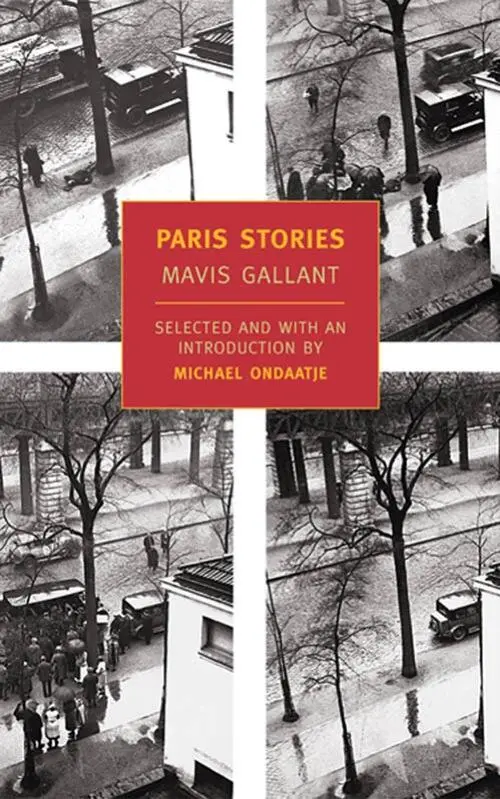
- Название:Paris Stories
- Автор:
- Издательство:NYRB Classics
- Жанр:
- Год:2002
- ISBN:нет данных
- Рейтинг книги:5 / 5. Голосов: 1
-
Избранное:Добавить в избранное
- Отзывы:
-
Ваша оценка:
Paris Stories: краткое содержание, описание и аннотация
Предлагаем к чтению аннотацию, описание, краткое содержание или предисловие (зависит от того, что написал сам автор книги «Paris Stories»). Если вы не нашли необходимую информацию о книге — напишите в комментариях, мы постараемся отыскать её.
Paris Stories — читать онлайн бесплатно полную книгу (весь текст) целиком
Ниже представлен текст книги, разбитый по страницам. Система сохранения места последней прочитанной страницы, позволяет с удобством читать онлайн бесплатно книгу «Paris Stories», без необходимости каждый раз заново искать на чём Вы остановились. Поставьте закладку, и сможете в любой момент перейти на страницу, на которой закончили чтение.
Интервал:
Закладка:
“No, you.
You're the one in a hurry.”
The lover abandoned under a dripping plane tree would feel a damp victory of a kind, awarding himself a first-class trophy for selfless behavior. It would sustain him ten seconds, until the departing one rolled down the taxi window to hurl her last flint: “You Fascist!” Why was this always the final shot, the coup de grâce delivered by women? Speck's wife, Henriette, book critic on an uncompromising political weekly, had said it three times last spring — here, in the street, where Speck stood locking the iron screen into place. He had been uneasily conscious of his wellborn neighbors, hanging out their windows, not missing a thing. Henriette had then gone away in a cab to join her lover, leaving Speck, the gallery, her job — everything that mattered.
He mourned Henriette; he missed her steadying influence. Her mind was like a one-way thoroughfare, narrow and flat, maintained in repair. As he approached the age of forty he felt that his own intellect needed not just a direction but retaining walls. Unless his thoughts were nailed down by gallery business they tended to glide away to the swamps of imagination, behind which stretched the steamier marshland of metaphysics. Confessing this to Henriette was unlikely to bring her back. There had been something brisk and joyous about her going — her hailing of a taxi as though of a friend, her surprised smile as the third “Fascist!” dissolved in the April night like a double stroke from the belfry of St. Clotilde's. He supposed he would never see her again now, except by accident. Perhaps, long after he had forgotten Henriette, he would overhear someone saying in a restaurant, “Do you see that poor mad intellectual talking to herself in the corner? That is Henriette, Sandor Speck's second wife. Of course, she was very different then; Speck kept her in shape.”
While awaiting this sop, which he could hardly call consolation, he had Walter and the gallery. Walter had been with him five years — longer than either of his marriages. They had been years of spiritual second-thinking for Walter and of strain and worry for Speck. Walter in search of the Eternal was like one of those solitary skippers who set out to cross an ocean only to capsize when barely out of port. Speck had been obliged to pluck his assistant out of Unitarian waters and set him on the firm shore of the Trinity. He had towed him to Transubstantiation and back; had charted the shoals and perils of careless prayer. His own aversion to superstitious belief made Speck particularly scrupulous; he would not commit himself on Free Will, for instance, uncertain if it was supposed to be an uphill trudge wearing tight boots or a downhill slide sitting on a tea tray. He would lie awake at night planning Walter's dismissal, only to develop a traumatic chest cold if his assistant seemed restless.
“What will the gallery do without you?” he would ask on the very morning he had been meaning to say, “Walter, sit down, please. I've got something to tell you.” Walter would remind him about saints and holy men who had done without everything, while Speck would envision the pure hell of having to train someone new.
On a rainy night such as this, the street resembled a set in a French film designed for export, what with the policemen's white rain capes aesthetically gleaming and the lights of the bookstore, the restaurant, and the gallery reflected, quivering, in Europeanlooking puddles. In reality, Speck thought, there was not even hope for a subplot. Henriette had gone forever. Walter's mission could not be photographed. The owner of the restaurant was in his eighties; the waiters were poised on the brink of retirement. As for the bookseller, M. Alfred Chassepoule, he seemed to spend most of his time wiping blood off the collected speeches of Mussolini, bandaging customers, and sweeping up glass. The fact was that Amandine's had turned out to have a fixed right-wing viewpoint, which made it subject to attack by commandos wielding iron bars. Speck, who had chosen the street for its upper-class hush, had grown used to the hoarse imprecation of the left and shriller keening of the right; he could tell the sob of an ambulance from the wail of a police van. The commerce of art is without bias: When insurance inspectors came round to ask what Speck might have seen, he invariably replied, “Seen where?” to which Walter, unsolicited, would add, “And I am Swiss.”
Since Henriette's departure, Speck often ate his meals in the local restaurant, which catered to his frugal tastes, his vegetarian principles, and his desire to be left in peace. On the way, he would pause outside Amandine's, just enough to mark the halt as a comforting bachelor habit. He would glance over the secondhand books, the yellowing pamphlets, and the overpriced cartoons. The tone of the window display seemed old-fashioned rather than dangerous, though he knew that the slogan crowning the arrangement, “Europe for Europeans,” echoed from a dark political valley. But even that valley had been full of strife and dissension and muddle, for hadn't the Ur-Fascists, the Italian ones, been in some way against an all-Europe? At least, some of their poets were. But who could take any of that seriously now? Nothing political had ever struck Speck as being above the level of a low-grade comic strip. On the cover of one volume, Uncle Sam shook hands with the Russian Bear over prostrate Europe, depicted as a maiden in a dead faint. A drawing of a spider on a field of banknotes (twelve hundred francs with frame, nine hundred without) jostled the image of a crablike hand clawing away at the map of France. Pasted against the pane, survivor of uncounted assaults, the old man continued to dismember his captive imp. Walter had told Speck he believed the old man to be St. Amand, Apostle of Flanders, Bishop in 430. “Or perhaps,” said Walter, after thinking it over, “435.” The imp probably stood for Flemish paganism, which the Apostle had been hard put to it to overcome.
From the rainy street Speck could see four or five of Amandine's customers — all men; he had never noticed a woman in the place — standing, reading, books held close to their noses. They had the weak eyes, long chins, and sparse, sparrow-colored hair he associated with low governmental salaries. He imagined them living with grim widowed mothers whose company they avoided after work. He had seen them, or young men like them, staggering out of the store, cut by flying glass, kicked and beaten as they lay stunned on the pavement; his anxious imagination had set them on their feet, booted and belted, the right signal given at last, swarming across to the gallery, determined to make Speck pay for injuries inflicted on them by total strangers. He saw his only early Chagall (quite likely authentic) ripped from its frame; Walter, his poor little spectacles smeared with blood, lambasted with the complete Charles Maurras, fourteen volumes, full morocco; Speck himself, his ears offended by acute right-wing cries of “Down with foreign art!” attempting a quick counterstroke with Significant Minor French Realists, Twentieth Century, which was thick enough to stun an ox. Stepping back from the window, Speck saw his own smile reflected. It was pinched and tight, and he looked a good twenty years older than thirty-nine.
His restaurant, crammed with civil servants at noon, was now nearly empty. A smell of lunchtime pot roast hung in the air. He made for his own table, from which he could see the comforting lights of the gallery. The waiter, who had finally stopped asking how Henriette was liking Africa, brought his dinner at once, setting out like little votive offerings the raw-carrot salad, the pot-roast vegetables without the meat, the quarter ounce of low-fat cheese, and a small pear. It had long been established that Speck did not wish to be disturbed by the changing of plates. He extracted a yellow pad and three pencils from his briefcase and placed them within the half circle of dishes. Speck was preparing his May-June show.
Читать дальшеИнтервал:
Закладка:
Похожие книги на «Paris Stories»
Представляем Вашему вниманию похожие книги на «Paris Stories» списком для выбора. Мы отобрали схожую по названию и смыслу литературу в надежде предоставить читателям больше вариантов отыскать новые, интересные, ещё непрочитанные произведения.







Обсуждение, отзывы о книге «Paris Stories» и просто собственные мнения читателей. Оставьте ваши комментарии, напишите, что Вы думаете о произведении, его смысле или главных героях. Укажите что конкретно понравилось, а что нет, и почему Вы так считаете.