Mavis Gallant - Paris Stories
Здесь есть возможность читать онлайн «Mavis Gallant - Paris Stories» весь текст электронной книги совершенно бесплатно (целиком полную версию без сокращений). В некоторых случаях можно слушать аудио, скачать через торрент в формате fb2 и присутствует краткое содержание. Год выпуска: 2002, Издательство: NYRB Classics, Жанр: Современная проза, на английском языке. Описание произведения, (предисловие) а так же отзывы посетителей доступны на портале библиотеки ЛибКат.
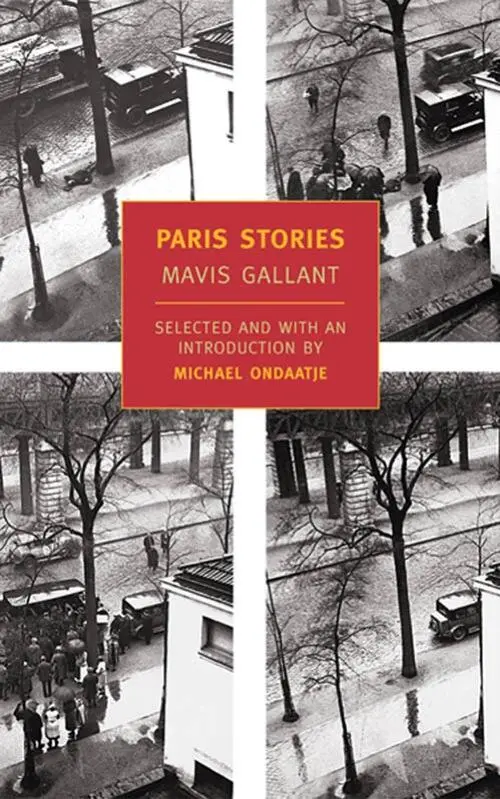
- Название:Paris Stories
- Автор:
- Издательство:NYRB Classics
- Жанр:
- Год:2002
- ISBN:нет данных
- Рейтинг книги:5 / 5. Голосов: 1
-
Избранное:Добавить в избранное
- Отзывы:
-
Ваша оценка:
Paris Stories: краткое содержание, описание и аннотация
Предлагаем к чтению аннотацию, описание, краткое содержание или предисловие (зависит от того, что написал сам автор книги «Paris Stories»). Если вы не нашли необходимую информацию о книге — напишите в комментариях, мы постараемся отыскать её.
Paris Stories — читать онлайн бесплатно полную книгу (весь текст) целиком
Ниже представлен текст книги, разбитый по страницам. Система сохранения места последней прочитанной страницы, позволяет с удобством читать онлайн бесплатно книгу «Paris Stories», без необходимости каждый раз заново искать на чём Вы остановились. Поставьте закладку, и сможете в любой момент перейти на страницу, на которой закончили чтение.
Интервал:
Закладка:
Mrs. Essling recalls that at seventeen this seemed entirely within her possibilities, and she replied something like “Yes, I see,” or “I quite understand,” or “You needn't mention it again.”
Mrs. Essling brought up her husband's four children and had two more of her own, and died after thirty-six years of marriage at the age of fifty-three. Her husband haunts her with proof of her goodness. He tells people that Mrs. Essling was born an angel, lived like an angel, and is an angel in eternity. Mrs. Essling would like relief from this charge. “Angel” is a loose way of speaking. She is astonished that the Professor cannot be more precise. Angels are created, not born. Nowhere in any written testimony will you find a scrap of proof that angels are “good.” Some are merely messengers; others have a paramilitary function. All are stupid.
After her death, Mrs. Essling remained in the Fifteenth District. She says she can go nowhere without being accosted by the Professor, who, having completed the last phase of his work Malebranche and Mysticism, roams the streets, looking in shopwindows, eating lunch twice, in two different restaurants, telling his life story to waiters and bus drivers. When he sees Mrs. Essling, he calls out, “There you are!” and “What have you been sent to tell me?” and “Is there a message?” In July, catching sight of her at the open-air fruit market on Dulac Street, the Professor jumped off a bus, upsetting barrows of plums and apricots, waving an umbrella as he ran. Mrs. Essling had to take refuge in the cold-storage room of the central market, where, years ago, after she had ordered twenty pounds of raspberries and currants for making jelly, she was invited by the wholesale fruit dealer, Mr. Lobrano, aged twenty-nine, to spend a holiday with him in a charming southern city whose Mediterranean Baroque churches he described with much delicacy of feeling. Mrs. Essling was too startled to reply. Mistaking her silence, Mr. Lobrano then mentioned a northern city containing a Gothic cathedral. Mrs. Essling said that such a holiday was impossible. Mr. Lobrano asked for one good reason. Mrs. Essling was at that moment four months pregnant with her second child. Three stepchildren waited for her out in the street. A fourth stepchild was at home looking after the baby. Professor Essling, working on his Malebranche and Money, was at home, too, expecting his lunch. Mrs. Essling realized she could not give Mr. Lobrano one good reason. She left the cold-storage room without another word and did not return to it in her lifetime.
Mrs. Essling would like to be relieved of the Professor's gratitude. Having lived an exemplary life is one thing; to have it thrown up at one is another. She would like the police to send for Professor Essling and tell him so. She suggests that the police find some method of keeping him off the streets. The police ought to threaten him; frighten him; put the fear of the Devil into him. Philosophy has made him afraid of dying. Remind him about how he avoided writing his Malebranche and Mortality. He is an old man. It should be easy.
SPECK'S IDEA
SANDOR SPECK'S first art gallery in Paris was on the Right Bank, near the Church of St. Elisabeth, on a street too narrow for cars. When his block was wiped off the map to make way for a five-story garage, Speck crossed the Seine to the shadow of Saint-Julien-le-Pauvre, where he set up shop in a picturesque slum protected by law from demolition. When this gallery was blown up by Basque separatists, who had mistaken it for a travel agency exploiting the beauty of their coast, he collected his insurance money and moved to the Faubourg Saint-Germain.
Here, at terrifying cost, he rented four excellent rooms — two on the loggia level, and a clean dry basement for framing and storage. The entrance, particularly handsome, was on the street side of an eighteenth-century hôtel particulier built around an elegant court now let out as a parking concession. The building had long before been cut up into dirty, decaying apartments, whose spiteful, quarrelsome, and avaricious tenants were forgiven every failing by Speck for the sake of being the Count of this and the Prince of that. Like the flaking shutters, the rotting window-sills, the slops and oil stains in the ruined court, they bore a Proustian seal of distinction, like a warranty, making up for his insanely expensive lease. Though he appreciated style, he craved stability even more. In the Faubourg, he seemed at last likely to find it: Not a stone could be removed without the approval of the toughest cultural authorities of the nation. Three Marxist embassies installed in former ducal mansions along the street required the presence of armed policemen the clock around. The only commercial establishments anywhere near Speck's — a restaurant and a bookstore — seemed unlikely targets for fire-bombs: The first catered to lower-echelon civil servants, the second was painted royal blue, a conservative color he found reassuring. The bookstore's name, Amandine, suggested shelves of calm regional novels and accounts of travel to Imperial Russia signed “A Diplomat.” Pasted inside the window, flat on the pane, was an engraving that depicted an old man, bearded and mitered, tearing a small demon limb from limb. The old man looked self-conscious, the imp resigned. He supposed that this image concealed a deep religious meaning, which he did not intend to plumb. If it was holy, it was respectable; as the owner of the gallery across the street, he needed to know nothing more.
Speck was now in the parish of St. Clotilde, near enough to the church for its bells to give him migraine headaches. Leaves from the church square blew as far as his door — melancholy reminders of autumn, a season bad for art. (Winter was bad, too, while the first chestnut leaves unfolding heralded the worst season of all. In summer the gallery closed.) In spite of his constant proximity to churches he had remained rational. Generations of highly intellectual Central European agnostics and freethinkers had left in his bones a mistrust of the bogs and quicksands that lie beyond reality perceived. Neither loss nor grief nor guilt nor fear had ever moved him to appeal to the unknown — any unknown, for there were several. Nevertheless, after signing his third lease in seven years, he decided to send Walter, his Swiss assistant, a lapsed Calvinist inching toward Rome, to light a candle at St. Clotilde's. Walter paid for a five-franc taper and set it before St. Joseph, the most reliable intermediary he could find: A wave of postconciliar puritanism seemed to have broken at St. Clotilde's, sweeping away most of the mute and obliging figures to whom desires and gratitude could be expressed. Walter was willing to start again in some livelier church — Notre Dame de Paris, for instance — but Speck thought enough was enough.
On a damp October evening about a year after this, there could be seen in Speck's window a drawing of a woman drying her feet (Speck permanent collection); a poster announcing the current exhibition, “Paris and Its Influence on the Tirana School, 1931–2”; five catalogues displayed attractively; and the original of the picture on the poster — a shameless copy of Foujita's Mon Intérieur reentitled Balkan Alarm Clock. In defiance of a government circular reminding Paris galleries about the energy crisis Speck had left the lights on. This was partly to give the lie to competitors who might be putting it about that he was having money troubles. He had set the burglar alarm, bolted the security door, and was now cranking down an openwork iron screen whose Art Nouveau loops and fronds allowed the works inside to be seen but nothing larger than a mouse to get in. The faint, floating sadness he always felt while locking up had to do with the time. In his experience, love affairs and marriages perished between seven and eight o'clock, the hour of rain and no taxis. All over Paris couples must be parting forever, leaving like debris along the curbs the shreds of canceled restaurant dates, useless ballet tickets, hopeless explanations, and scraps of pride; and toward each of these disasters a taxi was pulling in, the only taxi for miles, the light on its roof already dimmed in anticipation to the twin dots that in Paris mean “occupied.” But occupied by whom? “You take it.”
Читать дальшеИнтервал:
Закладка:
Похожие книги на «Paris Stories»
Представляем Вашему вниманию похожие книги на «Paris Stories» списком для выбора. Мы отобрали схожую по названию и смыслу литературу в надежде предоставить читателям больше вариантов отыскать новые, интересные, ещё непрочитанные произведения.




Обсуждение, отзывы о книге «Paris Stories» и просто собственные мнения читателей. Оставьте ваши комментарии, напишите, что Вы думаете о произведении, его смысле или главных героях. Укажите что конкретно понравилось, а что нет, и почему Вы так считаете.