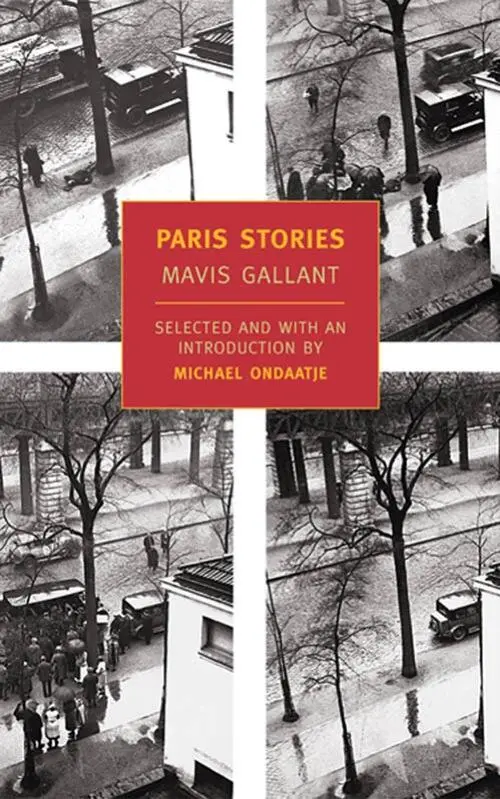
Mavis Gallant - Paris Stories
Здесь есть возможность читать онлайн «Mavis Gallant - Paris Stories» весь текст электронной книги совершенно бесплатно (целиком полную версию без сокращений). В некоторых случаях можно слушать аудио, скачать через торрент в формате fb2 и присутствует краткое содержание. Год выпуска: 2002, Издательство: NYRB Classics, Жанр: Современная проза, на английском языке. Описание произведения, (предисловие) а так же отзывы посетителей доступны на портале библиотеки ЛибКат.
- Название:Paris Stories
- Автор:
- Издательство:NYRB Classics
- Жанр:
- Год:2002
- ISBN:нет данных
- Рейтинг книги:5 / 5. Голосов: 1
-
Избранное:Добавить в избранное
- Отзывы:
-
Ваша оценка:
Paris Stories: краткое содержание, описание и аннотация
Предлагаем к чтению аннотацию, описание, краткое содержание или предисловие (зависит от того, что написал сам автор книги «Paris Stories»). Если вы не нашли необходимую информацию о книге — напишите в комментариях, мы постараемся отыскать её.
Paris Stories — читать онлайн бесплатно полную книгу (весь текст) целиком
Ниже представлен текст книги, разбитый по страницам. Система сохранения места последней прочитанной страницы, позволяет с удобством читать онлайн бесплатно книгу «Paris Stories», без необходимости каждый раз заново искать на чём Вы остановились. Поставьте закладку, и сможете в любой момент перейти на страницу, на которой закончили чтение.
Интервал:
Закладка:
The right show at the right time: It was trickier than getting married to the right person at any time. For about a year now, Paris critics had been hinting at something missing from the world of art. These hints, poignant and patriotic on the right, neonationalist and pugnacious on the left, wistful but insistent dead center, were all in essence saying the same thing: “The time has come.” The time had come; the hour had struck; the moment was ripe for a revival of reason, sanity, and taste. Surely there was more to art than this sickness, this transatlantic blight? Fresh winds were needed to sweep the museums and galleries. Two days ago there had been a disturbing article in Le Monde (front page, lower middle, turn to page 26) by a man who never took up his pen unless civilization was in danger. Its title — ”Redemption Through Art — Last Hope for the West?” — had been followed by other disturbing questions: When would the merchants and dealers, compared rather unfairly to the money changers driven from the temple, face up to their share of responsibility as the tattered century declined? Must the flowering gardens of Western European culture wilt and die along with the decadent political systems, the exhausted parliaments, the shambling elections, the tired liberal impulses? What of the man in the street, too modest and confused to mention his cravings? Was he not gasping for one remedy and one only — artistic renovation? And where was this to come from? “In the words of Shakespr,” the article concluded, supposedly in English, “That is the qustn.”
As it happened, Speck had the answer: Say, a French painter, circa 1864–1949, forgotten now except by a handful of devoted connoisseurs. Populist yet refined, local but universal, he would send rays, beacons, into the thickening night of the West, just as Speck's gallery shone bravely into the dark street. Speck picked up a pencil and jotted rapidly: “Born in France, worked in Paris, went his own way, unmindful of fashion, knowing his hour would strike, his vision be vindicated. Catholical, as this retrospective so eloquently…” Just how does “catholical” come in, Speck wondered, forking up raw carrots. Because of ubiquity, the ubiquity of genius? No; not genius — leave that for the critics. His sense of harmony, then — his discretion.
Easy, Speck told himself. Easy on the discretion. This isn't interior decoration.
He could see the notices, knew which of the critics would write “At last,” and “It has taken Sandor Speck to remind us.” Left, right, and center would unite on a single theme: how the taste of two full generations had been corrupted by foreign speculation, cosmopolitan decadence, and the cultural imperialism of the Anglo-Saxon hegemony.
“The calm agnostic face,” Speck wrote happily, “the quiet Cartesian voice are replaced by the snarl of a nation betrayed (1914), as startling for the viewer as a child's glimpse of a beloved adult in a temper tantrum. The snarl, the grimace vanish (1919) as the serene observer of Universal Will (1929) and of Man's responsibility to himself return. But we are left shaken. We have stopped trusting our feelings. We have been shown not only the smile but the teeth.”
Here Speck drew a wavy line and turned to the biography, which was giving him trouble. On a fresh yellow page he tried again:
1938 — Travels to Nice. Sees Mediterranean.
1939 — Abandons pacifist principle. Lies about age. Is mobilized.
1940 — Demobilized.
1941 —
It was here that Speck bogged down. Should he say, “Joins Resistance”? “Resistance” today meant either a heroic moment sadly undervalued by the young or a minor movement greatly inflated in order to absolve French guilt. Whatever it is, thought Speck, it is not chic. The youngest survivor must be something like seventy-three. They know nothing about art, and never subscribe to anything except monuments. Some people read “Resistance” in a chronology and feel quite frankly exasperated. On the other hand, what about museums, state-subsidized, Resistance-minded on that account? He chewed a boiled leek and suddenly wrote, “1941 — Conversations with Albert Camus.” I wonder where all this comes from, Speck said to himself. Inspiration was what he meant.
These notes, typed by Walter, would be turned over to the fashionable historian, the alarming critic, the sound political figure unlikely to be thrown out of office between now and spring, whom Speck would invite to write the catalogue introduction. “Just a few notes,” Speck would say tactfully. “Knowing how busy you are.” Nothing was as inspiriting to him as the thought of his own words in print on a creamy catalogue page, even over someone else's name.
Speck took out of his briefcase the Directoire snuffbox Henriette had given him about a fortnight before suddenly calling him “Fascist.” (Unexpected feminine generosity — first firm sign of adulterous love affair.) It contained three after-dinner tablets — one to keep him alert until bedtime, another to counter the stimulating effect of the first, and a third to neutralize the germ known as Warsaw flu now ravaging Paris, emptying schools and factories and creating delays in the postal service. He sat quietly, digesting, giving the pills a chance to work.
He could see the structure of the show, the sketchbooks and letters in glass cases. It might be worthwhile lacquering the walls black, concentrating strong spots on the correspondence, which straddled half a century, from Degas to Cocteau. The scrawl posted by Drieu la Rochelle just before his suicide would be particularly effective on black. Céline was good; all that crowd was back in vogue now. He might use the early photo of Céline in regimental dress uniform with a splendid helmet. Of course, there would be word from the left, too, with postcards from Jean Jaurès, Léon Blum, and Paul Éluard, and a jaunty get-well message from Louis Aragon and Elsa. In the first room Speck would hang the stiff, youthful landscapes and the portraits of the family, the artist's first models — his brother wearing a sailor suit, the awkward but touching likeness of his sister (Germaine-Isabelle at the Window) .
“Yes, yes,” Speck would hear in the buzz of voices at the opening. “Even from the beginning you can tell there was something.” The “something” became bolder, firmer in the second room. See his cities; watch how the streets turn into mazes, nets, prison corridors. Dark palette. Opaqueness, the whole canvas covered, immensities of indigo and black. “Look, 1929; he was doing it before What's-His-Name.” Upstairs, form breaking out of shadow: bread, cheese, wine, wheat, ripe apples, grapes.
Hold it, Speck told himself. Hold the ripeness. This isn't social realism.
He gathered up the pencils, the snuffbox, and the pad, and put them back in the briefcase. He placed seventy francs, tip included, in a saucer. Still he sat, his mind moving along to the second loggia room, the end room, the important one. Here on the neutral walls would be the final assurance, the serenity, the satire, the power, and the vision for which, at last, the time had come. For that was the one thing Speck was sure of: The bell had rung, the hour had struck, the moment was at hand.
Whose time? Which hour? Yes — whose, which, what? That was where he was stuck.
The street was now empty except for the policemen in their streaming capes. The bookstore had put up its shutter. Speck observed the walls of the three Marxist embassies. Shutters and curtains that once had shielded the particular privacy of the aristocracy — privacy open to servants but not to the street — now concealed the receptions and merry dinner parties of people's democracies. Sometimes at this hour gleaming motorcars rolled past the mysterious gates, delivering passengers Speck's fancy continued to see as the Duchesse de Guermantes and anyone she did not happen to despise. He knew that the chauffeurs were armed and that half the guests were spies; still, there was nothing to stop a foreign agent from having patrician tastes, or from admiring Speck's window as he drove by.
Читать дальшеИнтервал:
Закладка:
Похожие книги на «Paris Stories»
Представляем Вашему вниманию похожие книги на «Paris Stories» списком для выбора. Мы отобрали схожую по названию и смыслу литературу в надежде предоставить читателям больше вариантов отыскать новые, интересные, ещё непрочитанные произведения.

Обсуждение, отзывы о книге «Paris Stories» и просто собственные мнения читателей. Оставьте ваши комментарии, напишите, что Вы думаете о произведении, его смысле или главных героях. Укажите что конкретно понравилось, а что нет, и почему Вы так считаете.