Mavis Gallant - Paris Stories
Здесь есть возможность читать онлайн «Mavis Gallant - Paris Stories» весь текст электронной книги совершенно бесплатно (целиком полную версию без сокращений). В некоторых случаях можно слушать аудио, скачать через торрент в формате fb2 и присутствует краткое содержание. Год выпуска: 2002, Издательство: NYRB Classics, Жанр: Современная проза, на английском языке. Описание произведения, (предисловие) а так же отзывы посетителей доступны на портале библиотеки ЛибКат.
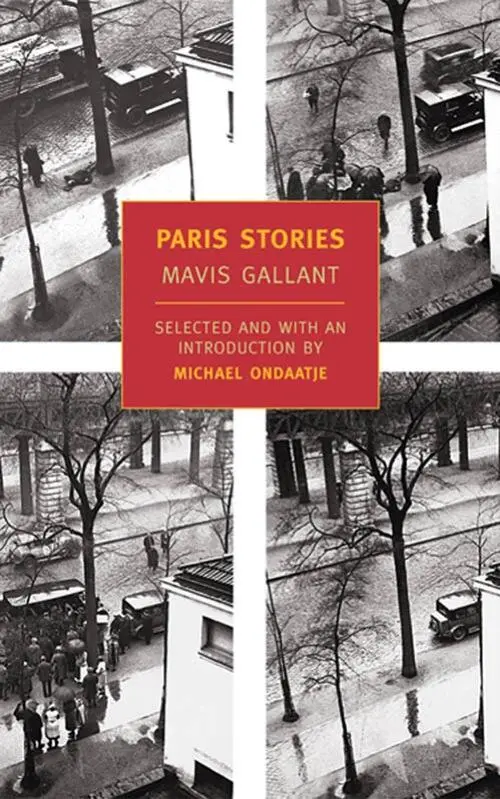
- Название:Paris Stories
- Автор:
- Издательство:NYRB Classics
- Жанр:
- Год:2002
- ISBN:нет данных
- Рейтинг книги:5 / 5. Голосов: 1
-
Избранное:Добавить в избранное
- Отзывы:
-
Ваша оценка:
Paris Stories: краткое содержание, описание и аннотация
Предлагаем к чтению аннотацию, описание, краткое содержание или предисловие (зависит от того, что написал сам автор книги «Paris Stories»). Если вы не нашли необходимую информацию о книге — напишите в комментариях, мы постараемся отыскать её.
Paris Stories — читать онлайн бесплатно полную книгу (весь текст) целиком
Ниже представлен текст книги, разбитый по страницам. Система сохранения места последней прочитанной страницы, позволяет с удобством читать онлайн бесплатно книгу «Paris Stories», без необходимости каждый раз заново искать на чём Вы остановились. Поставьте закладку, и сможете в любой момент перейти на страницу, на которой закончили чтение.
Интервал:
Закладка:
“Well, what do you want?”
“First of all,” he said,“to meet you.”
“What for?”
He cupped his hand round the telephone, as if spies from the embassies down the street were trying to overhear. “I am planning a major Cruche show. A retrospective. That's what I want to talk to you about.”
“Not unless I know what you want.”
It seemed to Speck that he had already told her. Her voice was languid and nasal and perfectly flat. An index to English dialects surfaced in his mind, yielding nothing useful.
“It will be a strong show,” he went on. “The first big Cruche since the 1930s, I believe.”
“What's that got to do with me?”
He wondered if the Senator had forgotten something essential — that Lydia Cruche had poisoned her husband, for instance. He said, “You probably own quite a lot of his work.”
“None of it's for sale.”
This, at last, was familiar; widows' negotiations always began with “No.” “Actually, I am not proposing to buy anything,” he said, wanting this to be clear at the start. “I am offering the hospitality of my gallery. It's a gamble I am willing to take because of my firm belief that the time — ” “What's the point of this show?”
“The point?” said Speck, his voice tightening as it did when Walter was being obtuse. “The point is getting Cruche back on the market. The time has come — the time to… to attack. To attack the museums with Hubert Cruche.”
As he said this, Speck saw the great armor-plated walls of the Pompidou Art Center and the chink in the armor through which an 80 x 95 Cruche 1919 abstract might slip. He saw the provincial museums, cheeseparing, saving on lightbulbs, but, like the French bourgeoisie they stood for, so much richer than they seemed. At the name “Cruche” their curators would wake up from neurotic dreams of forced auction sales, remembering they had millions to get rid of before the end of the fiscal year. And France was the least of it; London, Zurich, Stockholm, and Amsterdam materialized as frescoes representing the neoclassical façades of four handsome banks. Overhead, on a Baroque ceiling, nymphs pointed their rosy feet to gods whose chariots were called “Tokyo” and “New York.” Speck lowered his voice as if he had portentous news. Museums all over the world, although they did not yet know this, were starving for Cruche. In the pause that followed he seemed to feel Henriette's hand on his shoulder, warning him to brake before enthusiasm took him over the cliff.
“Although for the moment Cruche is just an idea of mine,” he said, stopping cold at the edge. “Just an idea. We can develop the idea when we meet.”
A week later, Speck parked his car between a ramshackle shopping center — survivor of the building boom of the sixties — and a municipal low-cost housing project that resembled a jail. In the space bounded by these structures crouched the late artist's villa, abiding proof in stucco that the taste of earlier generations had been as disastrous as today's. He recognized the shards of legal battle: Center and block had left the drawing board of some state-employed hack as a unit, only to be wedged apart by a widow's refusal to sell. Speck wondered how she had escaped expropriation. Either she knows someone powerful, he thought, or she can make such a pest of herself that they were thankful to give up.
A minute after having pushed the gate and tugged the rusted wire bellpull, he found himself alone in a bleak sitting room, from which his hostess had been called by a whistling kettle. He sat down on a faded sofa. The furniture was of popular local design, garnished with marble and ormolu. A television set encrusted with gilt acanthus leaves sat on a sideboard, like an objet d'art. A few rectangular shadings on the wallpaper showed where pictures had hung.
The melancholy tinged with foreboding Speck felt between seven and eight overtook him at this much earlier hour. The room was no more hideous than others he had visited in his professional quest for a bargain, but this time it seemed to daunt him, recalling sieges and pseudo courtships and expenditures of time, charm, and money that had come to nothing. He got up and examined a glass-fronted bookcase with nothing inside. His features, afloat on a dusty pane, were not quite as pinched as they had been the other night, but the image was still below par for a man considered handsome. The approach of a squeaking tea cart sent him scurrying back to the sofa, like a docile child invited somewhere for the first time.
“I was just admiring — ” he began.
“I've run out of milk,” she said. “I'm sure you won't mind your tea plain.” With this governessy statement she handed him a cup of black Ceylon, a large slice of poisonous raisin cake, and a Mickey Mouse paper napkin.
Nothing about Cruche's widow tallied with the Senator's description. She was short and quite round, and reminded Speck of the fat little dogs one saw being reluctantly exercised in Paris streets. The abundant red-gold hair of the Senator's memory, or imagination, had gone ash-gray and was, in any case, pinned up. The striking fact of her person was simply the utter blankness of her expression. Usually widows' faces spoke to him. They said, “I am lonely,” or “Can I trust you?” Lydia Cruche's did not suggest that she had so much as taken Speck in. She chose a chair at some distance from Speck, and proceeded to eat her cake without speaking. He thought of things to say, but none of them seemed appealing.
At last, she said, “Did you notice the supermarket next door?”
“I saw a shopping center.”
“The market is part of it. You can get anything there now — bran, frozen pizzas, maple syrup. That's where I got the cake mix. I haven't been to Paris for three years.”
Speck had been born in France. French education had left him the certainty that he was a logical, fair-minded person imbued with a culture from which every other Western nation was obliged to take its bearings. French was his first language; he did not really approve of any other. He said, rather coldly, “Have you been in this country long?”
“Around fifty years.”
“Then you should know some French.”
“I don't speak it if I don't have to. I never liked it.”
He put down his cup, engulfed by a wave of second-generation distress. She was his first foreign widow. Most painters, whatever their origins, had sense enough to marry Frenchwomen — unrivaled with creditors, thrifty hoarders of bits of real estate, endowed with relations in country places where one could decamp in times of need and war.
“Perhaps, where you come from — ”he began.
“Saskatchewan.”
His tea had gone cold. Tannic scum had collected on its surface. She said, “This idea of yours, this show — what was it you called it? The hospitality of your gallery? I just want to say don't count on me. Don't count on me for anything. I don't mind showing you what I've got. But not today. The studio hasn't been dusted or heated for years, and even the light isn't working.”
In Speck's experience, this was about average for a first attempt. Before making for civilization he stopped at a florist's in the shopping center and ordered two dozen roses to be delivered to Mme. Cruche. While these were lifted, dripping, from a plastic pail, he jotted down a warm message on his card, crossing out the engraved “Dr. Sandor Speck.” His title, earned by a thesis on French neo-humanism and its ups and downs, created some confusion in Paris, where it was taken to mean that Speck could cure slipped disks and gastric ulcers. Still, he felt that it gave a grip to his name, and it was his only link with all the freethinking, agnostic Specks, who, though they had not been able to claim affinity by right of birth with Voltaire and Descartes, had probably been wise and intelligent and quite often known as “Dr.”
Читать дальшеИнтервал:
Закладка:
Похожие книги на «Paris Stories»
Представляем Вашему вниманию похожие книги на «Paris Stories» списком для выбора. Мы отобрали схожую по названию и смыслу литературу в надежде предоставить читателям больше вариантов отыскать новые, интересные, ещё непрочитанные произведения.

Обсуждение, отзывы о книге «Paris Stories» и просто собственные мнения читателей. Оставьте ваши комментарии, напишите, что Вы думаете о произведении, его смысле или главных героях. Укажите что конкретно понравилось, а что нет, и почему Вы так считаете.