Mavis Gallant - Paris Stories
Здесь есть возможность читать онлайн «Mavis Gallant - Paris Stories» весь текст электронной книги совершенно бесплатно (целиком полную версию без сокращений). В некоторых случаях можно слушать аудио, скачать через торрент в формате fb2 и присутствует краткое содержание. Год выпуска: 2002, Издательство: NYRB Classics, Жанр: Современная проза, на английском языке. Описание произведения, (предисловие) а так же отзывы посетителей доступны на портале библиотеки ЛибКат.
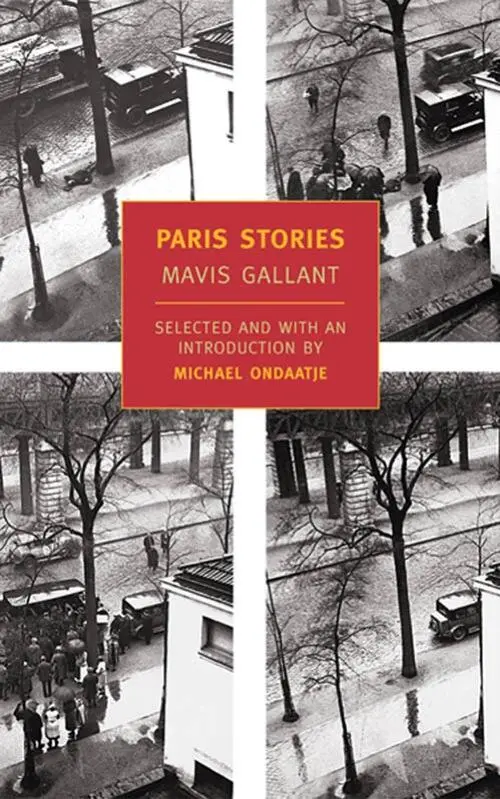
- Название:Paris Stories
- Автор:
- Издательство:NYRB Classics
- Жанр:
- Год:2002
- ISBN:нет данных
- Рейтинг книги:5 / 5. Голосов: 1
-
Избранное:Добавить в избранное
- Отзывы:
-
Ваша оценка:
Paris Stories: краткое содержание, описание и аннотация
Предлагаем к чтению аннотацию, описание, краткое содержание или предисловие (зависит от того, что написал сам автор книги «Paris Stories»). Если вы не нашли необходимую информацию о книге — напишите в комментариях, мы постараемся отыскать её.
Paris Stories — читать онлайн бесплатно полную книгу (весь текст) целиком
Ниже представлен текст книги, разбитый по страницам. Система сохранения места последней прочитанной страницы, позволяет с удобством читать онлайн бесплатно книгу «Paris Stories», без необходимости каждый раз заново искать на чём Вы остановились. Поставьте закладку, и сможете в любой момент перейти на страницу, на которой закончили чтение.
Интервал:
Закладка:
He searched her face for the fun, the teasing, even the malice that might give shape to this conversation, allow him to take hold of it. He said, “I can't believe you mean this.”
“You don't have to. I'm sure you have your own spiritual pathway. Whatever it is, I respect it. God reveals himself according to each person's mental capacity.”
One of Speck's widows could prove she descended from Joan of Arc. Another had spent a summer measuring the walls of Toledo in support of a theory that Jericho had been in Spain. It was Speck's policy never to fight the current of eccentricity but to float with it. He said cautiously, “We are all held in a mysterious hand.” Generations of Speck freethinkers howled from their graves; he affected not to hear them.
“I am a Japhethite, Dr. Speck. You remember who Noah was? And his sons, Ham, Shem, and Japheth? What does that mean to you?” Speck looked as if he possessed Old Testament lore too fragile to stand exposure. “Three,” said Lydia. “The sacred number. The first, the true, the only source of Israel. That crowd Moses led into the desert were just Egyptian malcontents. The true Israelites were scattered all over the earth by then. The Bible hints at this for its whole length. Japheth's people settled in Scotland. Present-day Jews are impostors.”
“Are you connected to this Japheth?”
“I do not make that claim. My Scottish ancestors came from the border country. The Japhethites had been driven north long before by the Roman invasion. The British Israelite movement, which preceded ours, proved that the name 'Hebrides' was primitive Gaelic for 'Hebrew.' The British Israelites were distinguished pathfinders. It was good of you to have come all the way out here, Dr. Speck. I imagine you'll want to be getting back.”
After backing twice into Lydia's fence, Speck drove straight to Galignani's bookshop, on Rue de Rivoli, where he purchased an English Bible. He intended to have Walter ransack it for contra-Japhethite pronouncements. The orange dust jacket surprised him; it seemed to Speck that Bibles were usually black. On the back flap the churches and organizations that had sponsored this English translation were listed, among them the National Bible Society of Scotland. He wondered if this had anything to do with Japheth.
As far as Speck could gather from passages Walter marked during the next few days, art had never really flourished, even before Moses decided to put a stop to it. Apart from a bronze snake cast at God's suggestion (Speck underscored this for Lydia in red), there was nothing specifically cultural, though Ezekiel's visions had a certain surrealistic splendor. As Speck read the words “the terrible crystal,” its light flooded his mind, illuminating a simple question: Why not forget Hubert Cruche and find an easier solution for the cultural penury of the West? The crystal dimmed. Speck's impulsive words that October night, “Cruche is coming back,” could not be reeled in. Senator Bellefeuille was entangled in a promise that had Speck at one end and Lydia at the other. Speck had asked if he might examine his lodge brother's collection and had been invited to lunch. Cruche had to come back.
Believing Speck's deliverance at hand, Walter assailed him with texts and encouragement. He left biblical messages on Speck's desk so that he had to see them first thing after lunch. Apparently the British Israelite movement had truly existed, enjoying a large and respectable following. Its premise that it was the British who were really God's elect had never been challenged, though membership had dwindled at mid-century; Walter could find no trace of Lydia's group, however. He urged Speck to drive to the north of Scotland, but Speck had already decided to abandon the religious approach to Cruche.
“No modern translation conveys the word of Japheth or of God,” Lydia had said when Speck showed her Walter's finds. There had been something unusual about the orange dust jacket, after all. He did not consider this a defeat. Bible reading had raised his spirits. He understood now why Walter found it consoling, for much in it consisted of the assurance of downing one's enemies, dashing them against stones, seeing their children reduced to beggary and their wives to despair. Still, he was not drawn to deep belief: He remained rational, skeptical, anxious, and subject to colds, and he had not succeeded in moving Lydia Cruche an inch.
Lunch at Senator Bellefeuille's was balm. Nothing was served that Speck could not swallow. From the dining room he looked across at the dark November trees of the Bois de Boulogne. The Senator lived on the west side of Paris — the clients' side. A social allegory in the shape of a city separated Speck from Lydia Cruche. The Senator's collection was fully insured, free from dust, attractively framed or stored in racks built to order.
Speck began a new catalogue introduction as he ate lunch. “The Bellefeuille Cruches represent a unique aspect of Cruche's vision,” he composed, heartily enjoying fresh crab soufflé. “Not nearly enough has been said about Cruche and the nude.”
The Senator broke in, asking how much Cruche was likely to fetch after the retrospective. Speck gave figures to which his choice of socks and cuff links lent authority.
“Cruche-and-the-nude implies a definition of Woman,” Speck continued, silently, sipping coffee from a gold-rimmed cup. “Lilith, Eve, temptress, saint, child, mother, nurse — Cruche delineated the feminine factor once and for all.”
The Senator saw his guest to the door, took his briefcase from the hands of a manservant, and bestowed it on Speck like a diploma. He told Speck he would send him a personal invitation list for the Cruche opening next May. The list would include the estranged wife of a respected royal pretender, the publisher of an influential morning paper, the president of a nationalized bank, and the highest-ranking administrative official of a thickly populated area. Before driving away, Speck took a deep breath of west-end air. It was cool and dry, like Speck's new expression.
That evening, around closing time, he called Lydia Cruche.
He had to let her know that the show could go on without her. “I shall be showing the Bellefeuille Cruches,” he said.
“The what?”
Speck changed the subject. “There is enormous American interest,” he said, meaning that he had written half a dozen letters and received prudent answers or none at all. He was accustomed to the tense excitement “American interest” could arouse. He had known artists to enroll in crash courses at Berlitz, the better to understand prices quoted in English.
Lydia was silent; then she said, slowly, “Don't ever mention such a thing again. Hube was anti-American — especially during the war.” As for Lydia, she had set foot in the United States once, when a marshmallow roast had taken her a few yards inside North Dakota, some sixty years before.
The time was between half past seven and eight. Walter had gone to early dinner and a lecture on lost Atlantis. The Belgian painter was back in Bruges, unsold and unsung. The cultural-affairs committee had turned Speck's bill for expenses over to a law firm in Brussels. Two Paris galleries had folded in the past month and a third was packing up for America, where Speck gave it less than a year. Painters set adrift by these frightening changes drifted to other galleries, shipwrecked victims trying to crawl on board waterlogged rafts. On all sides Speck heard that the economic decline was irreversible. He knew one thing — art had sunk low on the scale of consumer necessities. To mop up a few back bills, he was showing part of his own collection — his last-ditch old-age-security reserve. He clasped his hands behind his neck, staring at a Vlaminck India ink on his desk. It had been certified genuine by an expert now serving a jail sentence in Zurich. Speck was planning to flog it to one of the ambassadors down the street.
Читать дальшеИнтервал:
Закладка:
Похожие книги на «Paris Stories»
Представляем Вашему вниманию похожие книги на «Paris Stories» списком для выбора. Мы отобрали схожую по названию и смыслу литературу в надежде предоставить читателям больше вариантов отыскать новые, интересные, ещё непрочитанные произведения.



Обсуждение, отзывы о книге «Paris Stories» и просто собственные мнения читателей. Оставьте ваши комментарии, напишите, что Вы думаете о произведении, его смысле или главных героях. Укажите что конкретно понравилось, а что нет, и почему Вы так считаете.