Mavis Gallant - Paris Stories
Здесь есть возможность читать онлайн «Mavis Gallant - Paris Stories» весь текст электронной книги совершенно бесплатно (целиком полную версию без сокращений). В некоторых случаях можно слушать аудио, скачать через торрент в формате fb2 и присутствует краткое содержание. Год выпуска: 2002, Издательство: NYRB Classics, Жанр: Современная проза, на английском языке. Описание произведения, (предисловие) а так же отзывы посетителей доступны на портале библиотеки ЛибКат.
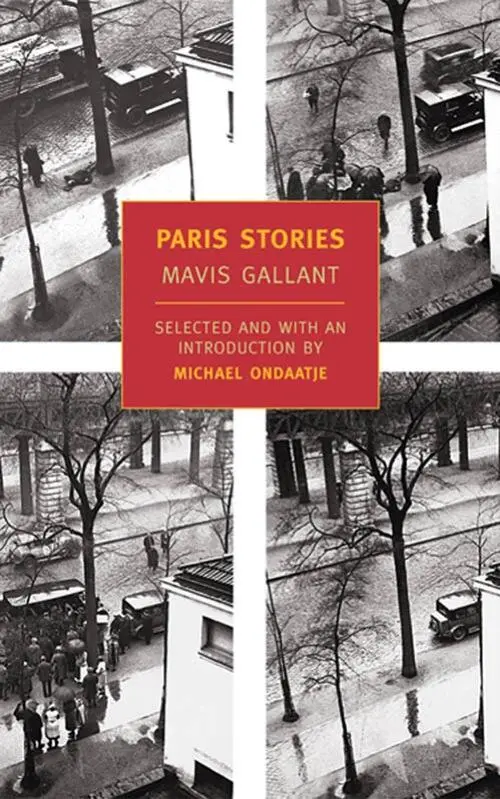
- Название:Paris Stories
- Автор:
- Издательство:NYRB Classics
- Жанр:
- Год:2002
- ISBN:нет данных
- Рейтинг книги:5 / 5. Голосов: 1
-
Избранное:Добавить в избранное
- Отзывы:
-
Ваша оценка:
Paris Stories: краткое содержание, описание и аннотация
Предлагаем к чтению аннотацию, описание, краткое содержание или предисловие (зависит от того, что написал сам автор книги «Paris Stories»). Если вы не нашли необходимую информацию о книге — напишите в комментариях, мы постараемся отыскать её.
Paris Stories — читать онлайн бесплатно полную книгу (весь текст) целиком
Ниже представлен текст книги, разбитый по страницам. Система сохранения места последней прочитанной страницы, позволяет с удобством читать онлайн бесплатно книгу «Paris Stories», без необходимости каждый раз заново искать на чём Вы остановились. Поставьте закладку, и сможете в любой момент перейти на страницу, на которой закончили чтение.
Интервал:
Закладка:
“We must discuss terms,” he said.
“When you're ready,” she replied. “Your cold seems a lot better.”
Inching along in stagnant traffic, Speck tried one after the other the FM state-controlled stations on his car radio. He obtained a lecture about the cultural oppression of Cajuns in Louisiana, a warning that the road he was now driving on was saturated, and the disheartening squeaks and wails of a circumcision ceremony in Ethiopia. On the station called France-Culture someone said, “Henri Cruche.”
“Not Henri, excuse me,” said a polite foreigner. “His name was Hubert. Hubert Cruche.”
“Strange that it should be an Italian to discover an artist so essentially French,” said the interviewer.
Signor Vigorelli explained that his admiration for France was second only to his intense feelings about Europe. His career had been consecrated to enhancing Italian elegance with French refinement and then scattering the result abroad. He believed that the unjustly neglected Cruche would be a revelation and might even bring the whole of Western art to its senses.
Speck nodded, agreeing. The interview came to an end. Wild jungle drums broke forth, heralding the announcement that there was to be a reading of medieval Bulgarian poetry in an abandoned factory at Nanterre. It was then and then only that Speck took in the sense of what he had heard. He swung the car in a wild U-turn and, without killing himself or anyone else, ran into a tree. He sat quietly, for about a minute, until his breathing became steady again, then unlocked his safety belt and got out. For a long time he stood by the side of the road, holding his briefcase, feeling neither shock nor pain. Other drivers, noticing a man alone with a wrecked car, picked up speed. He began to walk in Lydia's direction. A cruising prostitute, on her way home to cook her husband's dinner, finally agreed to drop him off at a taxi stand. Speck gave her two hundred francs.
Lydia did not seem at all surprised to see him. “I'd invite you to supper,” she said. “But all I've got is a tiny pizza and some of the leftover cake.”
“The Italian,” said Speck.
“Yes?”
“I've heard him. On the radio. He says he's got Cruche. That he discovered him. My car is piled up in the Bois. I tried to turn around and come back here. I've been walking for hours.”
“Sit down,” said Lydia. “There, on the sofa. Signor Vigorelli is having a big Cruche show in Milan next March.”
“He can't,” said Speck.
“Why can't he?”
“Because Cruche is mine. He was my idea. No one can have my idea. Not until after June.”
“Then it goes to Trieste in April,” said Lydia. “You could still have it by about the tenth of May. If you still want it.”
If I want it, said Speck to himself. If I want it. With the best work sold and the insurance rates tripled and the commissions shared out like candy. And with everyone saying Speck jumped on the bandwagon, Speck made the last train.
“Lydia, listen to me,” he said. “I invented Hubert Cruche. There would be no Hubert Cruche without Sandor Speck. This is an unspeakable betrayal. It is dishonorable. It is wrong.” She listened, nodding her head. “What happens to me now?” he said. “Have you thought about that?” He knew better than to ask, “Why didn't you tell me about him?” Like all dissembling women, she would simply answer, “Tell you what?”
“It might be all the better,” she said. “There'll be that much more interest in Hube.”
“Interest?” said Speck. “The worst kind of interest. Third-rate, tawdry interest. Do you suppose I can get the Pompidou Center to look at a painter who has been trailing around in Trieste? It had to be a new idea. It had to be strong.”
“You'll save on the catalogue,” she said. “He will probably want to share.”
“It's my catalogue,” said Speck. “I'm not sharing. Senator Bellefeuille… my biography… never. The catalogue is mine. Besides, it would look as if he'd had the idea.”
“He did.”
“But after me,” said Speck, falling back on the most useless of all lover's arguments. “After me. I was there first.”
“So you were,” she said tenderly, like any woman on her way out.
Speck said, “I thought you were happy with our arrangement.”
“I was. But I hadn't met him yet. You see, he was so interested in the Japhethite movement. One day he opened the Bible and put his finger on something that seemed to make it all right about the graven image. In Ecclesiastes, I think.”
Speck gave up. “I suppose it would be no use calling for a taxi?”
“Not around here, I'm afraid, though you might pick one up at the shopping center. Shouldn't you report the accident?”
“Which accident?”
“To the police,” she said. “Get it on record fast. Make it a case. That squeezes the insurance people. The phone's in the hall.”
“I don't care about the insurance,” said Speck.
“You will care, once you're over the shock. Tell me exactly where it happened. Can you remember? Have you got your license? Registration? Insurance?”
Speck sank back and closed his eyes. He could hear Lydia dialing; then she began to speak. He listened, exactly as Cruche must have listened, while Lydia, her voice full of silver bells, dealt with creditors and dealers and Cruche's cast-off girlfriends and a Senator Bellefeuille more than forty years younger.
“I wish to report an accident,” Lydia sang. “The victim is Dr. S. Speck. He is still alive — luckily. He was forced off the road in the Bois de Vincennes by a tank truck carrying high-octane fuel. It had an Italian plate. Dr. Speck was too shaken to get the number. Yes, I saw the accident, but I couldn't see the number. There was a van in the way. All I noticed was 'MI.' That must stand for Milan. I recognized the victim. Dr. Speck is well known in some circles…an intimate friend of Senator Antoine Bellefeuille, the former minister of…that's right.” She talked a few minutes longer, then came back to Speck. “Get in touch with the insurance people first thing tomorrow,” she said, flat Lydia again. “Get a medical certificate — you've had a serious emotional trauma. It can lead to jaundice. Tell your doctor to write that down. If he doesn't want to, I'll give you the name of a doctor who will. You're on the edge of nervous depression. By the way, the police will be towing your car to a garage. They know they've been very remiss, letting a foreign vehicle with a dangerous cargo race through the Bois. It might have hit a bus full of children. They must be looking for that tanker all over Paris. I've made a list of the numbers you're to call.”
Speck produced his last card: “Senator Bellefeuille will never allow his Cruches to go to Milan. He'll never let them out of the country.”
“Who — Antoine?” said Lydia. “Of course he will.”
She cut a cupcake in half and gave him a piece. Broken, Speck crammed the whole thing in his mouth. She stood over him, humming. “Do you know that old hymn, Dr. Speck — 'The day Thou gavest, Lord, is ended'?”
He searched her face, as he had often, looking for irony, or playfulness — a gleam of light. There floated between them the cold oblong on the map and the Chirico chessboard moving along to its Arctic destination. Trees dwindled to shrubs and shrubs to moss and moss to nothing. Speck had been defeated by a landscape.
Although Speck by no means considered himself a natural victim of hard luck, he had known disappointment. Shows had fallen flat. Galleries had been blown up and torn down. Artists he had nursed along had been lured away by siren dealers. Women had wandered off, bequeathing to Speck the warp and weft of a clear situation, so much less interesting than the ambiguous patterns of love. Disappointment had taught him rules: The first was that it takes next to no time to get used to bad news. Rain began to fall as he walked to the taxi stand. In his mind, Cruche was already being shown in Milan and he was making the best of it.
Читать дальшеИнтервал:
Закладка:
Похожие книги на «Paris Stories»
Представляем Вашему вниманию похожие книги на «Paris Stories» списком для выбора. Мы отобрали схожую по названию и смыслу литературу в надежде предоставить читателям больше вариантов отыскать новые, интересные, ещё непрочитанные произведения.

Обсуждение, отзывы о книге «Paris Stories» и просто собственные мнения читателей. Оставьте ваши комментарии, напишите, что Вы думаете о произведении, его смысле или главных героях. Укажите что конкретно понравилось, а что нет, и почему Вы так считаете.