Mavis Gallant - Paris Stories
Здесь есть возможность читать онлайн «Mavis Gallant - Paris Stories» весь текст электронной книги совершенно бесплатно (целиком полную версию без сокращений). В некоторых случаях можно слушать аудио, скачать через торрент в формате fb2 и присутствует краткое содержание. Год выпуска: 2002, Издательство: NYRB Classics, Жанр: Современная проза, на английском языке. Описание произведения, (предисловие) а так же отзывы посетителей доступны на портале библиотеки ЛибКат.
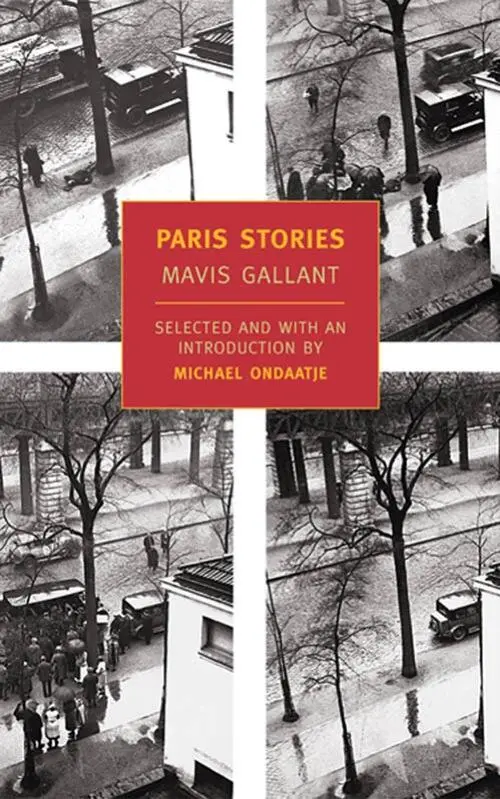
- Название:Paris Stories
- Автор:
- Издательство:NYRB Classics
- Жанр:
- Год:2002
- ISBN:нет данных
- Рейтинг книги:5 / 5. Голосов: 1
-
Избранное:Добавить в избранное
- Отзывы:
-
Ваша оценка:
Paris Stories: краткое содержание, описание и аннотация
Предлагаем к чтению аннотацию, описание, краткое содержание или предисловие (зависит от того, что написал сам автор книги «Paris Stories»). Если вы не нашли необходимую информацию о книге — напишите в комментариях, мы постараемся отыскать её.
Paris Stories — читать онлайн бесплатно полную книгу (весь текст) целиком
Ниже представлен текст книги, разбитый по страницам. Система сохранения места последней прочитанной страницы, позволяет с удобством читать онлайн бесплатно книгу «Paris Stories», без необходимости каждый раз заново искать на чём Вы остановились. Поставьте закладку, и сможете в любой момент перейти на страницу, на которой закончили чтение.
Интервал:
Закладка:
“It was with instinctive prescience that Hubert Cruche saw the need for a Europe united from the Atlantic to the… That Cruche skirted the murky zone of partisan politics is a tribute to his… even though his innocent zeal may have led him to the brink… early meeting with the young idealist and future statesman A. Bellefeuille, whose penetrating essay…close collaboration with the artist's wife and most trusted critic… and now, posthumously… from Paris, where the retrospective was planned and brought to fruition by the undersigned… and on to Italy, to the very borders of…”
Because this one I am keeping, Speck decided; this one will be signed: “By Sandor Speck.” He smiled at the bright, wet streets of Paris as he and Cruche, together, triumphantly crossed the Alps.
BAUM, GABRIEL, 1935 — ( )
UNCLE AUGUST
AT THE start of the 1960s Gabriel Baum's only surviving relative, his Uncle August, turned up in Paris. There was nothing accidental about this; the International Red Cross, responding to an appeal for search made on Gabriel's behalf many years before, had finally found Gabriel in Montparnasse and his uncle in the Argentine. Gabriel thought of his uncle as “the other Baum,” because there were just the two of them. Unlike Gabriel's father and mother, Uncle August had got out of Europe in plenty of time. He owned garages in Rosario and Santa Fe and commercial real estate in Buenos Aires. He was as different from Gabriel as a tree is from the drawing of one; nevertheless Gabriel saw in him something of the old bachelor he too might become.
Gabriel was now twenty-five; he had recently been discharged from the French Army after twenty months in Algeria. Notice of his uncle's arrival reached him at a theater seating two hundred persons where he had a part in a play about J. K. Huysmans. The play explained Huysmans's progress from sullen naturalism to mystical Christianity. Gabriel had to say, “But Joris Karl has written words of penetrating psychology,” and four or five other things.
The two Baums dined at the Bristol, where Gabriel's uncle was staying. His uncle ordered for both, because Gabriel was taking too long to decide. Uncle August spoke German and Spanish and the pale scrupulous French and English that used to be heard at spas and in the public rooms of large, airy hotels. His clothes were old-fashioned British; watch and luggage were Swiss. His manners were German, prewar — pre-1914, that is. To Gabriel, his uncle seemed to conceal an obsolete social mystery; but a few Central Europeans, still living, would have placed him easily as a tight, unyielding remainder of the European shipwreck.
The old man observed Gabriel closely, watching to see how his orphaned nephew had been brought up, whether he broke his bread or cut it, with what degree of confidence he approached his asparagus. He was certainly pleased to have discovered a younger Baum and may even have seen Gabriel as part of God's subtle design, bringing a surrogate son to lighten his old age, one to whom he could leave Baum garages; on the other hand it was clear that he did not want just any Baum calling him “Uncle.”
“I have a name,” he said to Gabriel. “I have a respected name to protect. I owe it to my late father.” He meant his own name: August Ernest Baum, b. Potsdam 1899 —.
After dinner they sat for a long time drinking brandy in the hushed dining room. His uncle was paying for everything.
He said, “But were your parents ever married, finally? Because we were never told he had actually married her.”
Gabriel at that time seemed to himself enduringly healthy and calm. His hair, which was dark and abundant, fell in locks on a surprisingly serene forehead. He suffered from only two complaints, which he had never mentioned. The first had to do with his breathing, which did not proceed automatically, like other people's. Sometimes, feeling strange and ill, he would realize that heart and lungs were suspended on a stopped, held breath. Nothing disastrous had come of this. His second complaint was that he seemed to be haunted, or inhabited, by a child — a small, invisible version of himself, a Gabriel whose mauled pride he was called on to salve, whose claims against life he was forced to meet with whatever thin means time provided, whose scores he had rashly promised to settle before realizing that debt and payment never interlock. His uncle's amazing question and the remark that followed it awoke the wild child, who began to hammer on Gabriel's heart.
He fixed his attention on a bottle — one of the dark bottles whose labels bear facsimiles of gold medals earned at exhibitions no one has ever heard of, in cities whose names have been swept off the map: Breslau 1884, Dantzig 1897, St. Petersburg 1901.
“The only time I ever saw her, they certainly were not married,” his uncle resumed. “It was during the very hot autumn of 1930. He had left the university announcing that he would earn his living writing satirical poetry. My father sent me to Berlin to see what was going on. She was going on. Her dress had short sleeves. She wore no stockings. She had a clockwork bear she kept winding up and sending round the table. She was hopelessly young. ‘Have you thought about the consequences?’ I asked him. ‘No degree. Low-grade employment all your life. Your father's door forever closed to you. And what about her? Is she an heiress? Will her father adopt you?’ She was said to be taking singing lessons,” he added, as if there were something wrong with that.
“Shut him up,” ordered the younger Gabriel, but Gabriel was struggling for breath.
“I have lost everything and everyone but I still have a name,” said his uncle. “I have a name to protect and defend. There is always the trace of a marriage certificate somewhere. Even when the registry office was bombed. Even when the papers had to be left behind. How old were you the last time you saw them?”
“Eight,” said Gabriel, now in control.
“Were they together?”
“Oh, yes.”
“Did they have time to say good-bye?”
“They left me with a neighbor. The neighbor said they'd be back.”
“Where was this?”
“Marseilles. We were supposed to be from Alsace, but their French sounded wrong. People noticed I wasn't going to school. Someone reported them.”
“Sounded wrong!” said his uncle. “Everything must have sounded wrong from the minute he left the university. It is a terrible story,” he said, after a moment. “No worse than most, but terrible all the same. Why, why did he wait until the last minute? And once he had got to Marseilles what prevented him from getting on a boat?”
“He was a man of action,” said Gabriel.
If his uncle wanted another Baum, he did not want a frivolous one. He said, “He was much younger than I was. I never saw him after 1930. He went his own way. After the war I had the family traced. Everybody was dead — camps, suicide, old age. In his case, no one knew what had happened. He disappeared. Of course, it took place in a foreign country. Only the Germans kept accurate records. I wish you knew something about the marriage. I know that my late father would not have wanted a bastard in the family.”
Uncle August visited Nice, Lugano, and Venice, which he found greatly changed, then he returned to South America. He sent long letters to Gabriel several times a year, undeterred by the fact that he seldom received an answer. He urged his nephew to take a strong, positive line with his life and above all to get out of Paris, which had never amounted to more than an émigré way station. Its moral climate invited apathy and rot.
Gabriel read his uncle's letters in La Méduse, a bar-tabac close to the old Montparnasse railway station. Actors and extras for television were often recruited there; no one remembered how or why this arrangement had come about. Gabriel usually sat with his back to the window, at a table to the right of the door facing the bar. He drank draft beer or coffee and looked at magazines other customers had left behind. Glancing up from one of his uncle's letters, he saw the misted window in the mirror behind the bar. In a polluted winter fog neon glowed warmly — the lights of home.
Читать дальшеИнтервал:
Закладка:
Похожие книги на «Paris Stories»
Представляем Вашему вниманию похожие книги на «Paris Stories» списком для выбора. Мы отобрали схожую по названию и смыслу литературу в надежде предоставить читателям больше вариантов отыскать новые, интересные, ещё непрочитанные произведения.







Обсуждение, отзывы о книге «Paris Stories» и просто собственные мнения читателей. Оставьте ваши комментарии, напишите, что Вы думаете о произведении, его смысле или главных героях. Укажите что конкретно понравилось, а что нет, и почему Вы так считаете.