Mavis Gallant - Paris Stories
Здесь есть возможность читать онлайн «Mavis Gallant - Paris Stories» весь текст электронной книги совершенно бесплатно (целиком полную версию без сокращений). В некоторых случаях можно слушать аудио, скачать через торрент в формате fb2 и присутствует краткое содержание. Год выпуска: 2002, Издательство: NYRB Classics, Жанр: Современная проза, на английском языке. Описание произведения, (предисловие) а так же отзывы посетителей доступны на портале библиотеки ЛибКат.
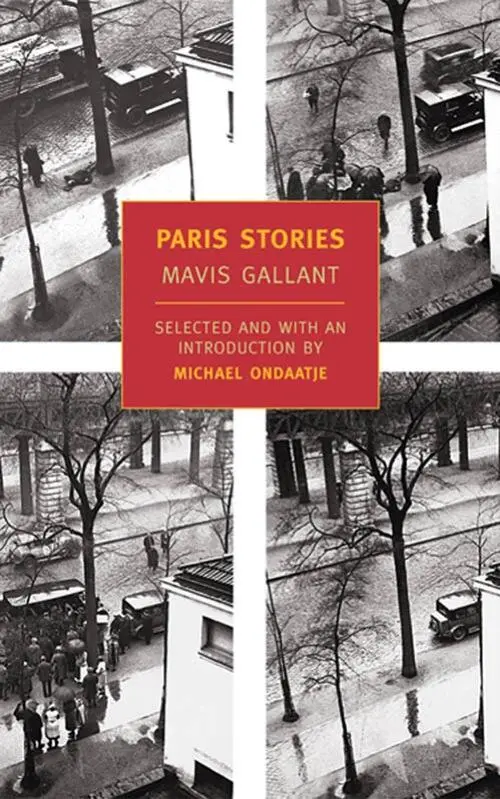
- Название:Paris Stories
- Автор:
- Издательство:NYRB Classics
- Жанр:
- Год:2002
- ISBN:нет данных
- Рейтинг книги:5 / 5. Голосов: 1
-
Избранное:Добавить в избранное
- Отзывы:
-
Ваша оценка:
Paris Stories: краткое содержание, описание и аннотация
Предлагаем к чтению аннотацию, описание, краткое содержание или предисловие (зависит от того, что написал сам автор книги «Paris Stories»). Если вы не нашли необходимую информацию о книге — напишите в комментариях, мы постараемся отыскать её.
Paris Stories — читать онлайн бесплатно полную книгу (весь текст) целиком
Ниже представлен текст книги, разбитый по страницам. Система сохранения места последней прочитанной страницы, позволяет с удобством читать онлайн бесплатно книгу «Paris Stories», без необходимости каждый раз заново искать на чём Вы остановились. Поставьте закладку, и сможете в любой момент перейти на страницу, на которой закончили чтение.
Интервал:
Закладка:
Her work. He knew he had to get it over with: “Would you like to show me some of your things, too?”
“I burned it all a long time ago.”
Speck's heart lurched. “But not his work?”
“It wasn't mine to burn. I'm not a criminal.” Mutely, he looked at the bare walls. “None of Hube's stuff ever hung in here,” she said. “His mother couldn't stand it. We had everything she liked — Napoleon at Waterloo, lighthouses, coronations. I couldn't touch it when she was alive, but once she'd gone I didn't wait two minutes.”
Speck's eighteenth-century premises were centrally heated. The system, which dated from the early 1960s, had been put in by Americans who had once owned most of the second floor. With the first dollar slide of the Nixon era they had wisely sold their holdings and gone home, without waiting for the calamity still to come. Their memorial was an expensive, casual gift nobody knew what to do with; it had raised everyone's property taxes, and it cost a fortune to run. Tenants, such as Speck, who paid a fat share of the operation, had no say as to when heat was turned on, or to what degree of temperature. Only owners and landlords had a vote. They voted overwhelmingly for the lowest possible fuel bills. By November there was scarcely a trace of warmth in Speck's elegant gallery, his cold was entrenched for the winter, and Walter was threatening to quit. Speck was showing a painter from Bruges, sponsored by a Belgian cultural-affairs committee. Cost-sharing was not a habit of his — it lowered the prestige of the gallery — but in a tight financial season he sometimes allowed himself a breather. The painter, who clearly expected Speck to put him under contract, talked of moving to Paris.
“You'd hate it here,” said Speck.
Belgian television filmed the opening. The Belgian Royal Family, bidden by Walter, on his own initiative, sent regrets signed by aides-de-camp on paper so thick it would scarcely fold. These were pinned to the wall, and drew more attention than the show itself. Only one serious critic turned up. The rooms were so cold that guests could not write their names in the visitors' book — their hands were too numb. Walter, perhaps by mistake, had invited Blum-Weiler-Blochs instead of Blum-Bloch-Weilers. They came in a horde, leading an Afghan hound they tried to raffle off for charity.
The painter now sat in the gallery, day after day, smoking black cigarettes that smelled of mutton stew. He gave off a deep professional gloom, which affected Walter. Walter began to speak of the futility of genius — a sure sign of melancholia. Speck gave the painter money so that he could smoke in cafés. The bells of St. Clotilde's clanged and echoed, saying to Speck's memory, “Fascist, Fascist, Fascist.” Walter reminded Speck that November was bad for art. The painter returned from a café looking cheerful. Speck wondered if he was enjoying Paris and if he would decide to stay; he stopped giving him money and the gallery became once more infested with mutton stew and despair. Speck began a letter to Henriette imploring her to come back. Walter interrupted it with the remark that Rembrandt, Mozart, and Dante had lived in vain. Speck tore the letter up and started another one saying that a Guillaumin pastel was missing and suggesting that Henriette had taken it to Africa. Just as he was tearing this up, too, the telephone rang.
“I finally got Hube's stuff all straightened out,” said Lydia Cruche. “You might as well come round and look at it this afternoon. By the way, you may call me Lydia, if you want to.”
“Thank you,” said Speck. “And you, of course, must call me — ”
“I wouldn't dream of it. Once a doctor always a doctor. Come early. The light goes at four.”
Speck took a pill to quiet the pounding of his heart.
In her summing-up of his moral nature, a compendium that had preceded her ringing “Fascist”s, Henriette had declared that Speck appraising an artist's work made her think of a real-estate loan officer examining Chartres Cathedral for leaks. It was true that his feeling for art stopped short of love; it had to. The great cocottes of history had shown similar prudence. Madame de Pompadour had eaten vanilla, believed to arouse the senses, but such recklessness was rare. Cool but efficient — that was the professional ticket. No vanilla for Speck; he knew better. For what if he were to allow passion for painting to set alight his common sense? How would he be able to live then, knowing that the ultimate fate of art was to die of anemia in safe-deposit vaults? Ablaze with love, he might try to organize raids and rescue parties, dragging pictures out of the dark, leaving sacks of onions instead. He might drop the art trade altogether, as Walter kept intending to do, and turn his talents to cornering the onion market. The same customers would ring at election time, saying, “Dr. Speck, what happens to my onion collection if the left gets in? Shouldn't we try to unload part of it in New York now, just to be on the safe side?” And Speck, unloading onions of his own in Tokyo, would answer, “Don't worry. They can't possibly nationalize all the onions. Besides, they aren't going to win.”
Lydia seemed uninterested in Speck's reaction to Cruche. He had expected her to hang about, watching his face, measuring his interest, the better to nail her prices; but she simply showed him a large, dim, dusty, north-facing room in which canvases were thickly stacked against the walls and said, “I wasn't able to get the light fixed. I've left a lamp. Don't knock it over. Tea will be ready when you are.” Presently he heard American country music rising from the kitchen (Lydia must have been tuned to the BBC) and he smelled a baking cake. Then, immersed in his ice-cold Cruche encounter, he noticed nothing more.
About three hours later he came downstairs, slowly, wiping dust from his hands with a handkerchief. His conception of the show had been slightly altered, and for the better, by the total Cruche. He began to rewrite the catalogue notes: “The time has come for birth…” No — ”for rebirth. In a world sated by overstatement the moment is ripe for a calm…” How to avoid “statement” and still say “statement”? The Grand Architect was keeping Speck in mind. “For avouchment,” said Speck, alone on the stairs. It was for avouchment that the time had come. It was also here for hard business. His face became set and distant, as if a large desk were about to be shoved between Lydia Cruche and himself.
He sat down and said, “This is going to be a strong show, a powerful show, even stronger than I'd hoped. Does everything I've looked at upstairs belong to you outright? Is there anything which for any reason you are not allowed to lend, show, or sell?”
“Neither a borrower nor a lender be,” said Lydia, cutting caramel cake.
“No. Well, I am talking about the show, of course.”
“No show,” she said. “I already told you that.”
“What do you mean, no show?” said Speck.
“What I told you at the beginning. I told you not to count on me. Don't drop boiled frosting on your trousers. I couldn't get it to set.”
“But you changed your mind,” said Speck. “After saying 'Don't count on me,' you changed your mind.” “Not for a second.”
“Why?” said Speck, as he had said to the departing Henriette.
“Why?”
“God doesn't want it.”
He waited for more. She folded her arms and stared at the blank television set. “How do you know that God doesn't want Hubert Cruche to have a retrospective?”
“Because He said so.”
His first thought was that the Grand Architect had granted Lydia Cruche something so far withheld from Sandor Speck: a plain statement of intention. “Don't you know your Commandments?” she asked. “You've never heard of the graven image?”
Читать дальшеИнтервал:
Закладка:
Похожие книги на «Paris Stories»
Представляем Вашему вниманию похожие книги на «Paris Stories» списком для выбора. Мы отобрали схожую по названию и смыслу литературу в надежде предоставить читателям больше вариантов отыскать новые, интересные, ещё непрочитанные произведения.




Обсуждение, отзывы о книге «Paris Stories» и просто собственные мнения читателей. Оставьте ваши комментарии, напишите, что Вы думаете о произведении, его смысле или главных героях. Укажите что конкретно понравилось, а что нет, и почему Вы так считаете.