Mavis Gallant - Paris Stories
Здесь есть возможность читать онлайн «Mavis Gallant - Paris Stories» весь текст электронной книги совершенно бесплатно (целиком полную версию без сокращений). В некоторых случаях можно слушать аудио, скачать через торрент в формате fb2 и присутствует краткое содержание. Год выпуска: 2002, Издательство: NYRB Classics, Жанр: Современная проза, на английском языке. Описание произведения, (предисловие) а так же отзывы посетителей доступны на портале библиотеки ЛибКат.
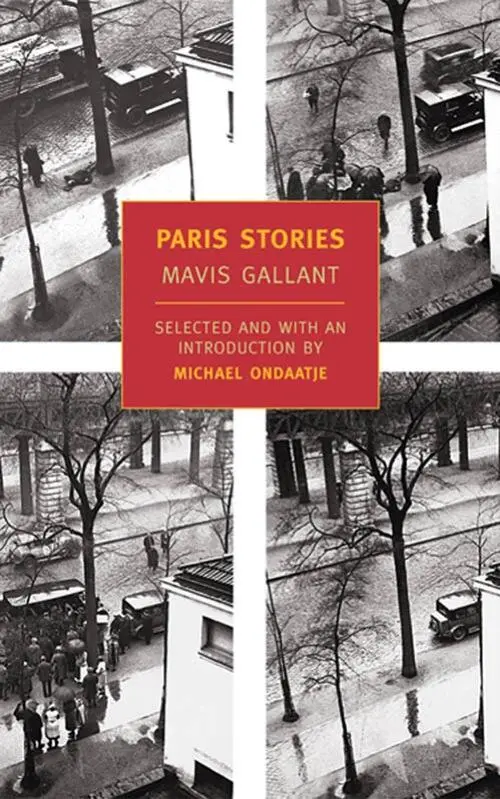
- Название:Paris Stories
- Автор:
- Издательство:NYRB Classics
- Жанр:
- Год:2002
- ISBN:нет данных
- Рейтинг книги:5 / 5. Голосов: 1
-
Избранное:Добавить в избранное
- Отзывы:
-
Ваша оценка:
Paris Stories: краткое содержание, описание и аннотация
Предлагаем к чтению аннотацию, описание, краткое содержание или предисловие (зависит от того, что написал сам автор книги «Paris Stories»). Если вы не нашли необходимую информацию о книге — напишите в комментариях, мы постараемся отыскать её.
Paris Stories — читать онлайн бесплатно полную книгу (весь текст) целиком
Ниже представлен текст книги, разбитый по страницам. Система сохранения места последней прочитанной страницы, позволяет с удобством читать онлайн бесплатно книгу «Paris Stories», без необходимости каждый раз заново искать на чём Вы остановились. Поставьте закладку, и сможете в любой момент перейти на страницу, на которой закончили чтение.
Интервал:
Закладка:
“Her husband,” said the Senator. “Hubert Cruche. A face like a gargoyle. Premature senile dementia. He'd been kicked by Venus at some time or other” — the euphemism for syphilis. “In those days the cure was based on mercury — worse than the disease. He seemed to know me. There was light in his eyes. Oh, not the light of intelligence. It was too late for that, and he'd not had much to begin with. He recognized me for a simple reason. I had already begun to assemble my Cruche collection. I bought everything Hubert Cruche produced for sixteen years — the oils, the gouaches, the pastels, the watercolors, the etchings, the drawings, the woodcuts, the posters, the cartoons, the book illustrations. Everything.”
That was it, Speck remembered. That was why the Senator who liked art never bought so much as a wash drawing. The house was full of Cruches; there wasn't an inch to spare on the walls.
With a monarch's gesture, the Senator dismissed his audience and stepped firmly toward the chauffeur, who stood holding the door of his Citroën. He said, perhaps to himself, perhaps to Speck, thin and attentive in the moonlight, “I suppose I ought to get rid of my Cruches. Who ever thinks about Cruche now?”
“No,” said Speck, whom the Grand Architect of the Universe had just rapped over the head. The Senator paused — benevolent, stout. “Don't get rid of the Cruches,” said Speck. He felt as if he were on a distant shore, calling across deep cultural waters. “Don't sell! Hang on! Cruche is coming back!”
Cruche, Cruche, Hubert Cruche, sang Speck's heart as he drove homeward. Cruche's hour had just struck, along with Sandor Speck's. At the core of the May-June retrospective would be his lodge brother's key collection: “Our thanks, in particular… who not only has loaned his unique and invaluable… but who also… and who…” Recalling the little he knew of Cruche's obscure career, Speck made a few changes in the imaginary catalogue, substituting with some disappointment The Power Station at Gagny-sur-Orme for Misia Sert on Her Houseboat, and Peasant Woman Sorting Turnips for Serge Lifar as Petrouchka. He wondered if he could call Cruche heaven-sent. No; he would not put a foot beyond coincidence, just as he had not let Walter dash from saint to saint once he had settled for St. Joseph. And yet a small flickering marsh light danced upon the low-lying metaphysical ground he had done so much to avoid. Not only did Cruche overlap to an astonishing degree the painter in the yellow notebook but he was exactly the sort of painter that made the Speck gallery chug along. If Speck's personal collection consisted of minor works by celebrated artists, he considered them his collateral for a rainy, bank-loan day. Too canny to try to compete with international heavy-weights, unwilling to burden himself with insurance, he had developed as his specialty the flattest, palest, farthest ripples of the late-middle-traditional Paris school. This sensible decision had earned him the admiration given the devoted miniaturist who is no threat to anyone. “Go and see Sandor Speck,” the great lions and tigers of the trade would tell clients they had no use for. “Speck's the expert.”
Speck was expert on barges, bridges, cafés at twilight, nudes on striped counterpanes, the artist's mantelpiece with mirror, the artist's street, his staircase, his bed made and rumpled, his still life with half-peeled apple, his summer in Mexico, his wife reading a book, his girlfriend naked and dejected on a kitchen chair. He knew that the attraction of customer to picture was always accidental, like love; it was his business to make it overwhelming. Visitors came to the gallery looking for decoration and investment, left it believing Speck had put them on the road to a supreme event. But there was even more to Speck than this, and if he was respected for anything in the trade it was for his knack with artists' widows. Most dealers hated them. They were considered vain, greedy, unrealistic, and tougher than bulldogs. The worst were those whose husbands had somehow managed the rough crossing to recognition only to become washed up at the wrong end of the beach. There the widow waited, guarding the wreckage. Speck's skill in dealing with them came out of a certain sympathy. An artist's widow was bound to be suspicious and adamant. She had survived the discomfort and confusion of her marriage; had lived through the artist's drinking, his avarice, his affairs, his obsession with constipation, his feuds and quarrels, his cowardice with dealers, his hypocrisy with critics, his depressions (which always fell at the most joyous seasons, blighting Christmas and spring); and then — oh, justice! — she had outlasted him.
Transfiguration arrived rapidly. Resurrected for Speck's approval was an ardent lover, a devoted husband who could not work unless his wife was around, preferably in the same room. If she had doubts about a painting, he at once scraped it down. Hers was the only opinion he had ever trusted. His last coherent words before dying had been of praise for his wife's autumnal beauty.
Like a swan in muddy waters, Speck's ancient Bentley cruised the suburbs where his painters had lived their last resentful seasons. He knew by heart the damp villa, the gravel path, the dangling bellpull, the shrubbery containing dead cats and plastic bottles. Indoors the widow sat, her walls plastered with portraits of herself when young. Here she continued the struggle begun in the Master's lifetime — the evicting of the upstairs tenant — her day made lively by the arrival of mail (dusty beige of anonymous threats, grim blue of legal documents), the coming and going of process servers, the outings to lawyers. Into this spongy territory Speck advanced, bringing his tactful presence, his subtle approximation of courtship, his gift for listening. Thin by choice, pale by nature, he suggested maternal need. Socks and cuff links suggested breeding. The drift of his talk suggested prosperity. He sent his widows flowers, wooed them with food. Although their taste in checks and banknotes ran to the dry and crisp, when it came to eating they craved the sweet, the sticky, the moist. From the finest pastry shops in Paris Speck brought soft macaroons, savarins soaked in rum, brioches stuffed with almond cream, mocha cake so tender it had to be eaten with a spoon. Sugar was poison to Speck. Henriette had once reviewed a book that described how refined sugar taken into one's system turned into a fog of hideous green. Her brief, cool warning, “A Marxist Considers Sweets,” unreeled in Speck's mind if he was confronted with a cookie. He usually pretended to eat, reducing a mille-feuille to paste, concealing the wreck of an éclair under napkin and fork. He never lost track of his purpose — the prying of paintings out of a dusty studio on terms anesthetizing to the artist's widow and satisfactory to himself.
The Senator had mentioned a wife; where there had been wife there was relict. Speck obtained her telephone number by calling a rival gallery and pretending to be looking for someone else. “Cruche's widow can probably tell you,” he finally heard. She lived in one of the gritty suburbs east of Paris, on the far side of the Bois de Vincennes — in Speck's view, the wrong direction. The pattern of his life seemed to come unfolded as he dialed. He saw himself stalled in industrial traffic, inhaling pollution, his Bentley pointed toward the seediest mark on the urban compass, with a vanilla cream cake melting beside him on the front seat.
She answered his first ring; his widows never strayed far from the telephone. He introduced himself. Silence. He gave the name of the gallery, mentioned his street, recited the names of painters he showed.
Presently he heard “D'you know any English?”
“Some,” said Speck, who was fluent.
Читать дальшеИнтервал:
Закладка:
Похожие книги на «Paris Stories»
Представляем Вашему вниманию похожие книги на «Paris Stories» списком для выбора. Мы отобрали схожую по названию и смыслу литературу в надежде предоставить читателям больше вариантов отыскать новые, интересные, ещё непрочитанные произведения.



Обсуждение, отзывы о книге «Paris Stories» и просто собственные мнения читателей. Оставьте ваши комментарии, напишите, что Вы думаете о произведении, его смысле или главных героях. Укажите что конкретно понравилось, а что нет, и почему Вы так считаете.