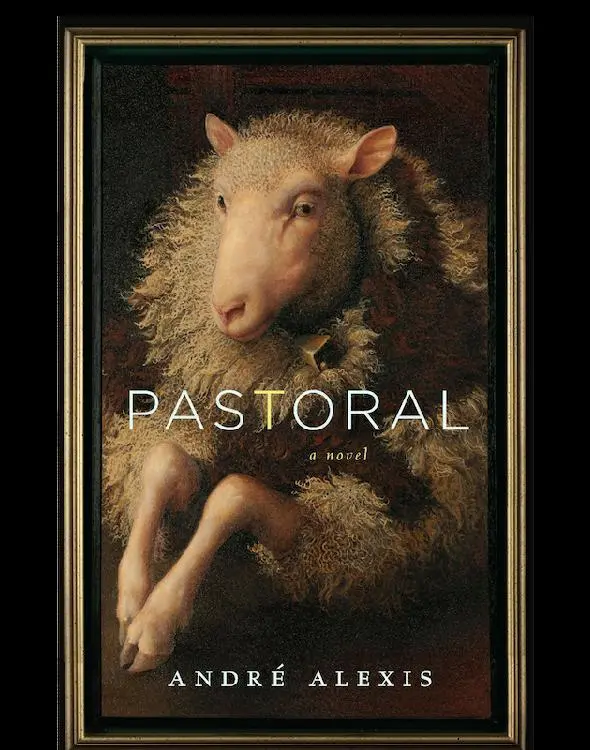
Andre Alexis - Pastoral
Здесь есть возможность читать онлайн «Andre Alexis - Pastoral» весь текст электронной книги совершенно бесплатно (целиком полную версию без сокращений). В некоторых случаях можно слушать аудио, скачать через торрент в формате fb2 и присутствует краткое содержание. Год выпуска: 2014, Издательство: Coach House Books, Жанр: Современная проза, на английском языке. Описание произведения, (предисловие) а так же отзывы посетителей доступны на портале библиотеки ЛибКат.
- Название:Pastoral
- Автор:
- Издательство:Coach House Books
- Жанр:
- Год:2014
- ISBN:нет данных
- Рейтинг книги:5 / 5. Голосов: 1
-
Избранное:Добавить в избранное
- Отзывы:
-
Ваша оценка:
Pastoral: краткое содержание, описание и аннотация
Предлагаем к чтению аннотацию, описание, краткое содержание или предисловие (зависит от того, что написал сам автор книги «Pastoral»). Если вы не нашли необходимую информацию о книге — напишите в комментариях, мы постараемся отыскать её.
"Astonishing. . an irresistible, one-of-a-kind work." — "Alexis [has an] astute understanding of the madly shimmering, beautifully weaving patterns created by what we have agreed to call memory." — There were plans for an official welcome. It was to take place the following Sunday. But those who came to the rectory on Father Pennant's second day were the ones who could not resist seeing him sooner. Here was the man to whom they would confess the darkest things. It was important to feel him out. Mrs Young, for instance, after she had seen him eat a piece of her macaroni pie, quietly asked what he thought of adultery. André Alexis brings a modern sensibility and a new liveliness to an age-old genre, the pastoral.
For his very first parish, Father Christopher Pennant is sent to the sleepy town of Barrow. With more sheep than people, it's very bucolic — too much Barrow Brew on Barrow Day is the rowdiest it gets. But things aren't so idyllic for Liz Denny, whose fiancé doesn't want to decide between Liz and his more worldly mistress Jane, and for Father Pennant himself, who greets some miracles of nature — mayors walking on water, talking sheep — with a profound crisis of faith.
André Alexis
Childhood
Asylum
Ingrid and the Wolf
Pastoral — читать онлайн бесплатно полную книгу (весь текст) целиком
Ниже представлен текст книги, разбитый по страницам. Система сохранения места последней прочитанной страницы, позволяет с удобством читать онлайн бесплатно книгу «Pastoral», без необходимости каждый раз заново искать на чём Вы остановились. Поставьте закладку, и сможете в любой момент перейти на страницу, на которой закончили чтение.
Интервал:
Закладка:
Lord grant me death and let me know
At last the last of Earth.
Time has done its work, now let it rest.
Come darkness and night,
Set this poor shadow free.
Heath said
— He was a strange man, your father.
— I know, said Lowther, but I’ve begun to understand him lately.
— You Williamses think too much.
— Yes, but these days it’s different. These days I accept that I’m an ignorant man, whatever I learn or take in. And I think that’s what my father was trying to tell me when he gave me his prayer book. Out of all these prayers there’s only one essential prayer.
— But it’s a prayer for death.
— I’m not sure that’s the important point. Dad spent his life reading philosophy and, in the end, there’s only one prayer he passed on. A handful of words. His way of saying life doesn’t amount to much.
— Do you want more coffee? I’m going to have a cup.
Heath took down a white cup and blew in it to remove what looked like an insect leg.
— Listen, he said. Do you know how long it took me to clear those moths out of that room? I’m still finding bits of them.
— Thank you for that, said Lowther. I’m really grateful.
— Did you get what you were looking for?
— I’m not sure what I was looking for, said Lowther.
— Well, what do you think of him now?
— He’s young, but I trust him.
— You do? Strange he didn’t actually tell us he saw the moths. Your young priest keeps secrets.
— Maybe, or maybe he’s discreet. The first thing most people would have done is tell the world about the miracle they’d witnessed.
— True. If I saw a bunch of gypsy moths doing strange things, I’d assume the rest of the world should know about it. I mean, why not? You’ve got to let people know their pests are going loco, you know? I spent hours creating that illusion, but that story about insect psychology was almost as hard. Nearly made myself sick trying to keep a straight face. I should hope you got something out of it. Anyway, what are you going to do now?
— I don’t know. But my time’s coming. I can feel it. I’ve got to make myself ready. That’s what all this is about, remember? I want to know the man who’s going to be travelling along that last road with me.
— I still think you’re being pessimistic.
— Heath, my father died at sixty-three, as did his father, as did his father before him. Ten generations of Williams men have died within weeks of turning sixty-three. I’ve had a good life. I’m not unhappy and I haven’t left anyone behind me to die like this.
— I know all that, said Heath. But maybe death isn’t as predictable as you think.
— Every year winter comes and every year we’re shocked when it snows and people forget to put on their snow tires and someone falls through the ice. No one knows the exact hour of winter, but it always comes somewhere round the same time.
— Hmm, said Heath.
They had been having this same argument for years. Lowther was convinced he could feel death’s approach, while Heath was dubious anything clear could be known where death was concerned. Each had been influenced by the other’s position, but only a little. There was now in Lowther’s mind a small doubt, a niggling sense that, after all, humans cannot know about these things. So, how could he be certain when his end would come? Meanwhile, over time, Heath had begun almost to accept that Lowther knew what he was talking about. He had begun to accept that the collection of atoms called Lowther Williams would dissipate and decay in Lowther’s sixty-fourth year. In fact, it was for this reason Heath hadn’t minded deceiving Father Pennant. Though the holographic moths and their trip switches had cost him a fortune, it had been something for the two friends to do together, something very like the pranks they had pulled when they were twelve but with a higher purpose: Lowther, convinced he would die soon, wanted to know — to truly know — the man who would administer his last rites, who would pray over him, who would shepherd him into the next world. Heath didn’t understand why this was important. He himself didn’t care who or what was around when his own spirit left its casing. He didn’t believe in a ‘next world.’ But it mattered to Lowther — his closest friend — and so it mattered to him.
The day outside Heath’s kitchen window hemmed and hawed: a lawn mower here, a passing car there, barely a moment’s silence. There were wispy clouds and the air was warm. For a moment, the outside smelled of toast and honey, while inside there was the odour of bleach and coffee.
Lowther too was thinking of the days spent with Heath when they were boys, of the things they had done as children. Hard to believe Heath’s mother had ever forgiven them for the time when they’d caused her hair to fall out. But she had forgiven them and had spoken of it with amusement until her dying day. But that is the kind of woman Mrs. Lambert was. She could no more have held such a thing against them than they could have done anything but regret it afterwards. And that is what he wanted to know about Father Pennant: what kind of man was he? The incident with the moths had been a success. It had brought something out of Father Pennant: his discretion and tact. Good qualities, both. But Lowther wanted to know a little more. He wanted to catch a glimpse of something more deeply hidden. He wanted to know the far corners of Father Pennant’s being because, in the end, he needed to know that Father Pennant was the right shepherd for him.
In Lowther’s imagining, his own death — for which he was wholly prepared — took place in a room with an accommodating bed, a sun-brightened window, the sky blue, the last voice heard that of a good man who appreciated the accomplishment of death. As he listened to the clinkety-clink the cup made as Heath put it down on a saucer, Lowther tried to imagine Father Pennant at Petersen’s gravel pit. Would Father Pennant catch Mayor Fox at the right time? And what would the priest make of it if he did? Lowther remembered the first time he had seen Fox walk on water. It had been disconcerting, a little frightening even. If it was the same for Father Pennant, why then, he — that is, Lowther — had his man.
The gravel pit just outside Barrow was a jewel or a danger, depending. The pit itself was hidden from view behind a bank of trees and some way along a sandy road. It was nearly circular and some sixty feet in diameter. It had been a long time since there’d been any digging and the water in the pit was deep. In fact, its depths had been exactly sounded: thirty feet and seven inches deep at its deepest point and every once in a while a young man or young woman, drunk or disoriented, fell into the water and drowned.
Lowther had left him about a mile from the pit, but Father Pennant happily walked there on his own. He walked by the side of the road, trampling on young thistles, dandelions, chicory and tall grasses. The smell of the weeds clung to his walking shoes and rose up so that, although he was by the side of a highway, it smelled as if he were in an endless field. The laneway that led to the pit was not hidden exactly, but there were no obvious signs that this particular path led somewhere interesting rather than to one of the many hidden properties, abandoned farms or private houses with their snarling dogs. The only hint of the pit’s existence was near the locked metal gate before the trees. There, on the ground, was a rotted but still legible wooden sign that read Petersen’s Gravel.
Feeling slightly foolish and vulnerable, Father Pennant climbed over the fence, as Lowther had advised him to do, and walked the sandy road to the pit. The trees were tall and they partially blocked out the sun, so there was a darkened hush until he came to the clearing. Then: the return of day. The sun shone on a landscape that had been sheared of trees. Before him were hills of reddish sand around which the path snaked. He had rounded a second hill and could see a part of the pit when Father Pennant realized he was not alone. He heard a voice and then, when he rounded another hill, he saw a man, back facing him, standing beside the water.
Читать дальшеИнтервал:
Закладка:
Похожие книги на «Pastoral»
Представляем Вашему вниманию похожие книги на «Pastoral» списком для выбора. Мы отобрали схожую по названию и смыслу литературу в надежде предоставить читателям больше вариантов отыскать новые, интересные, ещё непрочитанные произведения.












Обсуждение, отзывы о книге «Pastoral» и просто собственные мнения читателей. Оставьте ваши комментарии, напишите, что Вы думаете о произведении, его смысле или главных героях. Укажите что конкретно понравилось, а что нет, и почему Вы так считаете.